



Three gruesome ways terrorists kill victims in Nigeria – Catholic Priest: “If they wanted to be very kind to you, they would ask you to dig your grave and go in. If they wanted to be very charitable, they would just shoot you with a gun. But if they wanted to be very cruel, then they could stone you to death when you’re already in.”
In May 2022, armed men kidnapped a Nigerian priest, Father Stephen Ojapah, his colleague, Fr. Oliver, and two others, including a young lady called Umida, and held them hostage for 33 agonising days. After his release, the Church posted Fr. Ojapah to the United Kingdom. Now he is sharing his story.
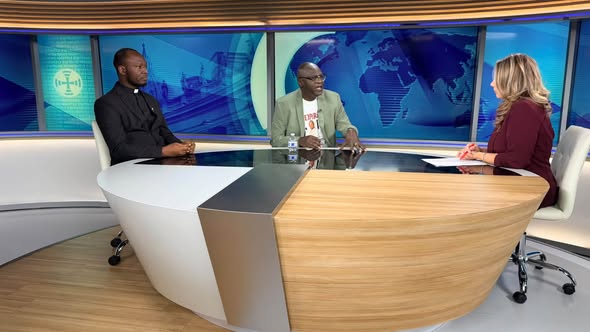
Two days ago, on Tuesday, September 12, 2026, Father Ojapah joined Emmanuel Ogebe, managing partner of the U.S.-Nigeria Law Group, who has closely followed the insecurity in Nigeria in an exclusive interview with the Eternal Word Television Network Inc. (EWTN News), an independent, non-profit Catholic media corporation, where he recalled the day armed men stormed his parish and abducted them, while Ogebe discussed the threats facing Christians across Nigeria.
Anchor: Joining me now is Father Stephen Ojapah, the parish priest who survived 33 days in captivity after being kidnapped in northern Nigeria. He is also the author of the book Tears and Torture: 33 Days in a Kidnappers’ Den. Also here is Emmanuel Ogebe, managing partner of the U.S.-Nigeria Law Group, who has been closely following the persecution facing Christians in Nigeria. Great to have you both here in the studio.
Emmanuel Ogebe: Thank you.
Father Stephen: Thank you very much.
Anchor: Father Stephen, if we could start with you. Can you take us back to that day in May? What do you remember about the moment the armed men stormed into the parish, kidnapped you, along with another priest and two others?
Father Stephen: I remember a lot, but I’ll try to make it simpler for the viewers to understand.
I was sleeping around 11:40 pm when I heard this loud noise. There were people right on top of me, with guns pointed at my head, asking me to wake up. They said in the local language, “Katashi kayi bake” (Get up. You have guests). When I opened my eyes, all I saw were people with guns. Within five minutes, all of us in the house were rushed out, and we began to trek, walking on foot into the bush.
It was one of the most horrible experiences of my life as a human being, not even as a Christian. We trekked for two days on foot nonstop—no food, no water, no nothing. By the time we arrived at the place where we were kept, they simply asked us in the local language, “Zakusha shayi?” “Would you take tea?”
And tea simply means, of course, tea, and all of us said yes. They came close, and they began to flog and beat every part of our bodies. That was the tea they meant after walking for two days. We remained in that dirty environment with no sanitation, no good water, no food, no nothing for 33 days.
At some point, all of us were losing energy, we were losing gas, we were losing strength. Three weeks into the whole situation, they came and asked us, among all of us, who they were going to kill to send a message home. And I simply said, because I knew they came for me, I stepped forward and said to them, “I would go.”
And they asked me, “Are you sure?” I said, “Yes.” They came back in the evening and said, “Okay, well, it is time.” I should stand and say goodbye to the people who were with me and walk down. Indeed, I stood up. I looked at them. I told them goodbye. I blessed them, and I encouraged them to please get back home and go back.
Interestingly, Umida was there with me. I asked her, “When you come out alive, look for Emmanuel Ogebe. He’ll know what to do.” Umida will tell you that story. I said, “Just look for Emmanuel Ogebe. He will know exactly what to do.” But thankfully, all of us are alive, and we are here to tell the story physically and in person.
So when we were going down the drain, if they wanted to be very kind to you, they would ask you to dig your grave and go in. If they wanted to be very charitable, they would just shoot you with a gun. But if they wanted to be very cruel, then they could stone you to death when you’re already in. So we were going that way when one of them simply said, “Father, Kakoma,” in the local language. In other words, “Father, come back.”
But when I turned back, I could see them arguing among themselves, almost like, “Well, let’s do this. Let’s do it. Let’s not do this.” But the long and short of the story is that we all came back.
And just to highlight a number of things, before we left, there were all kinds of humiliating activities, you know, beating. Father Oliver, who was there with us, was hungry. He had peptic ulcer. He was stooling blood for two weeks because there was no proper food.
The young lady who was there with us had her menstrual cycle as a lady, and it was very, very humiliating and very, very depriving. But all of us were there to watch her go through that pain, and we could do absolutely nothing.
Anchor: A harrowing story, Emmanuel. Unfortunately, we know this happens often. You make multiple trips to Nigeria. Even around the holidays, things are worse. Can you tell us more about that?
Emmanuel Ogebe: Yes. Father Stephen is one of the few people to survive, come out, and be able to share his story.
But the back story to what happened was that in Sokoto State, in his diocese, a Christian girl had just been burnt alive by her classmates.
A Christian schoolgirl who was traveling to that place stopped with her brother at his parish for safety, and then they were abducted there.
So we have a situation in Nigeria where regular, everyday Muslims were lynching a Christian girl alive, and then terrorists were abducting a priest.
So Nigeria is the deadliest place in the world to be a Christian and has accounted for more deaths than the rest of the world combined over the last 15 years.
Anchor: You forgave your captors. Why was that important for you?
Father Stephen: I think I still remember I was a priest. I still remember that one of my biggest prayers was for the grace to die without denying Jesus. I encouraged all of them to have that prayer because daily they will tell you, “Zamu kasheka. We will kill you. We will kill you.”
So when one of them asked me, “Will you still forgive us after all we have done to you?”—this was before we left. Truly, when I looked at him, I felt and knew he needed forgiveness. And I also knew, for my own peace and for my own growth, I needed to offer him that forgiveness, and I was happy to offer him that forgiveness.
And I said to him, “Yes, I do forgive you for whatever has happened. I do forgive you.”
Anchor: Emmanuel, what more does the Nigerian government need to do to better protect Christians? And also, how can the international community help?
Emmanuel Ogebe: Yes. Now, one of the things that needs to happen is that the U.S. currently has 200 troops in Nigeria helping the Nigerian government get serious about fighting terrorism.
Unfortunately, they’re leaving at the end of this month, and we need the U.S. troops to stay so that they can protect Christians through Christmas, which is the deadliest part of the year for Christians.
The second thing that needs to happen is that we need to have refuge for the persecuted.
Father Stephen is fortunate that he was able to be posted out to the UK, where he’s serving now as a chaplain. But a Nigerian priest, Father Ben Madu, in Boston, had his religious visa denied. And he took his life in July just because he didn’t want to go back to Nigeria and be killed by terrorists.
So we need foreign countries—Italy, Canada, the U.S.—to take in the Christian refugees who are stranded in Cameroon and have been stranded there for 13 years now.
Anchor: Father Stephen, an incredible story. Emmanuel, thank you so much for your work. We really appreciate you both coming in to discuss this important topic.
Thank you.
- Watch the full segment at Youtube.com/@EWTNnews.


