US Ambassador agrees with Ogebe who has asked Congressman Scott Perry to publicly repudiate his false claim
By Jeph Ajobaju, Chief Copy Editor
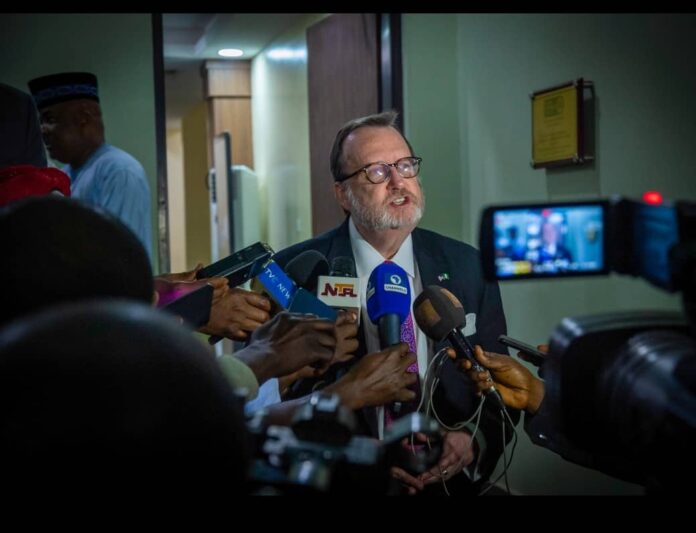
United States Ambassador to Nigeria Richard Mills has clarified that there is no evidence that the United States Agency for International Development (USAID) is funding Boko Haram or any other terrorist group, contrary to the claim by US Congressman Scott Perry.
Mills’ clarification on Wednesday supports the argument by international human rights lawyer Emmanuel Ogebe, a Nigerian American based in Washington, who has been pouring cold water on the allegation since Perry made it in the US House of Representatives on February 13.
Ogebe last week wrote to Perry to repudiate the claim, saying it endangers the lives of American diplomats, Christians, and aid workers.
Mills insisted after a meeting with the Nigeria Governors Forum (NGF) in Abuja late Wednesday night that no nation condemns Boko Haram’s violence more strongly than the US.
He assured that if any evidence is found of USAID funding of Boko Haram, the US government will work with the Nigerian government to investigate it.
His words: “Let me be clear – there is no friend of Nigeria stronger in condemning Boko Haram’s violence and disregard for human life than the United States. We have designated Boko Haram as a foreign terrorist organisation since 2013, blocking the group from transferring assets to the US and allowing us to arrest and seize its members.
“We cooperate in investigations with the Nigerian government. I can assure you that we have strict policies and procedures to ensure that USAID funding or any other US assistance, whether from USAID, the Department of Defence, or the State Department, is not diverted to terrorist groups like Boko Haram.
“There is absolutely no evidence of such diversion, and if we ever had evidence that any programme funding was being misused by Boko Haram, we would immediately investigate it with our Nigerian partners.
“So, when it comes to Boko Haram, the United States stands with Nigeria in wanting to rid this country of the scourge that this organisation represents.”
Aid not cut but temporarily paused to find ways to make it more effective
Mills also clarified that the Donald Trump administration did not cut assistance but implemented a 90-day pause to develop ways to make it more effective.
“No assistance has been cut yet, and no decisions have been made about the future of our assistance.
“In fact, US Secretary of State Marco Rubio has said that this is not about ending foreign assistance to our partners like Nigeria. It’s about making our assistance more effective and aligning it with US government policies and interests.
“That’s what this 90-day pause is for.
“However, there are waivers for life-saving assistance, such as support for HIV patients, maternal and child nutrition, and internally displaced people. So that continues. In 90 days, we will know where we stand.”
On other issues discussed with the 36 Governors, Mills said he outlined the embassy’s vision for the future of US-Nigerian relationship.
“I explained to them that we are going to focus on four key priorities in the coming years. The first is improving the business environment to increase trade and investment between the United States and Nigeria.
“Second, a renewed focus on improving transparency and accountability in Nigeria, fighting corruption, and empowering Nigerian voices advocating for more transparency.
“Third, we want to be more engaged at the subnational level, at the state level, and with local governing authorities. I believe the embassy needs to engage more in this area as we develop our programs and assistance.
“Lastly, we discussed our health care programmes, which are a large part of US assistance to Nigeria. As these programmes succeed – such as reducing HIV cases and eradicating polio – we want to ensure their sustainability and transition them to the Nigerian government at the federal and state levels.”
Mills reiterated that the aim is to ensure the sustainability of these health programmes and transfer them to the Nigerian government for effective management, helping to create a stronger healthcare future.
Perry on USAID
Perry on February 13 accused USAID of funding terrorist groups, including Boko Haram, a terrorist group founded in 2002 by Mohammed Yusuf.
Boko Haram objectives include promoting Sunni Islam and eliminating Shia Islam in Nigeria.
Over the years, the Islamist jihadist group has seen to it that thousands of Nigerians lost their lives, billions of naira worth of property destroyed, and many families displaced.
Perry, a Republican from Pennsylvania, made his statement during the first hearing of the Subcommittee on Delivering on Government Efficiency.
The session, titled “The War on Waste: Stamping Out the Scourge of Improper Payments and Fraud,” focused on alleged misappropriations of taxpayer funds.
“Who gets some of that money? Does that name ring a bell to anybody in the room? Because your money, your money, $697 million annually, plus the shipments of cash funds in Madrasas, ISIS, Al-Qaeda, Boko Haram, ISIS Khorasan, terrorist training camps. That’s what it’s funding,” Perry said.
The Nigerian Senate has urged National Security Adviser Nuhu Ribadu along with the heads of the National Intelligence Agency and the Defence Intelligence Agency to investigation allegations of terrorist funding involving USAID.
Read also: