



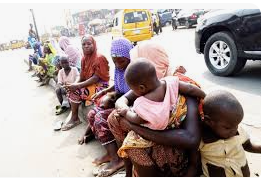
Tinubu’s denial notwithstanding, World Bank doubles down on 139m citizens living in poverty
By Jeph Ajobaju, Chief Copy Editor
Worsening poverty level in Nigeria has been reiterated by the World Bank, despite President Bola Tinubu’s denial of the bank’s earlier assessment of the poverty impact of rising inflation.
The latest ‘Africa’s Pulse’ report released by the World Bank on Tuesday laughed off Abuja’s quest for single-digit inflation in the short term as unrealistic, warning that Nigeria is stuck among African countries grappling with high consumer price inflation.
The report:
- Projected that Nigeria, Angola, Ethiopia, Ghana, Malawi, Sudan, Zambia, São Tomé and Príncipe, and Zimbabwe, will continue to record double-digit inflation rates through 2025.
- Said 37 of Africa’s 47 economies are projected to maintain single-digit inflation by 2026 but Nigeria is an outlier due to persistent structural challenges, including currency depreciation, high food and energy prices, and supply bottlenecks that stoke up price instability.
Tinubu’s Media and Public Communication Adviser Sunday Dare quickly dismissed the report as unrealistic.
But on Wednesday the World Bank doubled down on its claim by expressing deep concern over deteriorating living standards in Nigeria despite touted economic stabilisation efforts, citing 139 million citizens who are now living in poverty.
The bank warned that Nigeria risks losing the gains of its ongoing reforms if it fails to bring real improvements to the lives of regular citizens.
World Bank Country Director for Nigeria, Mathew Verghis, made the point in Abuja at the launch of the October 2025 Nigeria Development Update titled “From Policy to People: Bringing the Reform Gains Home”.
The document has elicited reactions from rights activists and opposition parties, many of who say it mirrors the harsh reality of daily life under the current administration.
However, the Villa again strongly disputed World the Bank figure, describing it as unrealistic and disconnected from Nigeria’s actual economic conditions.
A statement Tinubu issued through Dare on Thursday said poverty statistics must be properly contextualised within the framework of global poverty measurement models.
“While Nigeria values its partnership with the World Bank and appreciates its contributions to policy analysis, the figure quoted must be properly contextualised. It is unrealistic,” Dare wrote on X.
He explained that the 139 million poverty estimate was derived from the global poverty line of $2.15 per person per day set in 2017 using the Purchasing Power Parity (PPP) model – which should not be seen as an exact count of Nigerians living in poverty.
When converted to local currency, he argued, the global poverty line of $2.15 per day amounts to about ₦100,000 per month, a figure that surpasses Nigeria’s new minimum wage of ₦70,000, making it an analytical construct rather than a real-time reflection of income realities.
“President Tinubu’s administration is committed to reducing the incidence of poverty. Nigeria rejects exaggerated statistical interpretations detached from local realities.”
Read also:


