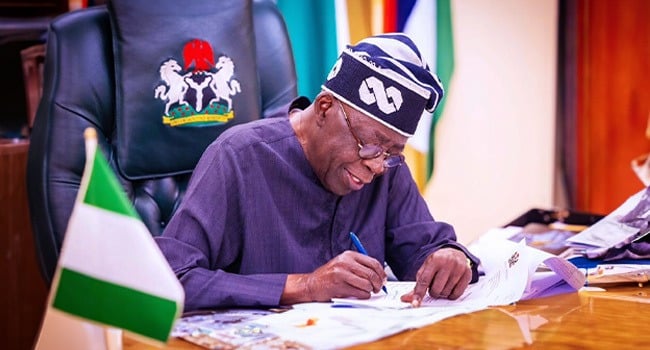
Tinubu retroactively dissolves committee on sale of FG properties: In a statement signed Thursday announcing the directive, Special Adviser to the President on Information and Strategy, Bayo Onanuga, said the dissolution took effect from November 5, 2025, and that the committee’s erstwhile Secretary, B. S. Dutsin-Ma, had been directed to immediately cease acting on behalf of the committee and the Federal Government on all related matters.
By Emma Ogbuehi
President Bola Tinubu on Thursday approved the immediate dissolution of the Presidential Implementation Committee on the Alienation of Federal Government Properties, a 25-year-old body established under former President Olusegun Obasanjo.
He also transferred all its functions to the Attorney-General of the Federation and Minister of Justice, Lateef Fagbemi.
In a statement signed Thursday announcing the directive, Special Adviser to the President on Information and Strategy, Bayo Onanuga, said the dissolution took effect from November 5, 2025, and that the committee’s erstwhile Secretary, B. S. Dutsin-Ma, had been directed to immediately cease acting on behalf of the committee and the Federal Government on all related matters.
The Presidency said the decision followed a careful review that found the PIC had extended its activities beyond its original mandate, resulting in multiple litigation across the country.
It said the development no longer justified the committee’s continued existence.
“After careful consideration, the government has noted that the activities of the PIC had extended beyond its original mandate, resulting in multiple litigations across the country, and the continued existence of the committee is no longer justified,” the statement read.
The PIC was established in 2000 under Obasanjo to oversee the privatisation, sale and lease of Federal Government landed assets under the administration’s monetisation policy.
The sweeping reform programme at the time sought to convert government-owned housing, vehicles and other assets into cash and end the practice of providing perquisites in kind to public servants.
Its membership comprised the then Minister of Housing as chairperson, alongside representatives from the Ministries of Transportation, Justice, Health and Agriculture, as well as the Nigeria Police Force, with Professor P. T. Ahire, then a Deputy Director in the Office of the SGF, serving as pioneer Secretary.
On March 22, 2001, the Federal Executive Council approved the establishment of a Panel of Inquiry to produce a White Paper to guide the implementation of the committee’s recommendations.
The panel worked for 21 months before submitting its report.
The monetisation policy it served emerged as one of the most consequential administrative reforms of the Obasanjo era.
However, its implementation generated decades of controversy, with thousands of disputes arising over the valuation and sale of government properties, allegations of undervaluation, claims of irregular sales to political insiders and a trail of court cases.