



The Nigerian state, the media, and the man in the Yellow House
Achike Chude
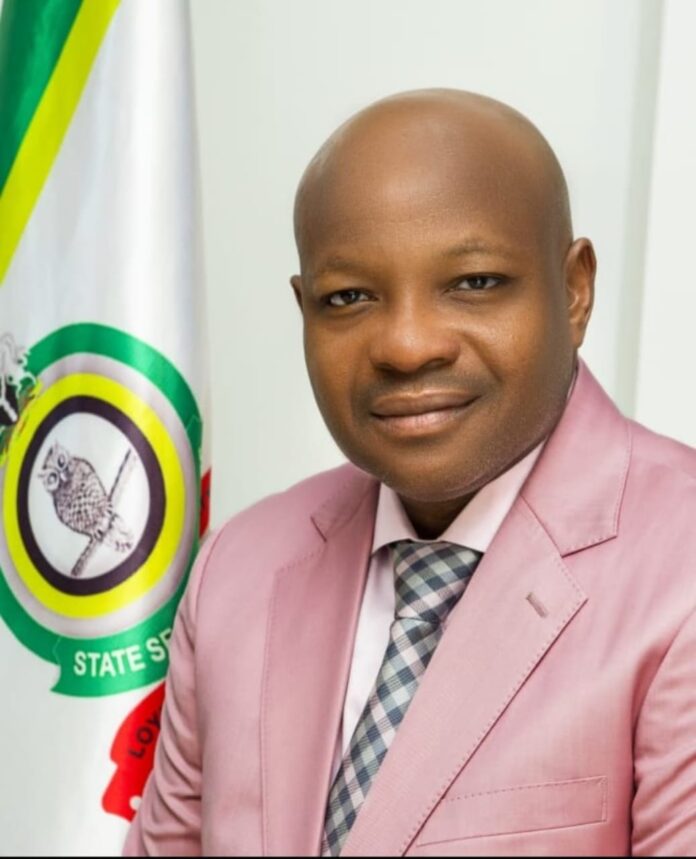
Recently, the Nigeria Union of Journalists did the seemingly unthinkable. The apex journalism body conferred its ‘Man of The Year Award’ to Mr Oluwatosin Adeola Ajayi. Very normal, right? Until you realise that Mr Ajayi occupies a very important, strategic and sensitive position within the security architecture of Nigeria. His primary duty is ‘the protection and stability of the Nigerian state. He is the Director General of the Department of State Services otherwise known as the DSS and, despite expected noises from some quarters he is said to be deserving of the award for a novel approach in his engagements with the media – at least in the past 18 months.
The DSS has obviously evolved over the years, from the period of its dreaded precursor the Nigerian Security Organization, NSO, then under various military dictatorships whose natural inclinations for lawlessness and rights violation were legendary.
It was therefore almost a given that when the well-articulated democratic winds blew away the men in jackboots from power, it also helped to bring in a new dispensation of men and women who swore that they were children of democracy capable of ensuring that democracy’s bounteous blessings would be made manifest before Nigerians.
Part of the anticipated legacy of the new civilian dispensation was the urshering in of democracy’s imperatives which fruits and benefits were presumably the rule of law, respect for human rights, political transparency and accountability, a free press, etc etc.
Since then the quintet of Obasanjo, Yar A Adua, Jonathan, Buhari, and Tinubu have all traversed Nigeria’s power centre at the ‘Rock’ in Abuja. The results of their collective leadership for the past 27 years have been mixed. Of the quintet, Tinubu’s continuous journey as the president is still ongoing albeit with a hazy future, in view of the incoming election in 2027.
Though the general direction of the country has now certainly been clouded over by myriads of socio-economic negativities, especially the hydra-headed problem of insecurity, the country has also witnessed very modest gains. But it is clear that whatever gains that have been achieved would always pale into insignificance for as long as present socio-economic contradictions inflicted by the political class are not radically addressed through elitist consensus by these causative agents who are all beneficiaries of the struggle to enthrone democracy in the country.
That Nigeria is perhaps at its most challenged point post-civil war is not a matter of debate. You would think that after twenty-seven years of ‘unbroken democracy’ the longevity of democratic control of political power would provide the country the opportunity to sooth and repair the country’s religious, ethnic, and geo-political tensions. Sadly, the outcome of our democratic experiment since 1999 has been the exacerbation of these fault lines by some within the political class for parochial purposes.
The consequences of these deficits and derelicts have resulted in the generation of social tensions exacerbated further by increasing poverty and a general state of hopelessness. These scenarios constitute a combustible dynamic capable of threatening the free civic space and the power of the state. Confrontation then becomes inevitable between that sector of the public with the constitutional mandate to defend the civic space and protect our democracy – the media, and the body set up by law to ensure state stability, cohesion, and continuity – the DSS. Other security agencies have also at various times weighed in in ways detrimental to the free exercise of journalism in the country.
Data from press freedom watchdog organizations—including the Centre for Journalism Innovation and Development (CJID), Media Rights Agenda (MRA), Reporters Without Borders (RSF), and the Committee to Protect Journalists (CPJ), highlights persistent press freedom violations in Nigeria, with security forces identified as primary perpetrators.
CJID’s Press Attack Tracker has recorded over 1,326 press freedom violations in Nigeria since 1986. In terms of fatalities, Nigeria leads West Africa in journalist deaths, accounting for 28 fatalities recorded between 1986 and 2026.
According to MRA and CJID reports, government security agencies account for more than 50%–60% of all documented attacks on journalists:
The police are reputed to be responsible for 48% of all violations.
That of the Department of State Services (DSS) stood at 7%–10% before now, while that of non-state actors stands at between 20%–25%. This involves targeted physical assaults during election coverage or investigative work.
Of all violations in the past 18 months, those by operatives of the Department of State Services seem to have come to a screeching halt except for a few abnormalities like that of Benue State recently when the DG of the service had to personally apologize to the NUJ for an infraction from his men. For the Director General of the Department of State Services to apologize to the Nigeria Union of Journalists for the conduct of his men in Nigeria is ‘insane,’ almost unbelievable, but very humbling and refreshing. He could have chosen otherwise, doubled down in support of his men and the heavens will not fall. He did the exact opposite.
But this change did not just happen one magical night. The dialogue between the Nigeria Union of Journalists and security agencies in the country has been ongoing for some time to ensure the protection of Journalists lawfully and constitutionally doing their duties of reporting the news, investigating and holding public office holders accountable. In all of these engagements either directly or indirectly, only one agency has been openly forthcoming. Only one agency has been willing to put its mouth where its money is. Only one agency has given a nationwide instruction to its men and women in the field to refrain from the harassment, intimidation, arrest of journalists anywhere in the country and siezure of the tools of their trade.
The man who made this possible, the DG of the DSS, Oluwatosin Ajayi Adeola went further to declare that no arrest of journalists anywhere in the country would be tolerated in any form and if there is any matter that requires the scrutiny of the DSS, the leadership of the NUJ would be informed. While the relationship with the DSS hopefully continues according to expectations the NUJ will continue to insist that a free and unhidered press is the gateway to the protection of our hard one democracy, national stability and cohesion – two elements at the core of the establishment of the Department of State Services.
So far, in the past one year and beyond, the DSS has kept to its promise. Arbitrary arrests and harassment of the people of the pen are no longer taking place.
For daring to do what his predecessors never even considered for a moment, methinks that Mr Oluwatosin Ajayi Adeola, the man in the Yellow House is indeed deserving of the award of ‘Man of The Year’ by the Nigeria Union of Journalists.
Achike Chude is the National Secretary of the NUJ


