



The mysterium: Washed hands, restless minds
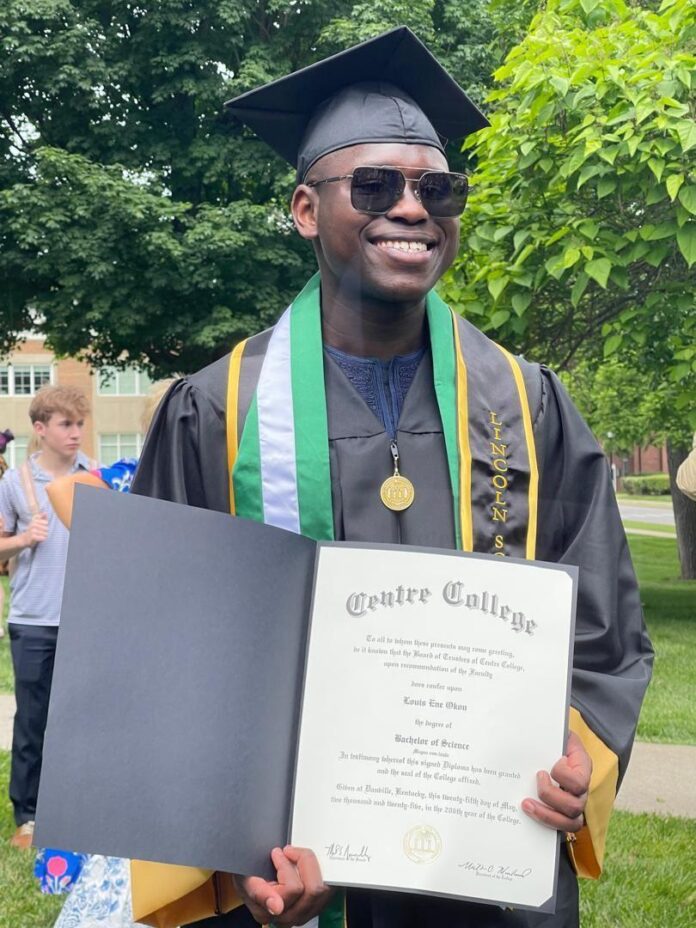
By Louis Okon
Good evening senior leadership, faculty, staff, Class of 2025, and fellow students. Please join me in my reflection on what it means to earn a Doctrina Lux Mentis degree.
A child who washes his hands can eat with elders. Chinua Achebe tells us in Things Fall Apart. It seems simple. Prepare diligently, graduate, and earn a seat at “the Table.” Seniors, through our liberal arts education, we have washed our hands and now prepare for our final leap toward that metaphorical Table.
And so, the proverb invites a closer reading – one we can test through the liberal arts framework. Anthropology taught me holism: the idea that no single lens is enough to understand human life. And that may be the most important thing the liberal arts has taught us. The world doesn’t present itself in silos. It simply demands a response. It requires leaders whose thinking is not confined by their majors and careers, because the consequences of the choices we make will not respect those boundaries.
Holism isn’t just theoretical – it’s deeply practical. Take climate change: science measures chemical disequilibrium; economics prices risk; anthropology tracks culture. These frames clash in isolation, but together, illuminate. The liberal arts call us to integrate meaning, thus, they cannot be dismissed as random electives. The liberal arts are a pedagogical tradition that disturbs comfort, deepens perception, and trains us to ask better questions. In my pursuit of intellectual holism, I have faced a sobering reality: no discipline, no professor, no course holds the answers I seek.
I have noticed a recurring theme in many of my classes. At some point, a professor will likely say, “We used to believe that, but we don’t anymore.” This is true across disciplines, even in the ‘hard sciences’: Newton once believed that space and time were absolute – until Einstein showed they were not fixed, but flexible. Therefore, no field ever gets it finally right. Truth is provisional – shaped by discovery, power, and perspective. One of the most important concepts I encountered in Intro to Islam is the idea of orthodoxy – what counts as correct belief and practice. Talal Asad showed that orthodoxy is rarely timeless. It is shaped – subtly but powerfully – by those privileged to define it. This realization raises uncomfortable questions: What is true Islam? What is true Christianity? Who gets to decide, and why? Orthodoxy isn’t an idle debate – it is a function of power at work, rewarding those who comply and punishing those who stray.
As students, that power sits with faculty; beyond campus, it’s policed by unwritten rules, norms and muted social pressure. Therefore, if power shapes truth and determines orthodoxy, does that mean we can know nothing? Of course not. But it does mean that we learn by wrestling with uncertainty. So, how do we do that without sliding into relativism or clinging to ideology and dogma? Physics offers a parable: light emits an infinite array of rays that radiate outward in every direction.
What we perceive depends entirely on where we stand. Truth behaves like light: its source is constant, stable, and enduring. Yet, it is always only partially visible – shaped by the angle from which we receive its ray. Each of us sees only a portion, because we are always in motion – through time, encounter, and the subtle gravity of place. Our vision shifts. Some see shadow; others, a single ray. Truth demands we share what we see – not for victory, but to widen our collective view of the light.
And let us remember: the light itself never changes, but we see it more clearly each time we return and reorient ourselves – together, in shared pursuit. That tension between truth and power – light and its rays – did not remain abstract for me. It became deeply personal, especially in my faith. Both Religion classes I took with Dr. Jefferson caused me profound turmoil: intellectual, yes, but even more so spiritually. They forced me to grapple with the sarx – the flesh – of Sacred Scripture: the unsettling idea that Divine revelation was entrusted to finite human vessels, shaped by the questions, cultures, and longings of their own time.
If the Bible was not simply written by God, as I had been taught my entire life, how could any Christian theology be valid? Was my faith valid? Through the liberal arts, I encountered knowledge in DLM, Postcolonial Literature, Philosophy, that affirmed the living relevance of my faith. Although they did not resolve my crisis, they revealed its enduring calm: its moral weight and metaphysical beauty. Seeking more through independent study, I found a quiet line from St. John Paul II: “Faith and reason are like two wings on which the human spirit rises to the contemplation of truth.” The Holy Father helped me understand that to be Catholic is not to absorb like a sponge. Rather, authentic Catholicism calls the faithful to wrestle with Scripture and engage the intellect. Equipped with the lesson that reason and logic can form the soul, I developed a new relationship with God and the Holy Mother Church – one of reverence, intellectual humility, and a renewed pursuit of full communion.
READ ALSO: Legacy leadership lessons from Kumuyi at 84
But my questioning didn’t stop there. I pondered a new question: Where do we turn when our inherited truths begin to crack? This experience of doubt is not new. Four centuries ago, René Descartes faced a similar reckoning. In an age of fractured authority, he questioned everything – even his own existence. Through this, he arrived at one certainty: Cogito ergo sum – I think, therefore I am. For Descartes, doubt was not a threat, but a method that affirmed unknowing as a path to clarity.
His method is a gift: doubt, not as destruction, but as disciplined refinement and reconstruction. Our crisis is similar, yet profoundly different. Descartes feared false certainty. Today, we’re drowned in hyper-curated feeds and competing truths. Self-proclaimed experts on social media speak with algorithmic confidence, rewarded not for accuracy or nuance, but performance. In this age of information overload and manufactured facts, methodical doubt becomes a vital form of intellectual ethics. It doesn’t just ask, “Is it true?” It demands we ask: “Who says so?” “On what grounds?” “And who does it serve?” Today, ideas travel like light. A question in Danville can stir a mind in Bangkok. In this global village, truth must be sought together, not alone.
The Southern African wisdom of Ubuntu – “I am, because you are” – names that bond, because your vision helps mine too. So, in this age of doubt, I turn not to further abstraction, but to each of us. Juniors and underclassmen: permit me to speak plainly. This is not high school, nor is it a vocational program. Centre is a place where minds are formed. We’ve all shown up unprepared to class. But when that becomes habit – reflected in silence, passivity, and detachment – it is a loud betrayal of Centre’s founding vision.
In 1819, Centre College was chartered as a “seminary of learning.” Not merely in the religious sense, but as a consecrated space for intellectual formation. It was never meant to be a degree factory or an assembly line – streamlined, noisy with noise, and indifferent to the minds it produces. Nor was it built for rote memorization – ChatGPT does that faster. Friends, real learning – the kind Centre was founded for – takes effort. It lives in the classroom, but also in quiet conversations with professors and peers, and the daily work of learning when no grade is at stake.
You don’t need a perfect GPA to be a full participant in this life of the mind. But silence and detachment, when left unchallenged, become habits. And those habits follow us – into our homes, our communities, and the moments that beg us to speak. And so I ask, not with judgment, but with urgency and love for our College: if you’re not here to think, to speak, and to grow – why are you here? And to all of us: that responsibility is not one we can cede to others. We cannot say, “Let them figure it out.” Let who figure it out? Thinking is not someone else’s job. To adopt that posture is to abdicate our moral responsibility as lifelong learners and products of a liberal arts formation.
Whatever your path, the responsibility holds. We cannot be passive recipients of decisions. Even when answers seem obvious, we must keep asking – because the light is never fully visible, only revealed more clearly with each question. When power decides which rays of light count as truth, the responsibility of those seated at the Table is not merely to speak, but to interrogate how truth itself is constructed, and by whom. In moments of real consequence, silence at the Table can become a moral failure, not because we must always have answers, but because choosing to remain silent – when we have questions or see harm – turns us into bystanders, rather than active participants in truth-seeking. This isn’t about half-baked, or copy-and-paste opinions – no. It means refusing to be complicit through silent assent.
Let me return to where we began. We began with the idea that washed hands grant access. But we leave with a more honest truth: washed hands are not a symbol of arrival – they are mirrors of accountability and responsibility. So as we take our seats at the Table, let us remember: graduation doesn’t entitle us to speak. It prepares us to serve, with thoughtfulness and care.
Let us have the courage to engage, even when answers feel out of reach. Because doubt, when held with integrity, can become a graceful faith: faith in the process of thinking, in the belief that truth is not handed down, but uncovered through effort, community and intentionality. Let us lead with humility and be unafraid to say, “I don’t know”, when honesty demands it. And let us fight the urge to become ‘yes men’ – those who echo the Table without regard to truth. Remember: the phrase, “We used to believe that,” is not inherently virtuous. Change alone proves nothing. Forward is only forward if it brings us closer to truth – to light. One day soon, when the Table asks, “What do you think?” – may we answer not with performance, but with care, courage, and faith.
Our world needs citizens who will ask, listen, and act. Let us not come to the Table with the illusion of certainty, but with the disciplined doubt that sharpens the intellect, and teaches the mind to ask wisely. And so we arrive: not at certainty, but at the threshold of light.
Doctrina Lux Mentis: learning is the light of the mind. May the pursuit of that light be not only our compass, but our duty and our gift, as we steward truth into the world, together.
- Okon, presented this honours convocation valedictory speech at the Centre College, Danville, Kentucky USA on May 25, 2025


