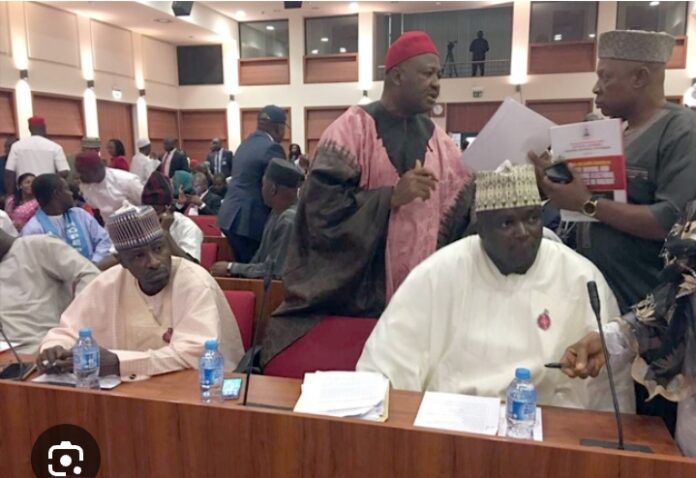
State Police Bill: NASS urged to hold comprehensive public hearings before passage
By Ishaya Ibrahim
The Rule of Law and Accountability Advocacy Centre (RULAAC) has urged the National Assembly to ensure that the proposed State Police Bill is subjected to broad-based public consultation, including comprehensive public hearings before it is passed.
A statement by Executive Director Okechukwu Nwanguma said the public hearing should be held across the six geopolitical zones before any final decision is taken on it, describing the bill as a far-reaching constitutional amendment.
It said: “The establishment of state police represents one of the most profound alterations to Nigeria’s constitutional and security architecture since the country’s return to democratic rule. Such a fundamental restructuring of policing should not be undertaken without giving Nigerians a meaningful opportunity to examine its implications, express their concerns, and contribute to shaping the final outcome.”
RULAAC noted widespread public perception that the Bill is an Executive-backed initiative that is being advanced with unusual speed through the legislative process.
“Whether these perceptions are justified or not, they underscore the need for greater transparency, broader consultation, and national consensus. A constitutional amendment of this magnitude should not be enacted without carrying the Nigerian people along,” it said.
According to the statement, the concerns are particularly significant as Nigeria moves closer to the 2027 general elections. It adds that constitutional and institutional reforms that could substantially alter the country’s policing architecture and the distribution of coercive powers should be approached with exceptional caution during a politically sensitive period.
“Any reform that affects law enforcement must not only be fair but must also be seen to be fair. It should not create fears that policing powers could be deployed to influence electoral outcomes, suppress legitimate political opposition, intimidate voters, or undermine public confidence in the democratic process,” it said.
RULAAC revealed it has consistently maintained that while Nigeria’s policing system urgently requires reform, the creation of state police is not, in itself, a guarantee of improved security.
It said experience at the state level has shown that many governors already exercise considerable influence over existing security structures.
It adds: “Without strong constitutional safeguards, operational independence, transparent recruitment and promotion processes, effective civilian oversight, independent complaints mechanisms, judicial accountability, and clear constitutional limits on the powers of state executives, state police could become vulnerable to political manipulation and abuse.”
RULAAC argues for alternative approach centred on the decentralisation of the Nigeria Police Force through genuine devolution of operational authority, command responsibility, personnel, and resources to state and zonal commands while preserving national standards, professionalism, accountability, and insulation from partisan political control. It said the model deserves equal and careful consideration as part of the ongoing national conversation on policing reform.
Accordingly, RULAAC urges the National Assembly to suspend any accelerated consideration of the State Police Bill until comprehensive public consultations and formal public hearings have been conducted across the country.
It said civil society organisations, professional bodies, the Nigerian Bar Association, the media, traditional and religious institutions, labour unions, women’s and youth groups, persons with disabilities, security experts, academia, and ordinary Nigerians should all have the opportunity to contribute to this important constitutional debate.
It said the National Assembly must ensure that any decision on state police is based on broad national consensus rather than political expediency. Constitutional reforms derive their legitimacy not merely from legislative votes but from the confidence and participation of the people whose rights and freedoms they affect.
It concluded that as Nigeria approaches the 2027 general elections, it is imperative that any reform of the country’s policing architecture strengthens democratic governance, protects human rights, reinforces the rule of law, and enhances public trust in the institutions responsible for providing security. It said the process through which such reforms are adopted is as important as the substance of the reforms themselves.