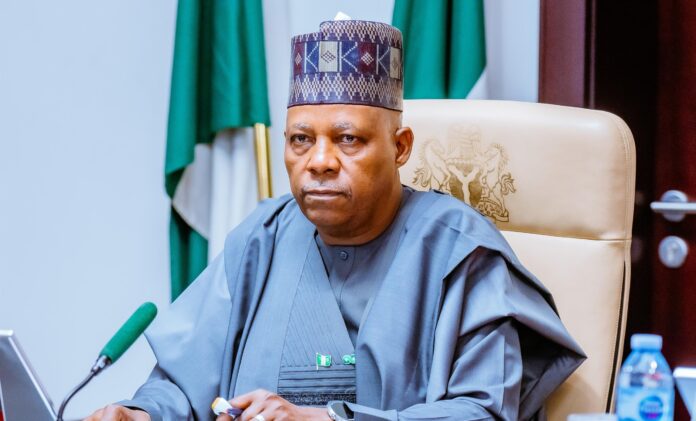
Shettima also claimed there are solar potentials in Sokoto, Borno and Katsina, gas resources in Delta, Rivers and Bayelsa, and hydro opportunities in Niger and Kebbi.
By Kehinde Okeowo
Nigeria’s Vice-President Kashim Shettima has seemingly thrown down a challenge to the 36 state governors in the country, urging them to start fixing electricity problems in their respective states rather than waiting for the Federal Government.
He made this known on Wednesday, 21 October, while addressing participants at the National Stakeholders’ Workshop on the Electricity Act 2023 at the State House Banquet Hall, Presidential Villa, Abuja.
According to Shettima, who was represented by the Deputy Chief of Staff to the President, Senator Ibrahim Hassan Hadejia, states are now permitted to generate and distribute their own electricity under the Electricity Act 2023.
He, however, admitted that Nigeria cannot build a competitive industrial economy without reliable power for businesses, households and public institutions.
ALSO READ: Sowore warns FG against using Ebola outbreak to suppress ‘democratic participation’
While asserting that under the new law states can develop and regulate their own electricity markets, Shettima said: ‘The Act empowers States to develop and regulate intrastate electricity markets within the applicable constitutional and statutory framework.
’State governors can fix electricity without the Federal Government. The size, diversity and endowments of this nation demand this decentralisation.
’Electricity supply must become a shared responsibility, pursued with innovation and accountability across the federation. Our States must shed the habit of waiting for the Federal Government to provide every answer.’
The former Borno State governor also cited solar potential in Sokoto, Borno and Katsina, gas resources in Delta, Rivers and Bayelsa, and hydro opportunities in Niger and Kebbi.
He urged states to turn these resources into investments that can power agriculture, manufacturing, healthcare and education.
Shettima further warned that the law alone will not provide power and urged states that have not set up their own electricity regulators to do so immediately.