




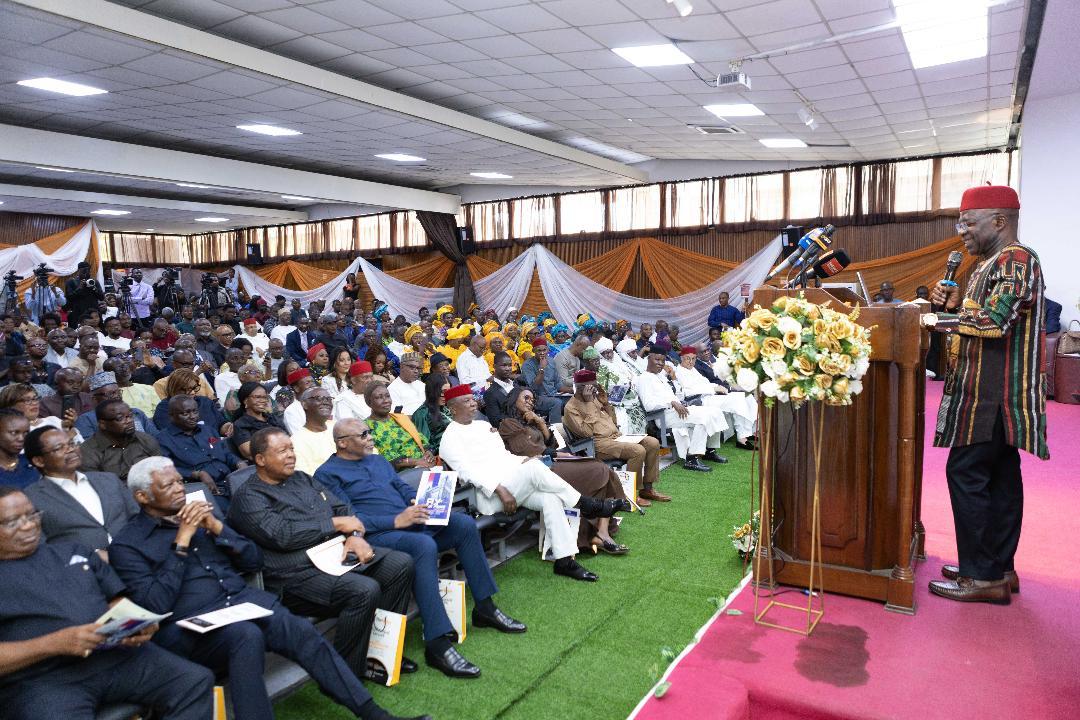
Otti spoke loud and clear at TheNiche lecture: His thesis was profound, the clarity of his hypothesis was refreshing, just as his candour was edifying. The message in his 4,875-word lecture was unambiguous, yet loud: Elections have consequences. And I agree in toto! The lecture was in a class by itself. The delivery, a masterclass – a niche performance at TheNiche lecture. At the end, he was rewarded with a standing ovation for his elucidation and candour by an appreciative audience.
By Ikechukwu Amaechi
No one left the auditorium of the Nigerian Institute of International Affairs on Thursday, April 23, 2026, wondering what Abia State Governor, Dr Alex Chioma Otti, was trying to say at the 2026 TheNiche Annual Lecture with the theme, “Governing the Economy: Choices, Trade-offs, and National Priorities.” He spoke loud and clear. In a country where political leaders have mastered the mischievous art of speaking tongue-in-cheek; where judgements of even the Supreme Court are couched in obfuscating clichés and woolly phrases that muddy the waters rather than elucidate, that was a breath of fresh air.
His thesis was profound, the clarity of his hypothesis was refreshing, just as his candour was edifying. The message in his 4,875-word lecture was unambiguous, yet loud: Elections have consequences. And I agree in toto!
His opening salvo indicated his intention to be forthright: “There is no silver bullet for solving Nigeria’s myriads of economic challenges because economics is about cold, hard facts, not vanities. With high level of unemployment, especially amongst the youth population, rising incidence of poverty and growing sense of helplessness amongst our compatriots, it would be uncharitable to wish these unsettling realities away,” he said.
That was pragmatic. For a man who pulled himself up by his bootstraps to be at the top in the banking industry, and who is now a governor, he definitely knows the way to the city of growth and development.
So, he is optimistic about the future of the country, preferring to see the cup as half full rather than half empty. “I refuse to submit to the position of cynics who insist that our situation is entirely hopeless because it is not… Our country has a great destiny and its future will certainly remain bright,” he submitted.
But as someone who has made a career of dealing with life in a practical manner rather than through wishful thinking, despite his sanguinity, he sounded a note of warning when he said: “Even then, the world cannot afford to wait in perpetuity for Nigeria to begin to play to its full strength. Quietly, it has moved on, hoping that someday, our country may catch up but whether that day would be in this decade or in the coming century, or perhaps never, will depend largely on what we do in the days and years that follow.”
Insisting that the frustrations of the last six decades have proved that there is a direct correlation between political choices and the daily experiences of the population, he asserted: “It is beyond argument that a good leadership system across board, one that understands the dynamic laws of economics and the intersection of political behaviour and public welfare, would certainly go a long way in taking us closer to our dream Nigeria.”
Unassailable points for which he was rewarded with generous applause. Harping on the critical connection between politics and the economy – how politics drives critical economic outcomes – Governor Otti, without equivocation, declared: “It is impossible to separate incompetent political leadership from the manifestations of economic decline such as drastic tanking of the size of the gross domestic product (GDP), widespread unemployment, reduced investment appetite and all such developments that ultimately lead to high poverty levels and endemic anxiety within the community.”
It was obvious that everyone in the hall related to that. Many nodded their heads in agreement when he said, “Perhaps we need to say it one more time that the foundation of economic governance is built on the decisions made by those who pull the levers of power; ultimately, the outcome of their choices impact our daily experiences. In a political system driven by mercantilism, desperation for power and corruption across multiple nodes in the value chain, things are bound to go from bad to worse because no system has endless supply of resources to feed the bottomless greed of political actors, including voters who see votes as wares for sale to the highest bidder.”
There is no doubt that bad and unconscionable leadership is the reason Nigeria, a country of immense potentials, continues to plumb the depths of destitution. So, his assertion that “strong and resilient institutions cannot be built on the back of a corrupt political culture, one that favours just about anyone with a deep wallet to buy voters, electoral officials, media practitioners and the instruments of violence,” resonated as well as his reminder that “evidence abounds that it is nigh-impossible to build a robust economy on the foundation of political corruption.”
Giving back to society, TheNiche way
In a country where governors have been frightened into a fit of panic, Otti could afford to speak with so much candour without unnecessary fluff because he has delivered handsomely on the promises of his mandate. In less than three years, he has chalked up achievements that have exposed the grim spectacle of the 24 years the locusts ate. In a country where hypocrisy, unbridled sycophancy and shameless toadying have become political survival strategies, Otti is surefooted because Abians are happy with his performance.
Because of his personal political reality, the governor seems to align with Joseph de Maistre, the French philosopher’s position that “every nation gets the government it deserves.” The political adage of a people getting the government they deserve suggests that, in a democracy, the government reflects the choices of its citizens. That is what it ought to be because ideally power resides with the people. And where that is the case, the quality of leadership reflects the people’s choices.
Granted, some Nigerians see votes as wares for sale to the highest bidder. While such people must be called out, it is important to point out that they are in the minority. Many Nigerians don’t partake in the bazaar. Even at that, it is doubtful that those voters mortgage their conscience even as they take money from the political reprobates masquerading as leaders. The real outcome of elections as announced at the polling booths, not the forged results ultimately declared by compromised INEC officials bears eloquent testimony. So, in a system where poverty has been weaponised, people collect money from their oppressors but still vote their conscience. Again, it may be convenient to blame those who have decided not to vote again knowing from experience that their votes won’t count. But what choice do they really have other than to abstain when the exercise of their franchise only helps in legitimising fraud?
Governor Otti knows this for a fact. He won the 2015 governorship election fair and square. Abians voted for him, not the man who was declared winner and subsequently ruined the state in eight years of imbecilic leadership. The people made their choice but the rigged system decided otherwise. The same thing would have happened in 2023 if not for the forthrightness of a ‘Daniel who came to judgement’ in the person of the irrepressible Prof Nnenna Oti, a woman of integrity, whose exemplary role in upholding the truth, made the difference.
In other states where there were no Nnenna Otis, the crooked system denied the people their choices. So, how correct will it be to say that the longsuffering people of Abia State deserved the government they got in 2015 when it was obvious that they didn’t vote for Okezie Ikpeazu who was declared winner by INEC?
So, while it is true that “as stakeholders in the Nigerian project, we ought to be worried that majority of our compatriots are increasingly shying away from participation at the ballots,” as Otti noted, it is important to ensure that the votes are not only counted but also count in determining who wields the levers of power. Voting for the sake of it when, at the end of the day the votes don’t count, will be an exercise in futility.
Development is impossible without a proper sense of stewardship amongst those in leadership positions. That is true. But that is only possible if those in power owe their positions to the electoral wishes of the people. Unfortunately, that seems not to be the case.
Governor Otti said poverty and prosperity, employment and joblessness, security and anxiety, prudence and rascality will all be on the ballot in 2027. They ought to be. But with the obvious attempt at coronation rather than election by the Bola Tinubu-led regime, I doubt if they will.
Unlike former President Goodluck Jonathan who famously said his political ambition is not worth the blood of any Nigerian, a declaration for which he has been ridiculed to no end as evidence of his naivety, those on the saddle today have left no one in doubt that their political ambitions, if need be, may well be worth the blood of a million Nigerians. That is what the ‘Tinubu is not Jonathan,’ mantra is all about – an ominous dog whistle.
So, the fact that leadership misfits are straddling the corridors of power in Nigeria is not necessarily because the people made wrong choices. If anything, Nigerian voters made the right choice in 2023. It was criminally aborted. How to ensure that the political marauders are stopped in their tracks in 2027, no matter what it takes, will be the real test of this pseudo-democracy.
It is no longer news that Otti, by dint of hard work, has become the poster governor of this political dispensation. For those wondering about his success in the midst of spectacular failures, TheNiche lecture gave him the opportunity to explain.
“I am often asked what we have done differently in Abia and my response is often simple: changing the behaviour of the political leadership,” he said matter-of-factly, adding, “In Abia, we have not only restored the faith of our people in government, we have effectively demonstrated that agencies of government can be alive to their responsibilities — that political office holders are actually servants of the people, not their masters.” That exactly is the essence of democracy.
The lecture was in a class by itself. The delivery, a masterclass – a niche performance at TheNiche lecture. At the end, he was rewarded with a standing ovation for his elucidation and candour by an appreciative audience.


