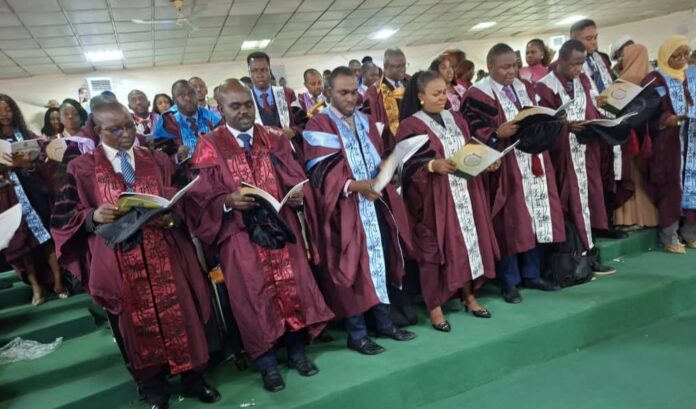
NPMCN Convocation: College seeks FG intervention over rising training costs
By Henry Nnaemeka
The National Postgraduate Medical College of Nigeria (NPMCN) has appealed to the Federal Government to intervene in the rising cost of postgraduate medical training, particularly the increasing financial burden of conducting Fellowship examinations.
The President of the College, Prof. Nnaemeka Ikefuna made the appeal on Thursday at the 44th Convocation Ceremony of the institution in Lagos, where 537 Fellows were certified as specialists in various fields of medicine and dentistry.
Ikefuna said the cost of conducting Fellowship examinations had risen sharply, with expenses covering logistics, examination materials, examiners’ allowances, accommodation, transportation, information technology, and other operational requirements.
He said examination fees paid by candidates were no longer sufficient to cover the cost, resulting in a huge deficit after the College’s last examination and delays in settling the full entitlements of some examiners.
According to him, the financial pressure would become more challenging with the implementation of new Duty Tour Allowance rates from October 1, 2026.
“The need for assistance to sustain this standard becomes more imperative with the implementation of the new Duty Tour Allowance rates effective from 1st October 2026,” he said.
The College President appealed to the Federal Government to provide financial support to sustain the quality and integrity of its examinations and enable it to devote more resources to postgraduate training and assessment.
He also called for continued government support through the Medical Residency Training Fund (MRTF) to assist resident doctors with the financial demands associated with College examinations.
Migration, burnout threaten specialist training
Ikefuna also raised concerns over the impact of the migration of doctors on postgraduate medical training.
He said the exodus of doctors had increased the workload on those remaining in Nigeria, potentially contributing to burnout, reduced efficiency and weaker mentorship for resident doctors.
He advocated workload restructuring, workforce strengthening and a one-to-one replacement policy for doctors who emigrate, as well as psychological support for resident doctors.
The College also called for increased funding for clinical simulation laboratories in Kano, Enugu and Abuja.
Ikefuna said facilities equipped with high-fidelity mannequins would help residents develop practical skills, improve competency assessment and strengthen clinical decision-making before certification.
Digital training, quality assurance
The College President disclosed that the institution was strengthening its examination quality assurance processes through evidence-based standard-setting methods and a quality assurance checklist applied during the March, April and May 2026 examinations.
He said the measures were designed to promote transparent and fair examinations, academic integrity and globally competitive specialist training.
The College is also expanding the use of digital technology in postgraduate training through competency-based work assessments, electronic portfolios, telemedicine and real-time tracking of residents’ training milestones.
Ikefuna said the College had received the National Universities Commission’s approval to proceed with a proposed PhD programme for clinicians, to operate as a pre-Fellowship programme alongside the existing Doctor of Medicine (MD) programme.
He disclosed that about 473 MD degrees had been conferred since 2020, with more than 55 recipients expected in 2026.
Fellow calls for stronger research integration
Delivering the convocation lecture, the Director-General of the Nigerian Institute of Medical Research (NIMR), Dr John Oladapo Obafunwa, called for stronger integration of medicine, law, research and ethics in medical education and practice.
Obafunwa advocated a formal physician-scientist track, protected research time and stronger collaboration between clinical institutions and research organisations.
He said NIMR has 278 staff, including 59 research fellows, but only seven are medically qualified, five of whom are Fellows of postgraduate medical colleges.
Representing the Permanent Secretary of the Federal Ministry of Health and Social Welfare, the Director of Hospital Services, Dr Abisola Adegoke, congratulated the 537 new specialists and urged them to uphold professionalism, integrity, compassion and lifelong learning in their service to Nigerians.