By Ishaya Ibrahim
Why is crude-oil rich Nigeria unable to fix its refineries to produce fuel for domestic consumption? This puzzle has defied many administrations. Despite having four refineries which have a combined capacity to process445,000 barrel per day (bpd) of crude oil, far above local demand, Nigeria is still one of the world’s biggest importer of the product.
The federal government maintains a fuel subsidy bill that has become too big to sustain.
According to the National Bureau of Statistics (NBS) third-quarter data of 2018, daily fuel consumption stands at 53 million litres. And depending on the price of crude oil at the international market, the government pays between N30 and N60 subsidy on every litre of fuel Nigerians consume.
On March 14, the Brent, which is the benchmark for crude oil price, traded at $67 per barrel (pb). In December when it traded at $60 pb, the group managing director of the Nigeria National Petroleum Corporation (NNPC), informed Nigerians that the corporation was paying N25 per litre as a subsidy for every fuel consumed in the country. If the N25 is multiplied by the 53 million litres the NBS reported, the subsidy bill will be N1.3 billion daily.
What’s wrong
The NNPC, established on April 1, 1977, is Nigeria’s state-owned oil corporation which is involved in both upstream (exploration of crude oil) and downstream (refining of the crude oil) activities.
The NNPC has four refineries, two in Port Harcourt, one each in Kaduna and Warri. The refineries have a combined installed capacity of 445,000 bpd.
The NNPC also has a network of pipelines that deliver crude oil to the refineries, and another set of pipelines that transports the refined products to different depots across the country for onward transmission to filling stations and then sold to Nigerians at retail prices.
So, why are the refineries not working despite having all these oil and gas infrastructures in place?
Nigeria’s first refinery was built in 1965 as a joint venture by Shell and British Petroleum. By 1989, the country has four refineries with a combined capacity that exceeded local demand.
A study by Abraham Wapner, published by the Columbia Centre on Sustainable Investment in March 2017, reveals that the completion of the fourth refinery in 1989 led to abrief period of surplus production, which allowed Nigeriato become a net exporter of refined petroleum over the next two years.
The research shows that by the end of 1991, production started decreasing due to irregular Turn Around Maintenance (TAM), while domestic demand soared.
“Since that time, the Nigerian refining industry has not been able to produce sufficient levels of refined petroleum to meet domestic demand and, has been a net importer of refined petroleum products,” the researcher explained.
Efforts by different administrations to get the refineries working again through Turn Around Maintenance (TAM) were unsuccessful.
In 2007, the Nigerian government decided that the best option was to get the private sector involved in crude oil refining. Two out of the four refineries were then sold to Africa’s richest man, Aliko Dangote at the sum of $750 million. The deal was however struck at the last few weeks the then President, Olusegun Obasanjo, was about leaving office.
Obasanjo’s successor, the late Umaru Musa Yar’Adua cancelled the transactions and returned the money back to Dangote.
In an interview aired on Channels Television on July 29, 2015, Obasanjo revealed that Yar’Adua told him that his associates pressured him to reverse the sales because, according to them, the refineries could still be fixed.
“Right now, you will hardly be able to sell the refineries for more than $250 million because they are very old,” Obasanjo said.
The Yar’Adua administration, in its efforts to get the refineries working again, brought the original builders of the refineries to make a technical assessment on them.
The Minister of Petroleum Resources at the time, Diezani Alison-Madueke, who also retained the portfolio under Yar’Adua’s successor, Goodluck Ebele Jonathan, explained why the TAM of the refineries could not be done four years after conducting the technical assessment.
According to Madueke, the government could not sign a formal agreement with the companies to carry out the TAM because they refuse to give guarantees and warranties for post-work maintenance.
The refusal to give post work warranties might be as a result of the rot the companies found. Madueke corroborated this when she said the last time a comprehensive TAM was conducted on the refineries was in 1992.
“To get a replacement for the equipment was not possible, because they were obsolete. For over 20 years, the equipment was not changed or maintained. It was clear that contracts had been given out by previous governments, but the people who took the contract did not know what they were doing because of the state the refineries were at the time,” she said.
Like his predecessors, making Nigeria’s refineries to work was one of the promises Muhammadu Buhari made when he was seeking the job of Nigeria’s president.
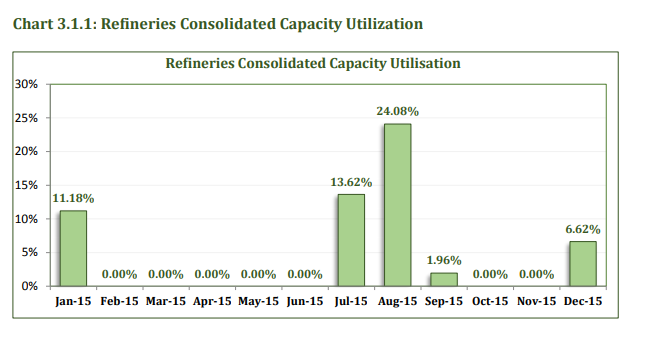
He has been elected for a second term, and the fortunes of the refineries have not improved as he met it in 2015. At the time, the biggest output it had was 24 per cent.
In 2017, none of the refineries worked beyond 50 per cent.
The NNPC in its monthly financial and operations report said the three refineries suffered the loss of N10.79 billion in August 2018.
The Nigerian government had earlier promised that the country’s refineries would start working at full capacity this year 2019. But that hope has been shifted to 2020.
The government is also banking on Dangote’s 650,000 bpd refinery which would become operational in 2020, to help Nigeria attain fuel sustainability, the same Dangote that wanted to participate in the country’s refining industry more than a decade ago and was denied.