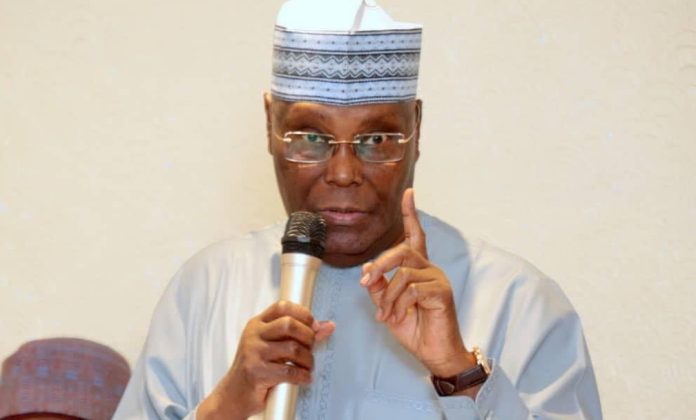
Nigerians must march again, June 12 more than public holiday – Atiku
Former Vice President and African Democratic Congress presidential candidate, Atiku Abubakar, has accused the administration of President Bola Tinubu of orchestrating a sustained assault on Nigeria’s democratic institutions and opposition parties, warning that the country is drifting towards what he described as a “civilian autocracy.”
In a Democracy Day statement titled “June 12: On The March, Again,” issued on Thursday in Abuja, Atiku said Nigerians should mark this year’s June 12 celebration with deep reflection rather than jubilation.
“As Nigerians prepare to commemorate another Democracy Day on June 12, we do so under the darkening shadow of a systematic assault on the democratic space by the Bola Ahmed Tinubu-led APC administration,” he said.
According to him, “What ought to be a celebration of freedom, popular sovereignty, and constitutional governance has instead become an occasion for sober reflection on the steady dismantling of the very ideals that inspired our struggle against military dictatorship.”
The former vice president alleged that opposition political parties have faced deliberate efforts aimed at weakening them ahead of the 2027 general elections.
“Over the past three years, Nigerians have witnessed a deliberate and coordinated effort to weaken, fragment, and neutralise opposition political parties ahead of the 2027 general elections,” he stated.
He further alleged that the ruling party has employed “manufactured leadership crises, orchestrated defections, political intimidation, and the abuse of state institutions” against opposition groups.
Atiku also accused several government institutions of abandoning neutrality and becoming instruments of partisan politics.
“Institutions that ought to serve the Nigerian people impartially have increasingly been transformed into instruments of partisan warfare,” he said.
“Financial crimes agencies, the police, the National Assembly, and even segments of the judiciary have been deployed to harass, intimidate, and coerce opposition voices into submission or defection.”
He argued that the Electoral Act 2026 and other developments have weakened democratic freedoms.
“The Electoral Act 2026 has further entrenched provisions that disproportionately favour the ruling party, while freedom of speech, freedom of association, and media independence have come under relentless assault.
“These actions strike at the very heart of democracy and stand in direct contradiction to the spirit, sacrifice, and legacy of June 12,” he said.
Reflecting on his role in Nigeria’s democratic struggle, Atiku recounted personal sacrifices made during the military era.
“I speak not as a distant observer but as one who paid a personal price in the struggle to enthrone democratic governance in our country. I resisted every attempt to be co-opted into military rule. Alongside other patriots, I stood firmly against dictatorship and paid dearly for that conviction,” he said.
“My businesses were confiscated. An assassination attempt was launched against me and my family in Kaduna. Several police officers lost their lives in that attack, and I was forced into exile.”
He also recalled stepping aside during the 1993 presidential primaries in favour of the late Moshood Kashimawo Olawale Abiola.
“In the historic June 12, 1993 presidential election—the foundation upon which this Democracy Day rests—I stepped aside for the late Chief Moshood Kashimawo Olawale Abiola to emerge as the presidential candidate of the Social Democratic Party and the eventual winner of that epochal election,” he said.
Atiku stressed that Nigeria’s democracy was earned through sacrifice and not handed over by military rulers.
“The democracy we enjoy today was not gifted to us by benevolent rulers. It was won through sacrifice, courage, resistance, and blood,” he said.
He paid tribute to several pro-democracy figures, including MKO Abiola, Kudirat Abiola, Pa Alfred Rewane and Shehu Musa Yar’Adua, as well as journalists, students and activists who lost their lives during the struggle.
The former vice president warned that although military rule ended decades ago, Nigeria now faces a different threat.
“Today, twenty-seven years after the military returned to the barracks, Nigeria finds itself confronted by a different but equally dangerous threat: the emergence of an increasingly authoritarian civilian order,” he said.
“Unlike military dictatorship, which ruled by decrees and brute force, this new authoritarianism seeks legitimacy through institutions it has steadily captured and weakened. Its methods may be more sophisticated, but its objective is the same: the concentration of power, the silencing of dissent, and the subversion of the will of the people.”
Listing what he described as warning signs, Atiku pointed to “a shrinking civic space,” “a compromised electoral environment,” “the intimidation of opposition figures,” “the weaponisation of poverty,” and “the weakening of democratic institutions.”
He added that there is “the growing perception that the ruling party is more interested in retaining power at all costs than in governing for the benefit of Nigerians.”
Atiku maintained that Democracy Day should serve as a reminder that democratic gains must be protected.
“This is why June 12 must remain more than a public holiday. It must remain a living reminder that democracy is never permanently won; it must be continually defended,” he said.
He expressed concern about the integrity of the 2027 elections, saying there is “a growing and legitimate concern that the Tinubu administration is determined either to manipulate the outcome of the 2027 elections or undermine the democratic process itself if it cannot secure victory through the ballot.”
The ADC presidential candidate pledged to work with citizens and organisations across the country to defend constitutional democracy.
“I remain committed to working with all Nigerians of goodwill—across political parties, civil society organisations, labour unions, professional bodies, youth groups, and the broader public—to resist these authoritarian tendencies and defend our constitutional democracy,” he said.
Describing the challenge as one that goes beyond party politics, he declared: “The task before us transcends partisan politics. It is a national duty.”
He urged Nigerians not to allow the sacrifices of June 12 to be forgotten.
“We must ensure that the sacrifices of June 12 were not in vain. We cannot celebrate the defeat of military dictatorship while tolerating the rise of civilian autocracy. We cannot honour the heroes of democracy while remaining silent as democratic institutions are weakened and captured,” he said.
Calling for renewed civic engagement, Atiku said: “For June 12 to retain its meaning, we must once again summon the courage of those who marched, protested, resisted, suffered, and sacrificed for freedom. We must stand up against bad governance, reject the politics of intimidation, and resist every manifestation of democratic backsliding.”
He concluded, saying, “The struggle continues. “And just as we marched before, we must be prepared to march again.”