



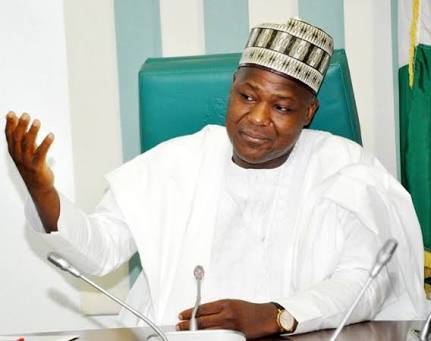
 Since the inauguration of the 8th National Assembly on June 9, 2015, events in the Federal legislature suggest that despite the All Progressive Congress (APC) majority, the main opposition, Peoples Democratic Party (PDP) has pulled it’s weight in ways unusual for a minority caucus.
The Peoples Democratic Party (PDP) held sway as the ruling party for 16 years but lost that status after the 2015 general elections where the All Progressives Congress (APC) won the Presidency and the majority in both the Senate and House of Representatives.
Although APC holds the majority status in the National Assembly, the sharing of committees in the House of Representatives suggests that PDP may be gradually taking over the green chamber, at least in its inner workings.
Recall that Senate President Bukola Saraki and Speaker, House of Representatives Yakubu Dogara both owe their seats to the bloc votes they got from the PDP lawmakers. Both leaders of the two chambers were not the preferred choice of their party, APC.
In the Senate, horse trading and high wire politics was the order of the day. Senator Saraki traded the position of the Deputy Senate President, which by convention, is for the majority party, to Senator Ike Ekweremadu, a ranking PDP Senator from Enugu State. That will be the first time such will happen since the country returned to civilian rule in 1999.
Last week, in the distribution of chairmanship slots, in the House of Representatives while APC caucus got 48 slots, lawmakers of the opposition parties will chair 47 committees – 45 for the PDP, and one each for the Social Democratic Party (SDP) and All Progressive Grand Alliance (APGA).
Many first-rate committees were allocated to PDP members and APC members loyal to Dogara. Supporters of the APC’s preferred candidate who lost the Speakership election Femi Gbajabiamila (now Majority Leader) were left with few and second-rate committees.
Now, Gbajabiamila’s group is poised for showdown with the Dogara-led House, signalling another round of crisis within the APC fold.
Traditionally, keenly sought after committees are: Petroleum Resources (Upstream); Petroleum Resources (Downstream); Appropriation; Finance; Communications; Power; Works; Customs; NDDC; Electoral Matters; Gas; Aviation; Baking/Currency; House Services; Water Resources; Agriculture; Education and Defence.
Some lawmakers retained the chairmanship of the committees they headed in the 7th Assembly. They include: Hon. Mohammed Tahir Monguno (APC, Borno) – Agricultural Production and Services; Hon. Aminu Suleiman (APC, Kano) – Tertiary Education; Hon. Nkiruka Onyejeocha (PDP, Abia) Aviation; Nnenna Ukeje (PDP, Abia) – Foreign Affairs; Jones Onyereri (Imo, PDP) – Banking and Currency; Shehu Shagari (Sokoto, APC) – Judiciary; Nicholas Mutu (Delta, PDP) -NDDC.
Some new members were named committee chairmen. They include Hon. Oladele Kayode (APC, Ogun) – Financial Crimes; Hon. Samuel Okon Ikon (PDP, Akwa Ibom) – Inter-parliamentary Relations; Hon. Timothy Golu (Plateau, PDP) – Legislative Budget and Research; and Hon. Abdulrazak Sa’ad Namdas (APC, Adamawa), among others.
Dogara’s allies that got juicy committees are, Hon. Abdulmumin Jibrin (APC, Kano) will chair the House Committee on Appropriation; Hon. Bashir Baballe Ila (APC, Kano) will chair the House Services Committee; Hon. Babangida Ibrahim (APC, Katsina) will head Finance Committee; Hon. Zakari Mohammed (APC, Kwara) will chair Basic Education and Services Committee while Hon. Jagaba Adams Jagaba (APC, Kaduna) is to head the Committee on Interior, etc.
Hon. Akinlaja Joseph from Ondo State (PDP), heads the Committee on Petroleum Resources (Downstream), while Hon. Victor Nwokolo from Delta State (PDP), is the Chairman, Committee on Petroleum Resources (Upstream).
The PDP’s Tobi Okechukwu from Enugu State, heads the Committee on Works, while another PDP member from Bayelsa State, is the Chairman, Committee on Gas Resources.
The PDP also heads the Committee on Army, Hon. Rima Shawulu (Taraba State); Committee on Air Force, Hon. Sampson Okwu (Benue State); and Committee on Aviation, Hon. Nkiruka Onyejeocha (Abia State).
The heading of committee termed juicy by the opposition PDP has drawn knocks and condemnation from a cross-section of Nigerians.
Recall that the APC clinched victory at the 2015 general election riding on the mantra of change despite PDP’s boast to rule for 60 years.
President Muhammadu Buhari, a serial contestant in the Presidential elections since 2003 emerged with the support of a coalition of political parties, APC.
Already conspiracy theories are being bandied about. With the sharing of committees in the House of Representatives and the grip of the PDP on the Senate, the question is, is PDP really out of power?.
Some political watchers have accused House Speaker Yakubu Dogara of sacrificing the interest of the APC to satisfy his former friends in PDP with 2019 in mind.
Others allege a sinister plan by PDP caucus to derail the developmental agenda of President Buhari by instigating crisis in the polity all in a plot to hijack power in 2019.
According to Abdullahi Haruna, a political commentator, PDP is not only rooted, the minority party holds the levers of power in both the Red and Green Chambers of the legislative arm of government.
In Haruna’s words: “They (PDP) took advantage of President Buhari’s golden resolve not to interfere in the matters that are exclusively the preserve of the legislature to railroad themselves into power in flagrant disobedience of what the national leadership of APC wanted.
“Both the President and APC were caught napping. And since it is democracy, where majority carries the day, in addition with the fact that the party has promised Nigerians not to behave the way PDP condoned impunity and executive rascality while in power, they decided to let sleeping dogs lie and allow Senator Saraki and Dogara be. The President had to make some sacrifice just to allow the country to move forward.
“As if the flagrant disobedience of the party’s directive was not enough, in the Constitution of the House Standing Committees, Dogara has taken the disobedience further by conceding most of the first-rate (juicy) committees to his PDP friends who made his ascent to power possible. Again, this is unprecedented in the country’s political history.
“It is against the background of the above that Nigerians must rise against these forces who are hiding behind one finger to derail the change agenda of the President. They don’t believe in the country’s development. They believe only in their pockets and those of their cronies.
“Well, if they succeed in making sure President Buhari loses focus, ordinary Nigerians will be the ones to suffer, much like the way they endured excruciating pains under the PDP in the last 16 years. The PDP are back again, but this time, they are wearing the pseudo-apparel of the change party, APC.”
‘Federal character’
On Monday, the House spokesman, Abdulrazak Sa’ad Namdas insisted that the selection of the chairmen and deputies of the 96 House Standing committees followed due process and was in line with the principles of the constitutionally-backed Federal character.
The newly-appointed Chairman, House Committee on Media and Public Affairs, justifying Speaker Yakubu Dogara’s appointment said aside 10 House principal officers, the remaining 350 House members got “at least two Grade A Committees”.
Pre-election agreements entered by Dogara with the opposition PDP caucus and some APC members before the closely contested June 9 speakership election shaped the composition of the 96 Standing Committees unveiled on October 22, 2015.
Namdas said: “The truth is that we (House) have 360 members, two presiding officers and 10 other principal officers. Ten are already out so we are left with 350 lawmakers.
“In sharing these committees, due process was actually followed. We statistically ensured that every member has at least two Grade A committees or what is general referred to as juicy committees.
“Part of the reason why we are doing this is to ensure that the leadership of the House runs an all inclusive administration with all Nigerians having a sense of belonging. We are having a pan-Nigeria situation. We want to ensure that all sections of the country and of all the parties are also carried along.
“This idea of saying certain people are not carried along is not true. All due process was actually followed. It is with fairness and the interest of Nigeria.”
Namdas said that certain committees like the Petroleum upstream and downstream traditionally went to the South. Likewise committees on Agriculture, Water resources and Education went to the North, he said.
“It is a convention and we will not change it and that is why this has been allocated to them. The leadership has done everything to meet up with Federal character and that is why I said that all sections and parties are carried along in this process so that legislative business will be carried on smoothly and the change mantra is there for us,” he said.
‘Cheap blackmail’
However, contrary to reports that Dogara sent a Letter of Invitation to Principal Officers for them to attend a meeting where their interests were reflected on the then proposed committee list, disclosures from some members loyal to Majority Leader Femi Gbajabiamia’s camp say the report is “cheap blackmail”.
“That Gbajabiamila attended and was party to the list ab initio is a cheap blackmail because the same persons who said so, were not confident enough to reveal that there was a communication from the Leader to the Speaker dated, October 20 and got the Speaker on October 21. And knowing the implications of content of that communication, a meeting of principal officers was hurriedly called by the Speaker on Oct. 22, 9.30am.” one of Gbajabiamila’s loyalist stated.
Documents emanating from Dogara’s office listed names of 21 members of the House from the Gbajabiamila camp formerly called the Loyalists Group, who got appointed as chairmen of committees with another 29 appointed deputy chairmen of committees.
Also, a letter of invitation sent to all Principal Officers of the House dated, October 21, 2015 by the Chief of Staff to the Speaker, Hon. Jerry Manwe, invited them to a meeting in order to “consult on appointment of committee chairmen” on Thursday, October 22, 2015.
According to the member who did not want his name mentioned, Dogara made his appointments prior to the meeting.
The source said: “The meeting called was not for Gbajabiamila to determine “who gets what” no matter how small. But to present the principal officers most especially Gbajabiamila, an already prepared Committee List and were merely asked to raise objection against any name they don’t want on the list, apparently to cause disaffection between the Leader, his APC loyalists, and members of the House.
“Because it’s not possible for the Leader to say remove this man and replace him with that man, and such affected member would ever see the leader as a good person.
“The essence of the so-called principal officers meeting on Thursday morning before the announcement in the evening was just to use their attendance particularly that of the House Leader to lend credence to “an already prepared list by the Speaker and his inner caucus.”
Rejected appointments
On Tuesday, two-term member of the House, Garba Mohammed Datti rejected his appointment as Chairman, House Committee on Solid Minerals. He was quickly replaced by Samaila Suleiman (Kaduna/APC).
Two days after, another House member Sunday Adepoju (APC, Oyo) resigned his position as deputy chairman of the Committee on Special Duties.
Datti, who was immediate past Deputy Minority Whip of the House said he was not consulted before being named.
Datti, a member of the APC from Kaduna State had during the plenary, presided by the Deputy Speaker Yussuf Lasun raised a point of order bothering on personal explanations to announce the rejection of his appointment.
The lawmaker who staged a walkout after the incident however explained that his action was not based on any grievances but on his “principled disposition”.
Meanwhile, the House spokesman Abdulrazak Sa’ad Namdas disclosed to newsmen that Datti has been replaced by Samaila Suleiman (Kaduna, APC).
“I feel as a former principal officer, I should have been consulted before my name was announced. I just heard of it on the floor. I have my own principles. I have decided on my own to withdraw as the chairman of that committee,” Datti told journalists outside the House chambers.
Datti continued: “I should have been consulted. If the president wants to appoint his ministers, I think before the announcement he has to consult them.”
He however expressed confidence in the Dogara-led leadership of the 8th House.
“I don’t have any qualms with the leadership as presently constituted, because the election was democratically done here. I am not against anybody but I am against the decision of coming to announce my name without consulting me. That is my reason,” he submitted.
House Speaker Yakubu Dogara on October 22 unveiled the headship of 96 Standing Committees. The Speaker gave the majority APC 48 chairmanship slots and the main opposition, Peoples Democratic Party (PDP) 45 seats, causing tension among members of the 360-member legislature.
On Monday, the House leadership insisted that selection of the chairmen and deputies of the Standing Committees followed due process and was in line with the principles of the constitutionally-backed Federal character.
APC loyalists maintain that the composition and quality of the headships of the committees was skewed in favour of PDP members, whose support helped Dogara become Speaker against Femi Gbajabiamila, who was supported by the party.
The Senate is set to announce its Standing Committees and its headship. Political monitors predict that the distribution will be similar to that of the House.
-Leadership


