NAJUC Lecture: Justice Bankole-Oki calls for urgent Judicial reforms
By Onyewuchi Ojinnaka
A former judge of Lagos State High Court, Justice Folashade Bankole-Oki (Rtd ) has advocated for urgent reforms in the Nigeria’s justice system, urging the judiciary, legal professionals, and the media to embrace technology, adopt international best practices, and engage public feedback to rebuild trust.
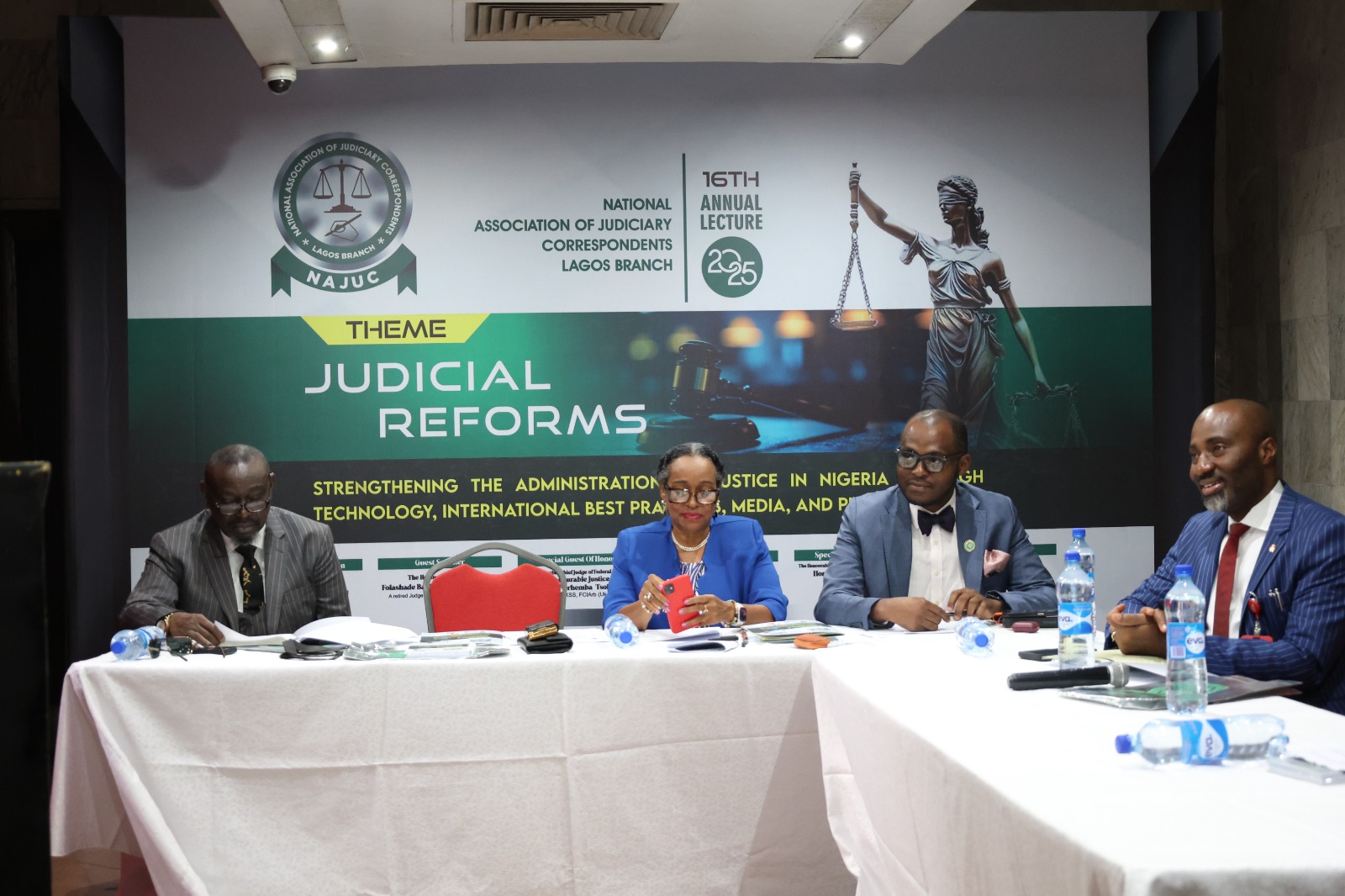
Justice Bankole-Oki was speaking on Thursday at the National Association of Judicial Correspondents (NAJUC) Annual Lecture in Lagos with the theme “Strengthening the Administration of Justice Through Technology, International Best Practices, Media, and Public Feedback,”
She held that NigerIa justice system urgently needs transformation.
“There is an urgent need to strengthen the administration of justice in Nigeria. Public trust has waned—and rightly so,” she stated.
She stressed that rebuilding this public trust is a shared responsibility among government, judiciary, legal practitioners, and especially the media. “Judicial correspondents bear a sensitive and essential role,” she said.
Justice Bankole-Oki highlighted the media’s vital role in protecting judicial integrity but warned that some regulatory measures, such as mandatory blogger registration, could threaten freedom of expression.
She canvassed for accurate and responsible reporting to avoid undermining and eroding public confidence.
She cited innovations in the Lagos State Judiciary, stating that wider adoption of virtual hearings, online dispute resolution, automated transcription, paperless trials, and e-filing should be put in place to tackle delays and backlogs.
The guest speaker called on the National Judicial Council (NJC) and state judicial commissions to drive policies which prioritise technological modernization, including securing digital evidence storage.
Speaking on artificial intelligence, she acknowledged its growing use in legal research and case management but cautioned against overdependence.
Justice Bankole-Oki charged judicial correspondents to maintain fairness and accuracy, warning against misleading headlines or biased narratives that could damage justice.
On whistleblowing, she urged for careful media verification and protection of whistleblowers, while cautioning against misuse.
“Technology, media, international benchmarks, and public feedback are no longer optional—they are essential for building an efficient, transparent justice system,” she concluded.
Also speaking, EFCC Chairman Ola Olukoyede lauded the media’s role in the fight against corruption. He called for courage, resilience, and unity in the ongoing campaign against corruption.
The Chief Judge of the Federal High Court, Hon. Justice John Terhemba Tsoho who was represented by Justice Ambrose Lewis Allagoa, urged stronger collaboration between the judiciary and judicial correspondents for accurate court reporting.
In his remarks, Justice Allagoa said that to report court judgements and proceedings accurately, reporters are free to approach the court registrars to get the proceedings or judgements of the court.
He urged NAJUC to properly identify its membership to avoid infiltrators into the profession who sit in comfort of their rooms and reports judicial proceedings based on hearsay without attending the court.
The Chairnan of the occasion Justice Taiwo Taiwo (Rtd) reaffirmed the need for judicial reforms to keep pace with AI and technological advances.
He commended the Chief Justice of Nigeria’s initiative to publish judicial nominees for public input as a transparency milestone.
The NAJUC chairman Olugbenga Soyele described the event’s theme as timely and essential for building a more efficient, transparent justice system with the media’s indispensable role.
The event was rounded up with an Award of Excellence to EFCC Chairman Olukoyede for his dedication to fighting corruption.