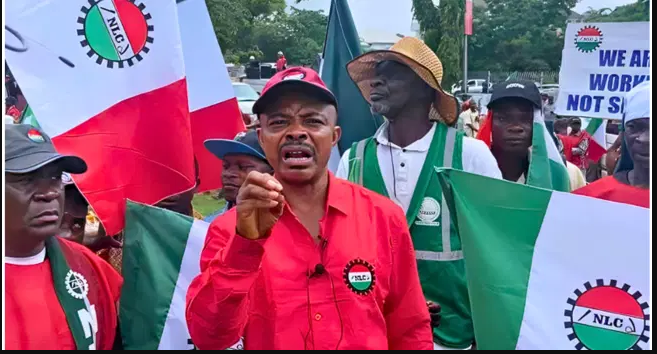
Minimum wage: Ajaero wants inflation, cost of living to determine new pay
By Eberechi Obinagwam
President of the Nigeria Labour Congress (NLC), Joe Ajaero, has said the next national minimum wage review must be guided by inflation, the value of the naira and the rising cost of living to ensure that workers’ earnings reflect prevailing economic realities.
Ajaero said negotiations should consider the cost of food, accommodation, transportation and other basic necessities rather than settle for figures that may quickly lose their purchasing power.
He spoke at the 2026 annual conference of the Labour Writers Association of Nigeria (LAWAN), held at the Golden Tulip Hotel, Airport Road, Lagos, on Friday.
Speaking on the future of workers’ welfare, the NLC president said preparations for the next minimum wage negotiation should commence ahead of the April 2027 review timeline.
He noted that the 2024 amendment to the National Minimum Wage Act reduced the wage review period from five years to three years, following the increase in the national minimum wage from N30,000 to N70,000.
According to him, the next wage determination must be informed by the actual cost of living and the economic conditions confronting Nigerian workers.
“It should not simply be a matter of proposing N50,000 or N100,000 without establishing what those amounts can actually purchase,” he said.
Ajaero said labour would consider inflation, the exchange value of the naira and the cost of essential services in arriving at its position, warning that approving a new wage without addressing its purchasing power could leave workers struggling shortly after implementation.
He said the objective should be to establish a wage that can reasonably meet workers’ basic needs rather than approve an increase that would quickly become inadequate.
The NLC president also revisited the transportation component of the previous minimum wage negotiations, saying government commitments to alternative transportation arrangements, including compressed natural gas (CNG)-powered and electric vehicles, had not been adequately realised.
He questioned the effectiveness of CNG buses distributed to organised labour, stressing the need for sustainable interventions to ease workers’ transportation costs.
Ajaero maintained that temporary financial relief could not replace lasting solutions to the economic difficulties confronting workers.
In his remarks, Comrade Rufus Olusesan, the National President of the Precision, Electrical and Related Equipment Senior Staff Association (PERESSA), called for greater accountability in the management of Nigeria’s oil revenue.
Olusesan alleged that the Federal Government realised more than N5.1 trillion in additional revenue from the increase in crude oil prices between March and April.
He said that crude oil prices rose from the budget benchmark of 68 dollars per barrel to between 109 and 110 dollars during the period, questioning how the additional revenue had been utilised.
Olusesan urged Nigerians to demand transparency and accountability in the management of public resources, saying that the country’s abundant natural and human resources required responsible leadership.
Also, Comrade Rufus Olusesan, the National President of the Precision, Electrical and Related Equipment Senior Staff Association (PERESSA), in his opening remark called for greater accountability in the management of Nigeria’s oil revenue.
Olusesan alleged that the Federal Government realised more than N5.1 trillion in additional revenue from the increase in crude oil prices between March and April.
He said that crude oil prices rose from the budget benchmark of 68 dollars per barrel to between 109 and 110 dollars during the period, questioning how the additional revenue had been utilised.
Olusesan urged Nigerians to demand transparency and accountability in the management of public resources, saying that the country’s abundant natural and human resources required responsible leadership.