By Emeka Alex Duru
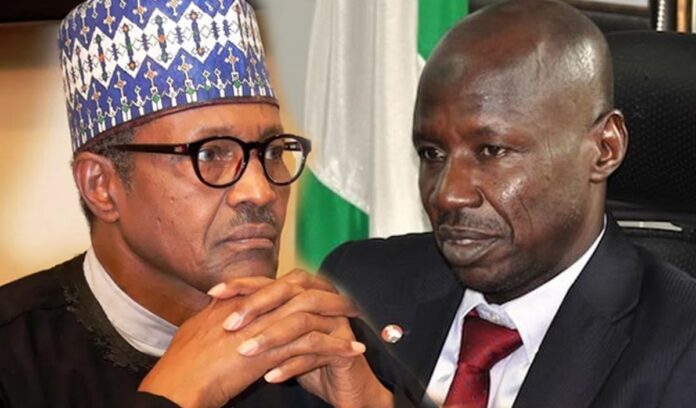
If the embattled Chairman of the Economic and Financial Crimes Commission (EFCC), eventually goes down in the current controversies surrounding his headship of the organisation, two major deductions will readily stand out. One, he has justified the allegations by critics that he lacks the integrity and credibility to head the anti-graft agency. It will also mean that the country’s touted battle against corruption, particularly under President Muhammadu Buhari, is a ruse and doomed. In any of the instances, Nigeria is the loser.
On Monday, July 6, 2020, Magu was drilled for six hours at the Presidential Villa, Abuja by a panel set up by the President on allegations of abuse of office and other charges. He was accused of living above his means, fraternising with corrupt persons, diversion of recovered funds.
Most of the allegations, it was learnt, emanated from a report by the Attorney-General of the Federation, Abubakar Malami (SAN), and a Directorate of State Services ( DSS) report which was submitted to the Senate in 2016 and 2017. Magu, a Commissioner of Police, is no stranger to controversies. On August 4, 2008, even before he was appointed to the EFCC chair, he was arrested following allegations that police discovered the Commission’s files and a computer containing classified documents at his Abuja residence.
A discordant Presidency
Since his appointment on November 9, 2015 in acting capacity, as replacement for Ibrahim Lamorde, he has been in the eye of the storm. Twice, the President had forwarded his name to the Senate, then led by Senator Bukola Saraki, for confirmation. On each occasion however, the lawmakers had turned down the request, explaining their action on a report from the DSS that had pronounced the acting chairman lacking in integrity required to head the organisation.
A 14-paragraph confidential report from the DSS had accused Magu of failing integrity test, stressing that if confirmed he could eventually constitute a liability to the anti-corruption drive of the administration.
The report, among others had alleged that Magu was occupying a N20 million per year accommodation, allegedly rented for him by someone under EFCC investigation. It further accused him of maintaining a flamboyant lifestyle and flouting the President’s order against public officers flying First Class when he went on pilgrimage. Magu however put a lie to the DSS report, insisting that neither his actions nor lifestyle had portrayed him as lacking in integrity. He rather threw back all the allegation of integrity deficiency on the DSS. Both the DSS and EFCC, incidentally report to the President.
With the Senate under Saraki, then seen as being at daggers drawn with the Executive arm of the government, Magu’s problem was seen from the angle of the lawmakers avoiding enthroning a monster that would devour them. But with the turn of things, the travails of the EFCC chair may not be issues of personality clashes between him and some National Assembly members, after all.
While the story of his ‘invitation’ by the DSS broke on Monday, Prof Femi Odekunle, a member of the Presidential Advisory Committee Against Corruption (PACAC), one of the anti-corruption agencies of the government, in what he referred to as preliminary reaction, explained the development as an “outcome of power-play by power blocs in the corridors of power in which Malami appears to be an arrow-head or major agent of a power bloc that is not really interested in, or in support of, Buhari’s anti-corruption fight”. The power play, he said, accounted for the non-confirmation of Magu by the parliament under Saraki as well as the non-resubmission of his name for confirmation since May, 2019 despite the apparent willingness of the 9th Assembly to consider it this time around. Odekunle claimed to be speaking for the committee. He was however countered by Aghogho Agbahor, Communications officer of the Committee, who accused him of airing his personal opinion. Thus, the indications of a fractured presidency continue to assume weights.
Whither Magu?
By Tuesday, July 7, 2020, the true status of Magu in driving the corruption war of the government remained hazy, with some demanding his suspension to give way for thorough investigations into the activities of EFCC under him. Former Deputy Director of DSS, Dennis Amachree, observes that the probe of the chairman of the country’s anti-corruption agency, gives cause for concern, adding that it is probable that the long arm of the law is at work. “It goes to show that nobody is above the law”, he said in a Television programme, adding that for Magu to be confronted with up to 22 allegations, he may have some problem.
Like Magu, like his predecessors?
If the Presidential panel indicts Magu and he is booted out of office, it would not come as surprise to informed analysts. In fact, in what is increasingly assuming a jinx, most, if not all the earlier heads of the commission, had exited in controversial circumstances. Magu’s predecessor Ibrahim Lamorde who was appointed acting chairman of the Commission by the Goodluck Jonathan administration on November 23, 2011, was booted out by Buhari in unpleasant manners, two years later. Lamorde succeeded Farida Waziri, who was appointed Chairperson in May 2008 by the late President Umaru Yar’Adua but was dismissed by President Jonathan. The pioneer chairman of EFCC, Nuhu Ribadu, who was appointed by President Olusegun Obasanjo, was removed from his post by Yar’Adua in December 2007, in breezy circumstances. Between the period of Ribadu’s removal and Farida’s appointment, Lamorde served in acting capacity. Allegations informing their unceremonious removal had always centred on abuse of office.
A Commission and its mission
Established under the Economic and Financial Crimes Commission (Establishment) Act, 2004, the agency has among other functions the investigation of all financial crimes including the advance fee fraud, money laundering, counterfeiting, illegal charge transfers, futures market fraud, fraudulent encashment of negotiable instruments, computer credit fraud and contract scam. It is also empowered to examine and investigate all reported cases of economic and financial crimes with a view to identifying individuals, corporate bodies or groups involved. It can also identify, trace, freeze, confiscate or seize proceeds derived from terrorist activities, economic and financial crime related offences or the properties the value of which corresponds to such proceeds.
On account of the initial success of the Commission in reining in advance fee criminals and scammers, it was generally seen as a bold move in tackling the incidence of crime that had dented the nation’s image locally and abroad.
With time however, especially, given the closeness of the successive leadership of the organisation to the administration in power and its perceived willingness to be used in executing vindictive wars of the president against opponents, EFCC gradually began to be seen as an instrument of blackmail and intimidation by the government of the day.
In the past, there were charges against officials of the commission on deviating from its original agenda in going about their briefs. There were allegations that EFCC officials in league with others in the larger society, arranged to possess the confiscated properties of convicts. The operatives were specifically accused of under-valuing the assets of convicts slated for public auction, and positioning their proxies to buy such properties. They were also accused of not remitting the full proceeds of the transactions. These are, incidentally, some of the allegations against Magu.