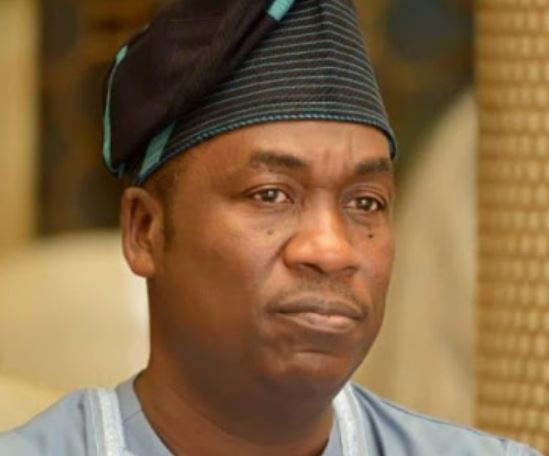
Hamzat advises workers earning N100,000 to live with parents to cut costs
Lagos State Deputy Governor, Obafemi Hamzat, has advised young workers not to feel pressured to immediately rent expensive apartments, urging them to consider living with their parents, relatives or in shared accommodation while building their finances.
Hamzat gave the advice during a question-and-answer session with Nigeria Info FM on Thursday while responding to concerns about how young workers earning low incomes could cope with rising rents in Lagos.
He was asked how a 22-year-old earning N100,000 monthly could afford a self-contained apartment or mini-flat costing about N1m annually.
Hamzat said young people should consider accommodation that reflects their income rather than trying to start from the top.
“Don’t let us misunderstand ourselves as a people. We are cultural people. Do you understand? So, if I start work as a young person and I’m not married, a lot of us live with our parents. A lot of us live with our cousins,” Hamzat said.
“You know, go to Turkey, for example, and see how young people also live.”
He said young workers should not feel compelled to immediately move into self-contained apartments if their incomes could not support such accommodation.
“So, if you don’t start from the top self-contained, you don’t start from the top. You start from the average depending on,” the deputy governor said.
Hamzat also said residents should not spend more than 40 per cent of their income on rent, noting that workers had other expenses to meet.
“In fact, if you spend more than 40 per cent of your income on rent, it is too high because you must eat, you must buy clothes, you must do transportation,” he said.
The deputy governor said the state’s housing strategy also involved making home ownership possible through mortgage financing, arguing that Nigerians could not continue to buy houses through one-off payments.
He said Lagos had a mortgage board to facilitate the system and that residents needed to be properly identified and assessed to determine their ability to repay.
“But, you know, the challenge is we cannot continue to buy houses the way we buy rice and yam. Do you understand? So, we must buy properties using a mortgage, and that’s why we have a mortgage board in Lagos,” Hamzat said.
He said the state was using the Lagos State Residents Registration Agency number to establish residents’ identity, address and place of work as part of the process of assessing their ability to obtain housing finance.
“So, that’s why we said people must have LASRRA number, so we can know that, okay, you live in Lagos. This is where you live. This is your address. This is where you work. So that there is a credit bill that checks everything that says, okay, you can pay,” he said.
Hamzat gave an example of a property costing N7m, saying a buyer could make a 10 per cent initial payment and spread the balance over 10 years.
“So, if a flat in Bisedi, which is seven million naira, you pay 10 per cent with 700,000, and over 10 years, you are able to pay monthly,” he said.
He added that monthly repayments could vary according to the buyer’s income.
“Some people pay 25,000 monthly or 35,000, whatever it is, depending on your income,” Hamzat said.
He said the mortgage model was necessary because many residents could not afford to pay the full cost of a property at once.
“That is the way to go because we know that a lot of people will not be able to afford to pay a one-shot deal,” he said.
The deputy governor said young people could therefore begin with smaller properties and gradually move towards home ownership as their incomes and savings improved.
“But the bottom line is, like I said, the culture of ability to save, so that if people see that you can save money, then I can give you a property.
“It doesn’t have to be, if you are a young person, you can start with one bedroom or even a self-contained, like you explained,” he said.
Hamzat, however, acknowledged that housing affordability was also dependent on the wider economy, saying residents needed better incomes to cope with the cost of living.
“What is important is we must also build our economy in such a way that people earn better, you understand, so that everybody can be uplifted, and that is the bottom line,” he said.
He said economic stability would make prices more predictable and help residents plan their finances.
“The cost of buying things is what we need to fix first, and then when we fix that, which is what the Federal Government is doing now, then we’ll be able to talk a lot more about other pillars that stop on top of that,” Hamzat said.
Lagos has previously promoted mortgage-based housing schemes, including LagosHOMS, which allows subscribers to own homes through rent-to-own arrangements, with payments spread over several years.
The state government has also identified mortgage financing and innovative financing mechanisms as part of efforts to make home ownership more accessible to residents.