



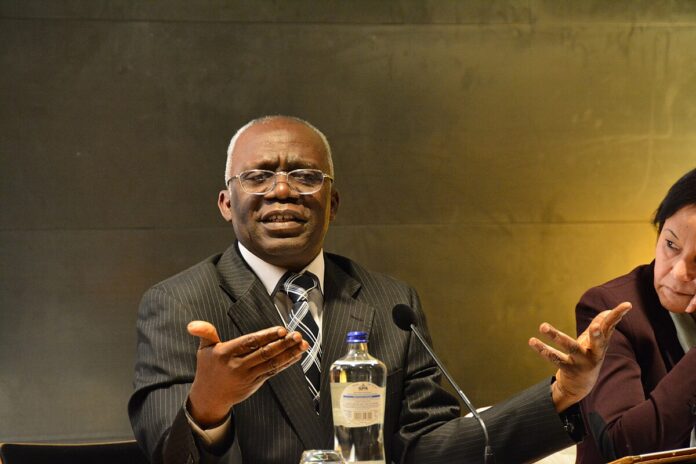
Falana says surprising Tinubu imposed on Rivers what he refused to accept, supported by Wike who also resisted it when he was Rivers Governor
By Jeph Ajobaju, Chief Copy Editor
Femi Falana has criticised Bola Tinubu for his declaration of a state of emergency in Rivers, saying the President is implementing a policy he refused to accept when he was Lagos Governor between 1999 and 2007.
The human rights lawyer bared his mind at the weekend at a webinar tagged, “Civilian Coup? Tinubu’s State of Emergency in Rivers,” recounting how Tinubu rejected such a pronouncement mooted by former President Olusegun Obasanjo, at the height of the O’odua Peoples Congress (OPC) crisis in Lagos.
He also expressed surprise that Federal Capital Territory (FCT) Minister Nyesom Wike, who equally resisted plans by former President Muhammadu Buhari to declare emergency rule the same Rivers during the 2019 general election crisis in the state, could support such a declaration now.
“One then wonders what has happened between then and now that these two individuals are now promoting those things they resisted and fought against, during their time as governors,” Falana said.
“I remember President Tinubu as Lagos State Governor, then, had threatened that Lagosians would reject any pronouncement of a state of emergency on the state by the then President, Olusegun Obasanjo, at the height of the OPC crisis.
“Besides, Wike was also at the forefront complaining against the use of federal might by the federal government, at the height of the tension induced by the 2019 elections Rivers.
“It’s quite a surprise that these two men are seen promoting what they firmly stood against, then.”
Falana also:
- Argued that while Tinubu as President has the right under Section 305 of the Constitution to declare a state of emergency, the right does not include the removal of elected officers of the state.
- Wondered where Tinubu derived his power to sack Governor Siminalayi Fubara when the Supreme Court recently pronounced as illegal the removal of some local government Chairmen and their Councillors by some Governors.
“It was even the federal government that took the case to court last year, and got a judgement.
“And part of the Supreme Court pronouncements was the instruction to the Central Bank of Nigeria (CBN) and the Accountant General of the federation not to release the statutory allocations to such states, unless their local government councils are properly constituted.
“So, if the Governor does not have the power to sack local government Chairmen, where is the President deriving his own power to sack the River State Governor from?”
Falana equally:
- Challenged his fellow lawyers who support the declaration of a state of emergency in Rivers to point out the section of the Constitution that empowers the President to sack state executives.
- Sought a critical look at Section 305 of the Constitution which provides four conditions under which the office of a Governor can be declared vacant, none of which empowers the President to carry out the task.
- Described as a mockery of democracy, the decision to ratify Tinubu’s pronouncement by voice votes in the two Chambers of the National Assembly (NASS).
- Said despite attempts by the government at painting a positive picture of its performance, genuine figures show a failing economy under Tinubu’s watch.
- Urged stakeholders to give as much prominence to discourses on the economy as on politics.
- Said this can be achieved by critically analysing the budgets of the sub-nationals, the way that of the centre is done, since activities at those levels have profound and lasting impact on the people.
Farooq Kperogi, a professor in America of Nigerian origin who hosted the event, explained that the webinar was designed to bring to light the key issue of constitutionality in the declaration of a state of emergency in Rivers and the sack of its elected officers
Read also:
Hilda Dokubo adamant death rumour won’t deter her “from speaking truth to power”


