Design Week Lagos: Turning African creativity into industry
By Eberechi Obinagwam
Nigeria’s creative industry does not lack ideas, talent or raw materials, but turning these advantages into commercially viable products and sustainable businesses remains a major challenge. At Design Week Lagos 2026, designers, manufacturers, financial institutions and international industry representatives examined what it would take to bridge that gap.
Held from October 18 to 25 under the theme “Making a New Africa: From Material to Market,” the festival brings together design, research, manufacturing and commerce, featuring more than 100 designers, studios and innovators across 58 countries.
Its programme includes 180 New Ideas, landmark installations, international research collaborations and the pre-launch of Design Museum Africa.
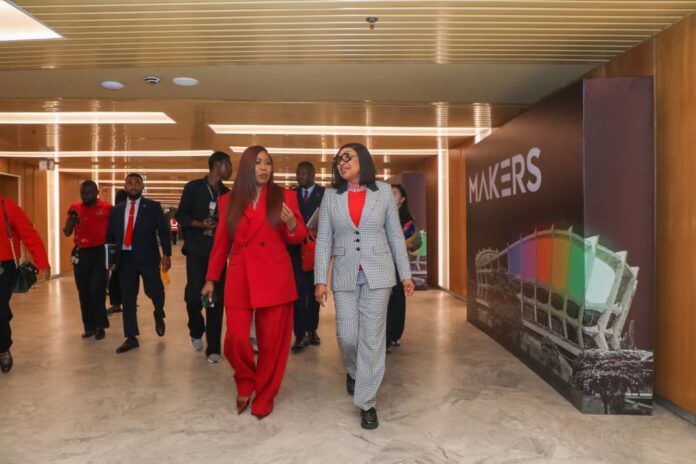
On Thursday, October 22, the festival held its Press Day at the National Theatre, Lagos. The programme featured a fireside conversation titled “Designing Africa’s Future” between Titi Ogufere, founder of Design Week Lagos, and Marva Griffin, Ambassador of International Relations for Salone del Mobile.Milano and Founder-Director of SaloneSatellite.
The day continued with a guided tour of exhibitions, installations, talks and special projects, followed by a press conference involving the leadership of Design Week Lagos and Salone del Mobile.Milano.
Beyond the displays and discussions, the festival focused on how African creativity and raw materials could be transformed into marketable products, sustainable businesses and globally competitive industries.
For Ogufere, founder of Design Week Lagos and the Interior Designers Association of Nigeria, the challenge goes beyond showcasing creative work. It involves building an environment in which designers can develop ideas into products that meet market needs and contribute to economic growth.
“The next chapter of African design cannot be about visibility alone,” Ogufere said. “Africa has extraordinary materials, knowledge, and creative talent.
The opportunity now is to transform those ideas into products, production, and industries, asking what Africa will make next, how we will make it, and how design can drive industrial growth across the continent.”
From creative talent to commercial success
Adaobi Stella Nwapa, Executive Director of Zenith Bank, spoke on the need to build businesses around creative talent during her keynote address on the subject, “From Craft to Commerce.”
She argued that talent alone was not enough to build a successful enterprise, adding that designers and makers also need business structures, financial records, pricing knowledge, effective teams and access to markets.
“Talent gets you noticed. The structure gets you financed,” she said, stressing the importance of turning individual creative efforts into organised businesses capable of growing and employing others.
Her argument pointed a recurring difficulty for small businesses, according to her, a good product does not automatically translate into a sustainable company, entrepreneurs must understand their costs, price their products properly, maintain reliable records and demonstrate how they intend to reach customers.
Nwapa outlined three areas through which Zenith Bank supports small and medium-sized enterprises: finance, business capacity and market access. These include financing options, business-development support and initiatives intended to help entrepreneurs improve their visibility and reach potential customers.
She also emphasised the importance of women-owned businesses, noting that female entrepreneurs need access to appropriate financing, mentorship and networks to help them scale.
A local design finding its way onto the waterways
One of the clearest examples of design moving beyond an idea came from Olumide Alake, a Research and Design Intern at Caverton Marine.
Alake described how he and his partner, Motolani Williams, won a competition to design a ferry for Lagos waterways. Their concept sought to reflect the identity of Lagos through the vessel’s form, colours and overall design.
The project subsequently progressed beyond the conceptual stage, with Caverton Marine and other collaborators involved in the development of the Omibus vessels.
Alake said the Electric Omibus 2.0 was currently operating, with trial testing conducted on routes from CMS to Falomo, Ikorodu to Falomo and other routes within the Lagos Green Corridor.
The project illustrates how a design competition can provide young creatives with opportunities to work with industry and contribute to practical solutions.
The experience reflects Ogufere’s argument that design education and industry collaboration must work together. Young designers need opportunities to take their ideas beyond exhibitions and into projects where they can be developed, tested and used.
Materials, innovation and the market
The commercial importance of materials was also evident in the exhibition by Arete Wood, whose founder, Uzo Obi, spoke about products supplied by the company, including boards used in furniture and interior applications.
The company showcased waterproof wall-cladding material and a new flooring collection, illustrating how material innovation can respond to changing consumer preferences and practical needs in homes and buildings.
Obi praised the exhibition for bringing together participants from different locations and giving visitors an opportunity to experience design products in one place.
The exhibition therefore offered more than a display of finished products. It provided a meeting point for businesses involved in the processes through which design ideas become usable, marketable goods.
Connecting African designers to global opportunities
The event’s international dimension was reinforced by the presence of Marva Griffin Wilshire, Ambassador of International Relations for Salone del Mobile.Milano and Founder-Director of SaloneSatellite, a platform known for supporting emerging designers.
Griffin Wilshire was among the honourees at the inaugural IDEA Honours ceremony, where she received the Architectural Legacy Honour for her contribution to international design. Ghanaian-Scottish architect and author Lesley Lokko received the Architectural Leadership Honour, while artist Yinka Shonibare CBE received the Cultural Impact Honour.
Speaking about the recognition, Griffin Wilshire said SaloneSatellite was established to give young creators opportunities to present their work, engage with industry and find partners willing to support their development.
She said her visit to Lagos provided an opportunity to discover African talent and help create conditions for young designers to establish themselves internationally.
The international engagement also offered opportunities for dialogue between African designers and global manufacturers. Marco Sabetta, General Manager of Salone del Mobile.Milano, said the exchange had given participating companies new perspectives on products and solutions.
“The competitiveness of design companies depends on their ability to interpret different ways of living, cultures, and needs,” Sabetta said. “Engaging with the Lagos community today provided our companies with invaluable new perspectives on products and solutions, while offering local talent direct access to international manufacturing expertise.”
The engagement suggests that international collaboration can benefit both sides: African designers gain access to manufacturing expertise and potential partners, while international companies gain a closer understanding of local markets, lifestyles and creative approaches.
Design Week Lagos has developed over several years through initiatives including the IDEA Awards, which began in 2012, and the Made by Design Show, introduced in 2016. Ogufere has also advocated for stronger design education and programmes that expose architects, engineers and other professionals to design disciplines beyond their formal training.
Some of the exhibitors whose products were showcased included Wood Line Trading, Cececa, Camargue Woven Textures, Precise, IO Furnitures and Shanghai Mitsubishi Elevator, among others.