



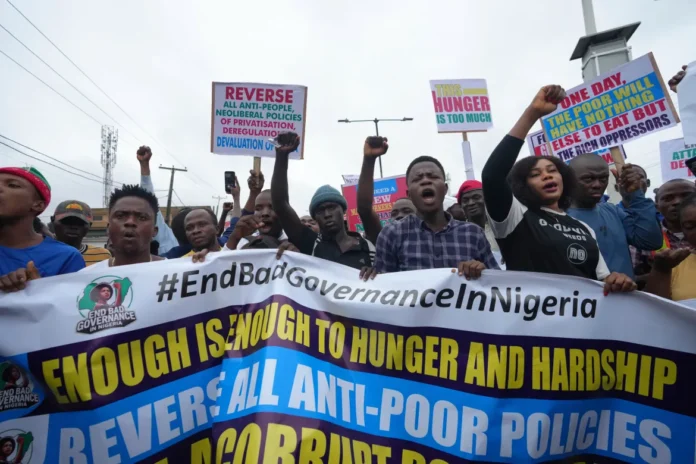
Amnesty International, RULAAC, S4C, #EndBadGovernance Movement condemned the alleged tracking and profiling of participants of the August 2024 protest by the tech firm CyberGlobes
By Ishaya Ibrahim
A report by Israeli newspaper Haaretz alleging that key participants in Nigeria’s 2024 #EndBadGovernance protests were tracked and profiled by Israeli surveillance firm CyberGlobes has drawn strong reactions from civil society organisations.
The report, titled “The Targets: Gay Men and Protesters. The Israeli Cyber Firm Quietly Arming Autocrats” and published on September 10, 2026, cites leaked internal documents allegedly showing that a CyberGlobes employee, Marc Leiba, conducted a series of searches linked to the 2024 #EndBadGovernanceInNigeria protests and exported the results to a folder titled “Nigeria – Demo, January 2025.”
According to the report, the leaked documents indicate that CyberGlobes’ software was used to collect and analyse social media data on protesters, political activists and regime critics in several countries, including Nigeria.
The leaked documents identify Nigeria as one of CyberGlobes’ projects and indicate that a company server has been installed in the country since 2023. They also identify the Nigerian government as a CyberGlobes client.
CyberGlobes did not deny working for the Nigerian government or the existence of the folder but described the report as distorted and misleading.
Amnesty International documented the use of live ammunition against #EndBadGovernanceInNigeria protesters and reported that security forces fired at demonstrators, including shots aimed at their torsos and, in some cases, their heads. At least 24 people were killed, according to the rights organisation, while thousands were arrested during the crackdown.
Dozens of #EndBadGovernanceInNigeria protesters, including children were later dragged to court and charged with controversial offences, including treason. The court later dismissed the charges due to lack of diligent prosecution.
Reacting to the latest report, Amnesty International Nigeria, the Rule of Law and Accountability Advocacy Centre (RULAAC), Spaces for Change (S4C) and the #EndBadGovernance Movement (Lagos chapter) condemned the alleged tracking and profiling of participants in the August 2024 protests.
Isa Sanusi, Director of Amnesty International Nigeria, described the alleged surveillance as part of a troubling global pattern.
“Increasing use of surveillance is perhaps one of the most dangerous approaches to undermining human rights,” he said, adding that the revelations show how far repressive regimes can go to suppress protests and human rights defenders.
Sanusi criticised the Nigerian government’s spending priorities, saying it was “a shame” that it was investing more in surveillance on citizens and activists, while healthcare, education and infrastructure suffer neglect.
He linked the case to a broader rise in state surveillance driven by the commercial spyware industry.
“Cases of governments snooping on activists have increased massively in the last decade,” Sanusi said, attributing this to more companies developing and selling spyware marketed as lawful interception technologies.
He faulted the absence of regulation, noting that there was no framework to prevent such misuse and no consequences when the technology is used to abuse the rights of activists.
Sanusi also questioned the government’s priorities. “When governments prioritise snooping on the people who are trying to defend our rights, clearly the government is not interested in the well-being of the people,” he said.
Victoria Ibezim-Ohaeri, Executive Director of Spaces for Change (S4C), cited research undertaken by Action Group on Free Civic Space titled Security Playbook of Digital Authoritarianism in Nigeria, to argue that surveillance of Nigerian activists and critics is not a secret.
She said that while federal and state governments procure such surveillance technology to curb terrorism and other crimes, the technology is diverted to spy on opposition politicians, journalists and activists.
Ibezim-Ohaeri cited another report, VICTIMS SPEAK: Tactics, Patterns and Impacts of Targeted Surveillance in Nigeria, which provided detailed accounts of 19 surveillance victims.
Recently, the organisation gathered activists and found that 14 of the 19 participants, most of whom were protesters, had their phones bugged with spyware.
She said the challenge stems from government requirements for telecommunications companies to have interceptable technology, meaning law enforcement agencies can access citizens’ private conversations.
She said that even though WhatsApp is end-to-end encrypted, the government uses external technology to access citizens’ private chats.
The bigger question Ibezim-Ohaeri posed to the Nigerian government was why it was not using these technologies to catch the terrorists making the country unsafe.
Okechukwu Nwanguma, Executive Director of RULAAC, said the fundamental issue was not that the government possesses surveillance capabilities but how they are used.
“Political association must never become evidence of criminal conduct,” he said, warning that mapping relationships between protesters risks conflating dissent with wrongdoing.
Nwanguma noted that the dismissal of treason charges against #EndBadGovernance protesters raised questions about whether legitimate protest activity was being interpreted through an excessively broad national-security lens.
He called on the Nigerian government to disclose which agency procured or operated the CyberGlobes technology, its legal basis, and whether it contributed to any arrests or prosecutions.
Hassan Taiwo Soweto, a committee member of the #EndBadGovernance Movement, Lagos chapter, described the revelation as “a shocking violation of the democratic rights of the Nigerian people”, linking it to what he called the Tinubu government’s alliance with CyberGlobes.
He noted that the protests stemmed from frustration with rising fuel and food prices, inflation, hunger and poverty and said it was the height of it all for a government that could not address those issues to contract an international spy agency to monitor citizens.
Soweto raised several questions he said needed answers, including how much Nigeria paid for the technology, how many people were spied on, what the harvested data was used for, and to what extent it contributed to the arrest, detention and killing of activists during and after the August 2024 protests.
He argued that surveillance of activists has a chilling effect on free expression, forcing self-censorship.
Calling the report a serious indictment of the government that should not be swept under the carpet, Soweto called on the National Assembly to investigate and urged the NLC, TUC and other civil society groups to speak out to expose the true extent of state surveillance on citizens.


