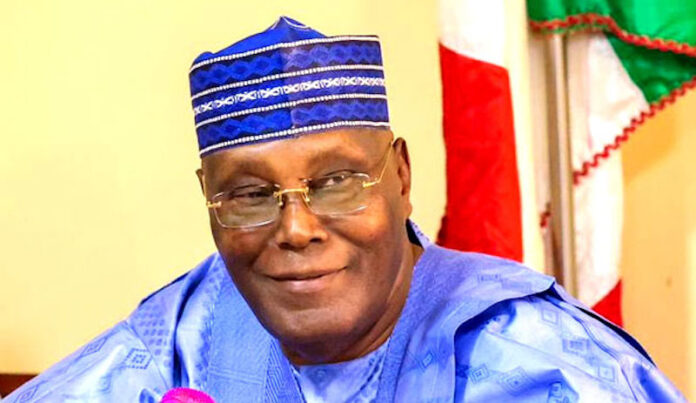
Atiku promising subsidy restoration because he’s desperate – Presidency
The Presidency has labelled the presidential candidate of the African Democratic Congress, Atiku Abubakar, as “desperate for power” for saying he would restore petrol subsidies if elected president in 2027.
In a statement Thursday issued by Special Adviser to the President on Information and Strategy, Bayo Onanuga, the Presidency said Atiku — who once argued for subsidy removal — has opportunistically recanted that position five months before the election.
It said: “Against expectations that he would announce a more creative and ingenious alternative to the programme being executed by the Tinubu administration, Atiku Abubakar behaved like a man from an archaic past who least comprehends the present economic dynamics and suggested that he would restore the much-abused, wasteful, pillaged, corruption-ridden fuel subsidy regime, which the Petroleum Industry Act made illegal from the end of June, 2023.
“Even though he used to believe that the subsidy regime must be eliminated, a point he canvassed in the run-up to his defeat in the 2023 election, he has now opportunistically recanted the major plank of his economic doctrine and turned a renegade.
“It is not difficult to explain why Atiku has latched onto the abandoned subsidy regime, five months to the election. Desperate for power, he needed to make a promise that he knew, if he were candid with our people, does not make fiscal sense, is retrogressive, and is against the genuine interest of the people.
“But before his suggestion hoodwinks the people, we must quickly subject the promise to a serious examination, especially in the context of Nigeria’s present economic and petroleum realities.”
It warned that restoring the old subsidy regime is neither simple nor cost‑free, describing the subsidy not as cash waiting in the Treasury but as the massive discounts previously absorbed by the NNPC — selling petrol far below cost and creating large unpaid liabilities still sitting on NNPC’s books.
The Presidency rejected Atiku’s claim of a N30 trillion windfall, calling it imaginary, and stressed that the Petroleum Industry Act (PIA) dismantled the subsidy framework and scheduled its removal by June 2023.
“First, we must clear some ambiguities about the so-called subsidy. It is not some money sitting in the treasury to be disbursed to offer cheap fuel to Nigerians. It is the massive discount the NNPC offered the Nigerian government: selling fuel it bought at N100 at N50 at the pump, leading to under-recovery of costs and massive losses.
“Somewhere in the NNPC books are still trillions of Naira in subsidy costs that the Nigerian government has not paid. Contrary to Atiku’s claim in his interview, no N30 trillion subsidy windfall or savings exists anywhere except in his imagination.”
According to the statement, President Tinubu said his administration only accelerated the timetable to stop further fiscal bleeding.
Restoration, the Presidency argued, would require major legal, fiscal and administrative changes and a credible funding source. It cautioned that the petroleum sector has changed dramatically since 2023: the emergence of substantial domestic refining capacity — notably the Dangote Refinery — has shifted Nigeria from heavy import dependence to local processing and even exports.
“Restoring the old arrangement therefore cannot simply be presented as a matter of announcing that government will once again pay part of the cost of petrol.
“It would require a clear legal, fiscal and administrative framework, including identifying the source of the funds and determining how such a policy would be implemented under the present petroleum-market structure.”
According to the statement, reviving the subsidy would undermine that progress, threaten smaller refineries, cost jobs, waste foreign exchange gains, and reverse recent gains that have improved state and local government revenues.
Onanuga pointed to fiscal benefits since subsidy removal, saying the funds once earmarked for petrol discounts have bolstered federal and subnational coffers and enabled record federation allocations. He warned that reintroducing subsidised fuel would again burden public finances through higher borrowing, reduced spending on infrastructure and social services, or diminished allocations to states and councils.
The presidency acknowledged the hardship that higher petrol prices impose on households and businesses, but urged policies that sustainably lower costs — such as wider adoption of compressed natural gas — rather than returning to an opaque, corruption‑prone subsidy system.
It called on Atiku and other political actors to provide full fiscal arithmetic and legal detail for any subsidy proposal: the annual cost, funding source, whether borrowing would be required, and how PIA and petroleum regulations would be amended and safeguarded against abuse.
Concluding, the Presidency invited robust policy debate but insisted it be anchored in the realities of today’s petroleum market, not the past. It warned that without clear answers, promises to restore subsidy risk returning Nigeria to hidden costs, rising debt and weaker public services.
“Nigeria cannot afford to return to policies whose costs are hidden from citizens until they appear later as debt, reduced government spending on social services, and further pressure on the national currency.
“The country should welcome robust debate about the cost of living and the direction of economic policy. But that debate must be anchored in Nigeria’s reality today, not yesterday’s petroleum economy,” the statement said.