Atiku alleges plot to disrupt ADC campaign in Sokoto, vows resistance
Former Vice President Atiku Abubakar has accused the Sokoto State Government and security operatives of working to frustrate the African Democratic Congress (ADC) campaign in the state, alleging that protesters were being mobilised to disrupt the party’s planned rally.
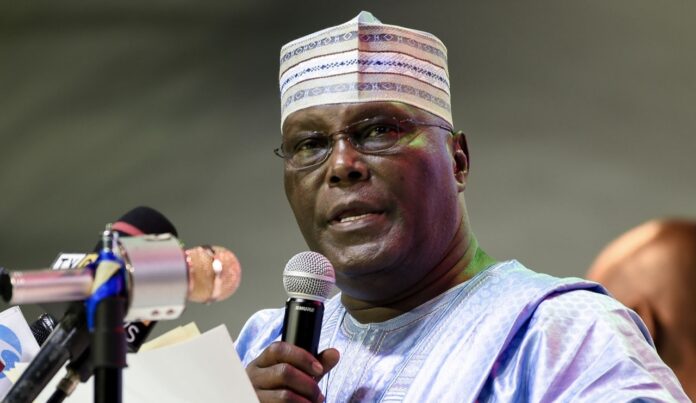
Atiku, the ADC presidential candidate, made the allegations at a news conference in Abuja on Tuesday, claiming that the party had been denied access to public facilities and logistical support ahead of the rally.
He said the restrictions were part of a deliberate effort to place the opposition at a disadvantage and undermine the right of Nigerians to freely choose their leaders.
“These are not harmless administrative delays. They are deliberate attempts to deny the ADC a level playing field,” he said.
Atiku also alleged that the Department of State Services (DSS) was recruiting protesters to cause disturbances and create a situation that could be used to impose a curfew and prevent the rally from taking place.
He identified an office behind Zenith Bank on Koko Road as one of the locations where the protesters were allegedly gathered.
“We know where some of these protesters are assembled: an office behind Zenith Bank on Koko road.
“Trucks are stationed there and dispatched to key points, including the roundabout. These mobilised protesters are causing gridlock.
“Commuters are being threatened and, in some cases, beaten. Some of the protesters have moved away from the roundabout to find shade,” he said.
The former Vice President accused security personnel allegedly involved in the operation of abandoning their professional duties for political interests.
“This is not intelligence work. It is political interference dressed in official uniform. Security agencies exist to protect Nigerians and uphold the law, not to recruit protesters or help a political party manufacture a crisis,” he said.
He asked the officers involved to end the alleged mobilisation and discharge their duties without political bias.
Turning to the wider political climate, Atiku accused President Bola Tinubu’s administration of attempting to weaken opposition parties by drawing their members into the ruling APC.
He described the strategy as one of political absorption and intimidation, warning that its ultimate objective was to leave Nigeria with little meaningful opposition.
“The aim is to reduce Nigeria to a one-party state in all but name,” he said.
Atiku also faulted the Federal Government’s handling of the economy, pointing to the rising prices of food, transport, fuel and electricity as evidence of the pressure on households.
He said the ADC would pursue policies aimed at expanding local production, increasing food supply, generating employment and lowering the cost of doing business if elected in 2027.
Among his proposals is a targeted production subsidy linked to fuel refined in Nigeria. He said the measure would ease the burden on consumers while supporting domestic industry.
The ADC candidate further alleged that the APC had turned to intimidation following what he called a disappointing turnout at its most recent rally in Kaduna.
“The more this government tries to silence the people, the clearer it becomes that it has already lost their confidence,” he said.
With the 2027 elections approaching, Atiku described the contest as a critical test of the country’s democracy, framing it as a choice between the Tinubu administration, which he accused of disregarding Nigerians’ hardship, and those seeking a change in direction.
He maintained that the alleged obstacles would not stop the ADC from campaigning and said he would personally attend the Sokoto rally on Wednesday.
“Our campaign will proceed, and I will be in Sokoto tomorrow, God willing, to address the good people of the state,” he said.
He asked residents to avoid violence and urged security agencies to ensure the safety of people going about their daily activities as well as those attending the rally.
Atiku also cautioned that any security officer found to have participated in efforts to restrict political activity would face accountability under the law.