By Emeka Alex Duru
The argument among critics is that the Igbo rarely speak with one voice on an issue. That is debatable, some say.
With a republican order that encourages everyone to take a stand on a trending matter before a consensus is arrived at, the people, have largely been misunderstood, or seen as being disorganized or regularly in opposition with one another.
But perhaps unknown to these outsiders, it is this essentially village square orientation that brings out the best in the people that place much premium on the interplay of ideas before arriving at an agreement.
With the arrangement which thrives on the principles of consultation, compromise and consensus, the Igbo, to the surprise of the neighbours, have always stood to be counted when it matters most.
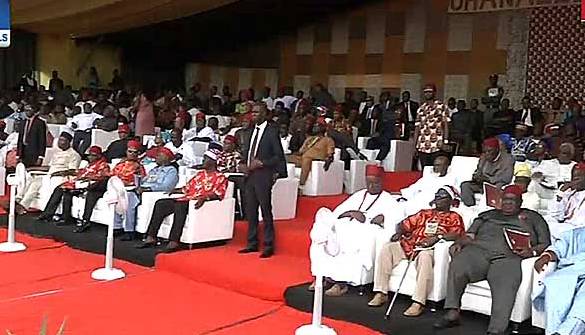
That was the spirit at play, in Awka, Anambra State, on Monday, May 21, 2018, when the Igbo, under the aegis of Ohanaeze, the apex Igbo socio-political organisation, made a strong demand for a restructured Nigerian nation.
At the well-attended forum, the people put forward a 14-point agenda that a restructured Nigeria should come on stream with.
They include;
A National Conversation; A New Constitution; A Convocation of a Constituent Assembly; A six-year tenure for the president; 5 Vice Presidents from the geopolitical zones other than the zone that produced the president; Each of the VPs must holding key ministries; Rotation of the president among the six geopolitical zones and Scrapping of Local Government System.
They also demanded, Creation of additional state for the South East; Total resource control by the federating units; Devolution of powers to federal units; Federal units to create Appeal and Supreme courts; Elections within regions and states as federating units to be conducted by the region’s election body and Scraping of state of origin to state of residence.
They vowed to keep pushing for a restructured Nigeria.
Of course, they have reasons to clamour for a restructured entity anchored on equity and justice. For a people that seem to have been consigned to the back waters of Nigeria’s politics, the Igbo have regularly complained of exclusion in the scheme of things in the country.
Their complaint takes root from abandonment of the key elements of the principles of reconciliation, reconstruction and rehabilitation, enunciated by the Federal Government at the cessation of the civil war in 1970.
With sad reminders of the war in the south east, occasioned by dilapidated infrastructure and near absence of federal government presence, the people have been crying marginalisation in the hands of successive administrations in the land.
This incidence of marginalisation, perhaps, becomes more manifest in the number of states in the zone. While others have six states, with the North West, having seven, south east has five states. What this means is that while other geo-political zones have 18 senators each, and the North West, 21, the south east, has 15.
The imbalance resonates in the House of Representatives, and number of local governments in the states.
For instance, the number of local government areas in the entire five states of the south east, which stands at 95, is fewer than the figure in the three states of Kano, Katsina and Jigawa (North West), that is 105.
In a situation where resource allocations are based on council ratio, therefore, the south east, will continually be at a disadvantage.
This is in spite of the contributions of indigenes of the zone in the socio-economic development of the country.
The people are therefore clamouring for a just federation that will enable them reap from their endeavours.
Incidentally, other Nigerians had made case for a restructured entity even before now. Among these were former military president, General Ibrahim Babangida and former Vice President, Atiku Abubakar.
Babangida had argued the Nigerian federation, as currently structured, is in need of reforms that will emphasise the individual strength and advantages of the component units so that governments can really work to improve the lives of the citizens.
He said; “If we have repeatedly done certain things and not getting the desired results, we need to change tactics and approach, and renew our commitment. It is our collective responsibilities to engender a reform that would be realistic and in sync with modern best practices.
“For example, restructuring has become a national appeal as we speak, whose time has come. I will strongly advocate devolution of powers to the extent that more responsibilities be given to the states while the Federal Government is vested with the responsibility to oversee our foreign policy, defence, and economy”.
He stressed that though restructuring and devolution of powers may not provide all the answers to Nigeria’s developmental challenges, the exercise will help to reposition the mindset of Nigerians as they generate new ideas and initiatives that would make the union worthwhile.
Atiku, who had earlier spoken on the issue, had made suggestions that involved changes to the allocation of powers, responsibilities and resources among the states or zones and between them and the federal government.
He particularly called for devolution of more powers and resources from the federal government as well as de-emphasizing federal allocations as the source of sustenance of states.
Remarkably, erstwhile Vice President, late Alex Ekwueme, had actually laid a foundation that could have given form to a restructured country, if his contributions at the1994-1995 Constitution Conference that gave birth to the present six geo-political structures had been properly implemented.
Ekwueme, had on basis of economic, political, social and consanguine considerations, recommended structuring the country into the South East, South West, South-South, North West, North East and North Central zones.
Not even his critics could fault the fantastic idea, especially on the ease of administration and political convenience it offered.
Regional groups such as Afenifere and South South leaders have made similar demand.
The case against the existing arrangement is that it is skewed in favour of some parts, against the others.
It is also seen to be encouraging indolence and dependency among states, especially with the governors running to the centre at the end of the month for the so-called federal allocation.
This, it has been argued, has prevented the governors from thinking inwards on ways of generating revenues for administering the states.
With the galvanization of individual opinions on the issue and other topics at the Igbo Summit therefore, the expectation is that the National Assembly, which had not given the matter serious attention when it earlier came up at the constitution amendment debate, would take another look at it.