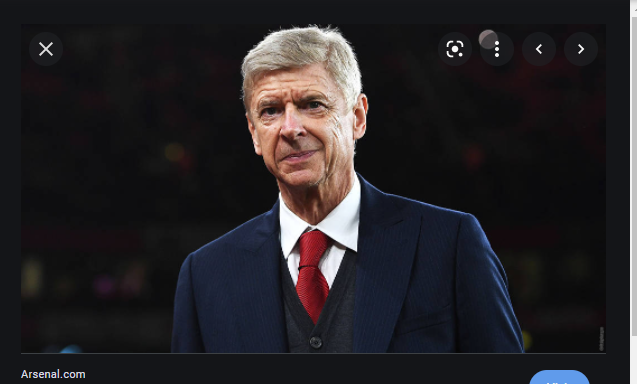
Arsene Wenger looked back at his stay at Arsenal and concluded he should have left the club when Stan Kroenke bought it over
By Kehinde Okeowo
Arsenal’s most successful manager in history, Arsene Wenger, has openly admitted that he stayed longer than required at the club.
The 72-year-old Wenger, who was eventually sacked after 22 years in the saddle, rejected job offers from some of the biggest clubs in the world.
His sack came in 2018 after the club’s supporters demanded his removal, following the dwindling fortune of the iconic North London club.
Also Read: Kurt Zouma’s header ends Liverpool’s 25-game unbeaten run
According to The Sun, Arsene Wenger expressed this feeling in a new documentary that was released this week.
The former Gunners boss expressed regret for not taking other opportunities that came his way while at the club and attributed his decision to his love for the club.
He also revealed that these offers came from within and outside England and that various Football Associations (FA) contacted him to take charge of their national football teams.
When speaking, Wenger said: “I should have gone somewhere else. My fatal flaw was that I loved too much where I was.
“I identified myself completely with Arsenal and that was the mistake I regret. But now there is no special reason for me to go there.
“I could have gone to the French national team, the English national team three times, I could have gone twice to Real Madrid, to Juventus, Paris Saint-Germain, and even to Manchester United.”
The gaffer opined he had mixed reception while at the club and concluded that no matter one’s love for a club, leaving it, always ends with a sad story.
He recalled: “It’s the end of your life, like a funeral. On the day everyone is nice to you and one week before you have to face a lot of criticism.
“I managed to control my emotions but, of course, the end of a love story is always sad.”
Wenger admitted his obsessive nature worked against him, as he finally faced up to the reality of his solitary existence.
He said: “The meaning of my whole life was football and sometimes I’m afraid to acknowledge it.
“I am a hermit. I lived in a bubble, my little triangle of the home, training center, and football stadium.
“I have the addiction gene and when you have that you don’t develop some of the aspects of your personality that y,ou should”
Arlene Wenger revealed that he would have loved a bigger family but appreciated having his only daughter by his side, he also expressed his hatred for losing games.
“I feel guilty because my passion created selfishness. My passion for football made me not take enough care of the people around me.
“I would have loved to have had a bigger family and now I am so grateful to have my daughter.
“I try to repair things but this desire not to lose makes you inhuman and destroys part of you.
“Women kill for love and men kill because they hate to lose. I meet many huge champions and they only talk about what they lost.
“Success is easy to absorb but the defeat remains forever. It hurt so much when we lost that sometimes I threw up.”
Wenger, who is now the head of global football development for Fifa saw cracks develop at the club when power play began at the board of the club.
He also attributed the problems of the club to the financial constraints that came with the decision to move from Highbury to the Emirates Stadium.
“I could see that it would be more difficult because we started with a project of £200million, which we could afford, and finished at £428m.
“The decisive point was 2007. It was the first time I could feel tensions in the boardroom because David Dein had an agreement to bring in Stan Kroenke and I was torn between being loyal to the club and being loyal to David.
“That’s when I thought I had to go, to the end of the project, but I still wonder if I did the right thing because life was never the same.
“Once we moved to the new stadium, we moved from first or second place to third or fourth and we lost our best players.
“Before we lost the players at 30 years plus. Afterward, we lost them at 25.
“So to work with restricted resources and still keep the club at a level where we could pay our debts, from 2006 to 2015, think I did my best job.” Arsene Wenger said.
The interview was conducted in the company of former Arsenal greats Dennis Bergkamp, Patrick Vieira, Thierry Henry, Martin Keown, and Lee Dixon, he also discussed his arch-rival and managerial nemesis, Sir Alex Ferguson in the documentary.
,