Aiyedatiwa’s flyover: The legacy project set to transform Akure
By Kikelomo Isijola
There are moments in the life of a city when a government makes a decision that goes beyond solving today’s problem. It makes a decision that prepares the city for tomorrow.
For Akure, the official flag-off of the 2.38-kilometre flyover along the Oyemekun – Oba Adesida corridor is one of those moments.
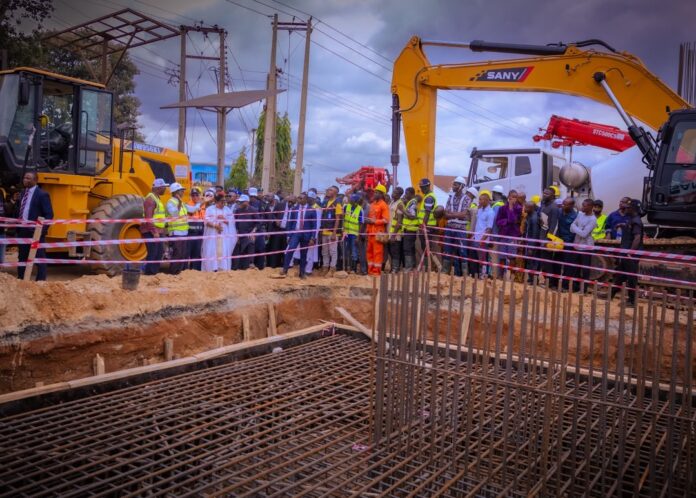
On Monday, 24th August, 2026, Governor Lucky Orimisan Aiyedatiwa formally commenced the project, connecting Adegbola Junction to St. Mathias/NNPC Filling Station in Alagbaka, through a flyover. It is a bold intervention in one of the busiest and most important corridors in Ondo State’s capital.
And there was something deeply encouraging about the atmosphere at the flag-off.
The excitement was not confined to government officials. Traditional rulers, community leaders, residents and other stakeholders came together to witness the beginning of a project that directly addresses a challenge they have lived with for years.
For the people of Akure, traffic congestion is not an abstract statistic. It is the time lost on the road. It is the fuel consumed while vehicles remain stuck. It is the trader struggling to move goods. It is the worker trying to get home. It is the student rushing to school. It is the business owner waiting for customers. It is everyday life!
Governor Aiyedatiwa understands this reality. That is why this project is particularly significant.
The Commissioner for Infrastructure, Lands and Housing, Engr. Abiola Olawoye, explained that the road is currently operating at about 50 per cent above its original design capacity.
That single fact tells the story of a city that has outgrown infrastructure designed for a different era.
The Ojaoba–Adesida Road was constructed around 1974 as a major township road in the then Western State and converted to a dual carriageway in 1978. It was expanded from 7.3 metres to 9.3 metres in 2001.
But Akure has continued to grow.
Population has increased. Businesses have expanded. Vehicle movement has multiplied. Yet the corridor has not received a major intervention capable of responding to this new reality.
Rather than continue to manage the problem with temporary measures, the Aiyedatiwa administration chose a lasting solution.
The state government examined several options before settling on the flyover as the most practical approach. It is a decision that also avoids the extensive demolition of properties that would have accompanied major conventional expansion.
The proposed structure will be approximately 2.4 kilometres long, including a 320-metre starting ramp and a 200-metre ending ramp, giving a combined ramp length of about 520 metres.
But the real numbers that matter are not the metres of concrete. They are the hours of human time that will be saved.
Think about a mother taking her child to school.
A businessman moving goods across the city.
A commercial driver trying to complete another trip before the end of the day.
A civil servant rushing to work.
A patient being taken to hospital.
A trader whose customers need easy access to the market.
For all of them, better traffic flow means a better day.
When completed, the flyover is expected to reduce congestion, improve journey times, lower vehicle operating costs and make movement across one of Akure’s busiest corridors significantly easier.
But the benefits will go beyond traffic.
Efficient mobility supports commerce.
When goods move faster, businesses operate better. When customers can reach commercial centres more easily, businesses have greater opportunities to grow. When workers spend less time in traffic, productivity improves.
That is how infrastructure becomes economic policy.
The flyover is also part of Governor Aiyedatiwa’s broader infrastructure agenda. His administration has completed several road projects across Akure, including Ajegunle Road, Odopetun–Oke Padi–Lao Road, Gbangbalogun–Odole–Odi Olowo Road, Bye-pass–Gbogi Street, UBA Road–The Stream in Alagbaka, Oja Oshodi Road, SK Bright Road, Ayeloro Road, Akosile Road, Maronu Road, Plaza Road, Bishop Court–Civil Service Commission Road, Site–Government House–CBN Road and Igoba Road.
Interventions have also been completed in Ajipowo Estate, Afunbiowo Estate and along the Alagbaka Extension–SIB Road.
Across the Central Senatorial District, work is ongoing on major corridors such as the 15.5-kilometre Imafon–Danjuma Road, 10-kilometre Oke Aro–Idanre dual carriageway and 7.7-kilometre Akure–Ijare Road.
Other projects are progressing in Oba-Ile Housing Estate, around the Ondo State University of Medical Sciences, Ijare, Igbara Oke, Ilara Mokin, Ondo West, Idanre, Akure South and Ondo East.
Governor Aiyedatiwa’s approach is to see infrastructure not as isolated projects, but as a network that connects communities, unlocks economic opportunities and makes life easier for citizens.
The response from the traditional institution was equally significant.
The Deji of Akure, Oba Aladetoyinbo Ogunlade Aladelusi, commended Governor Aiyedatiwa for the flyover and the reconstruction of adjoining roads, noting their importance in improving movement and addressing challenges along major corridors.
The Secretary to the State Government, Dr. Taiwo Fasoranti, who is a son of the soil expressed the appreciation of Akure residents for the projects being executed in the city and across Ondo State.
These expressions of support underscore something important- this is a project the people want and need.
The contractor, Bulletin Construction Company, has also accepted the responsibility that comes with such a major undertaking.
Its Managing Director, Chief Faysal Harb, assured the governor that the company would not disappoint.
Recalling the company’s involvement in the expansion of Ilesha Garage Road about two decades ago, Harb said the flyover represents the company’s second major project in Ondo State.
He promised timely delivery and adherence to specifications, while assuring residents that the company would work to minimise disruption during construction.
“We work day and night to make sure we deliver this project,” he said.
Because Governor Aiyedatiwa has not simply flagged off a project, he has placed his administration’s credibility behind it.
Ultimately, the Adegbola – Oba Adesida – Alagbaka flyover has the potential to become one of the defining projects of Governor Lucky Aiyedatiwa’s administration.
A governor’s tenure is measured in years. A well-built bridge can serve for decades.
Long after today’s ceremony, people will drive across this structure. Traders will move goods. Businesses will welcome customers. Workers will commute. Students will travel. Families will save precious time.
That is the beauty of infrastructure – it speaks through the lives it touches.
Governor Aiyedatiwa is therefore not simply constructing a flyover. He is investing in Akure’s future and making a deliberate statement that the state capital must have infrastructure that matches its growth, ambition and economic potential.
For a government committed to purposeful development, this is what leadership should look like: identifying a challenge, listening to the people, choosing a practical solution and having the courage to deliver it.
Ultimately, the true measure of Governor Lucky Orimisan Aiyedatiwa’s leadership will not be found only in the speeches delivered or ceremonies held, but in the enduring difference his decisions make in the lives of the people.
The Adegbola – Oba Adesida – Alagbaka flyover is one of those decisions.
It is a response to a growing city, a solution to a daily challenge and, more importantly, an investment in the future of Akure. When completed, its impact will be felt not only by those who use the corridor, but by traders, businesses, families, workers, students, investors and generations yet unborn.
Years from now, the political moment may have passed, but the structure will remain. People will drive across it, businesses will thrive around it, and residents will enjoy the mobility and opportunities it creates.
That is the essence of a lasting legacy.
Governor Aiyedatiwa is not simply constructing a flyover; he is building a bridge between the Akure of today and the Akure of tomorrow.
And when the story of Akure’s transformation is eventually written, this landmark project may well stand as one of the clearest chapters of the Aiyedatiwa years – a visible testament to a leadership that saw beyond the present, acted with purpose and dared to build for generations.
Aiyedatiwa’s legacy is not just being spoken about. It is taking shape in concrete, steel and the renewed hope of the people.
Hon. Kikelomo Isijola is the Special Assistant to Gov Aiyedatiwa on Digital Media