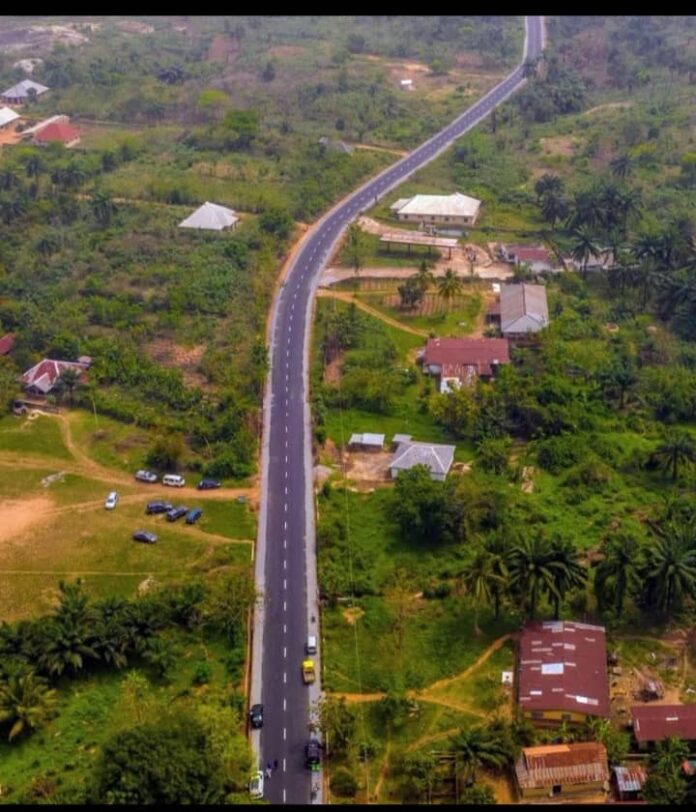
Aiyedatiwa’s first year road revolution maps growth and connectivity across Ondo State
By Julius Alabi, Akure
In a state where road infrastructure has long shaped the rhythm of commerce, mobility and rural access, the first year of Governor Lucky Orimisan Aiyedatiwa has unfolded as a deliberate attempt to redraw Ondo’s development map through an ambitious spread of road projects.
From the riverine corridors of Ilaje to the agrarian belts of Akoko and the fast-expanding capital city of Akure, the administration’s footprint is visible in a mix of commissioned roads, ongoing constructions and newly approved projects.

At the heart of this push is the “OUR EASE” policy framework, designed to deepen infrastructure, stimulate economic activities and improve access across the state’s three senatorial districts.
Marking his first anniversary in February 2026, Aiyedatiwa commissioned a wide range of road projects cutting across urban and rural communities.
In Akoko South-West, the Aiyegunle–Iwaro Oka Road—stretching about six kilometres—now serves as a critical route for heavy-duty vehicles, particularly boosting agricultural transportation in the area.
Owo township witnessed a cluster of interconnected road upgrades, including Opomulero, Iselu and Isuada roads, alongside Falodun, Kajola and Adelami roads. The projects collectively improve inner-city mobility and ease traffic flow within the ancient town.
Across Akure metropolis, infrastructure expansion took centre stage with the commissioning of the 5.5-kilometre Igoba Township Road and the Alagbaka Extension Road, alongside several inner roads such as Gbangbalogun–Odole–Odiolowo, Lao–Oke Padre–Odopetu and Oja Oshodi corridors. These projects are gradually redefining connectivity within the state capital and linking emerging residential zones.
In the southern senatorial district, a six-kilometre NDDC road in Igbokoda was delivered, while multiple roads in Okitipupa and Irele ranging from Onaopemipo and Adeyemi roads to Mobayode Street and Luwa Road, received rehabilitation and upgrades, improving access in coastal and semi-urban communities.
Earlier in May 2025, the administration had also completed the rehabilitation and asphalt overlay of Stadium/Hospital Road in Ondo City, reinforcing its urban renewal efforts.
Beyond completed projects, several large-scale constructions are underway, signalling a longer-term vision for the state’s transport network.
In Ilaje Local Government Area, work is progressing on an 8.5-kilometre dual carriageway stretching from College Road through Okoga Junction to Irewole Roundabout—a project expected to significantly ease movement within the oil-producing axis.
Akure and its environs are also witnessing major interventions, including the ongoing construction of a flyover and junction improvements around the Onyeagbulem–Shagari/Irese corridor. The Oluwatuyi/Ijoka dual carriageway and the 7.8-kilometre Akure–Oda Road project further underline efforts to decongest traffic and support urban expansion.
Other strategic projects include the Akure–Idanre road dualisation, Akungba–Ikare road expansion and the long stretch of Ode Ajagba–Akotogbo road, all aimed at strengthening inter-city connectivity.
The administration’s infrastructure drive extends beyond current construction sites. In late 2025, the State Executive Council approved over 101 kilometres of new road construction and rehabilitation, a move that signposts an aggressive pipeline of future projects.
Complementing this is the “18 LGA initiative,” which provides for at least five kilometres of road construction in each of the state’s 18 local government areas, an approach intended to ensure equitable distribution of development.
Among the notable upcoming projects are the Akure–Oke Aro–Idanre road, Agbaluku–Imo road in Arigidi Akoko and township road improvements in Supare.
Taken together, the projects reflect what government officials describe as an “18-0” development approach, an effort to touch all local government areas while targeting about 60 kilometres of roads across senatorial districts in phases.
More than a compilation of road projects, the unfolding infrastructure push signals a broader attempt to reposition Ondo State’s economy through improved logistics, easier market access and enhanced rural-urban integration.
As the administration moves beyond its first year, the true measure of these roads may lie not just in kilometres completed, but in the economic corridors they unlock and the communities they reconnect.