
Air Peace, Nigeria’s aviation industry gem: Air Peace is Nigeria’s aviation industry gem that should be protected by all. Now, that does not mean it should not be called out when it errs. I once had cause to cross swords with the airline. Neither the airline nor its proprietor is infallible. But such criticisms must be constructive with the goal of making it better not with an intent to destroy… Airline business globally is tasking. It is even more so here with innumerable business headwinds. What the airline is doing in the country’s aviation industry is nothing short of a miracle and truth be told, except for Alhaji Aliko Dangote, no other Nigerian entrepreneur has been able to do for Nigeria’s economy what Allen Onyema has done with Air Peace. His is even more profound because it is yielding both tangible and intangible capital for the country. He deserves praise, not vilification. And let no one make any mistake about this: if Air Peace goes under, as some people seem to be wishing, Nigeria will be worse for it. It is tantamount to wishing that the Dangote Refinery, warts and all, goes bust.
By Ikechukwu Amaechi
On Sunday, May 24, Air Peace commenced direct flights to Barbados, one of the 13 independent sovereign nations in the Caribbean. It was historic, not only for the organisation but also Nigeria where good news has become as scarce as hen’s teeth.
Henceforth, the airline will operate a nine-hour twice-monthly scheduled flights from Lagos to Barbados via Antigua, marking the first direct air connection between West Africa and the Caribbean. This is epochal considering the fact that before now, traveling from West Africa to the Caribbean meant enduring grueling, multi-stop journeys through Europe and North America, involving transit visas and layovers that sometimes exceed 20 hours. All these have changed by a sheer stroke of aviation ingenuity orchestrated by one man, Allen Onyema.
A highly appreciative Barbadian government, mindful of the historical import of the occasion rolled out the red carpet to give the transcendental airline a grand welcome. At the Indigo Hotel in Barbados, high ranking government officials, including Ian Gooding-Edghill, Minister of Tourism and International Transport; Shane Archer, Minister of State in the Prime Minister’s Office with responsibility for Youth and Culture, and David Commissiong, the country’s ambassador to the Caribbean Community (CARICOM), were present.
Gooding-Edghill was spot on when he described the new route as “a landmark occasion for Barbados, for the Caribbean and for deepening relations between the region and the African continent.”
“When Air Peace flies into Barbados, it does so carrying the weight of a relationship that both regions have been working toward,” he said, assuring government’s support. “We have no intention of being passive beneficiaries of your investment. We will work through our trade and investment bodies, tourism agencies, private sector and diplomatic channels to stimulate demand and ensure favourable conditions exist for this route to succeed,” he said in appreciation of the fact that sustainable air transport links, aside enhancing the experience of the travelling public, opens new opportunities for tourism and trade.
Sadly, in Nigeria, what was a historic milestone in the Caribbean was a non-event. Wayward leaders were engrossed in fraudulent primary elections even as scores of innocent school children and their teachers were herded into numerous ungoverned spaces by terrorists.
For a president that junkets the world allegedly in quest of foreign investors, this was an invaluable opportunity that should have been seized the same way the Barbadian government did. But that is obviously not a priority, at least for now, for the Bola Tinubu administration.
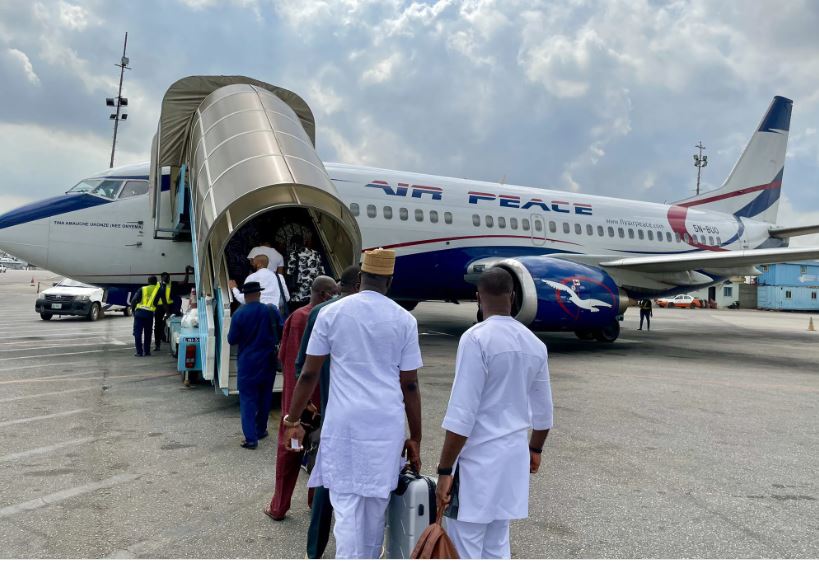
On the same day of the historic flight, Air Peace expanded its fleet with an additional Boeing 737-800 Next Generation aircraft, designed to boost passenger capacity, support more efficient route deployment and strengthen schedule reliability across its expanding network within Nigeria and elsewhere. Configured with 189 economy class seats, spacious cabin layout, larger overhead storage compartments, advanced avionics, modern safety systems and fuel-efficient engines, it is one of the most reliable narrow-body aircraft globally.
In Barbados, Onyema, the Air Peace boss, is a folk hero, just as he is in Brazil. He is celebrated not only by ordinary folks but the leadership of both countries.
For instance, when President Tinubu paid a state visit to Brazil on August 25, 2025, Onyema was there at the personal invitation of President Luiz Inácio Lula da Silva. The diplomatic mission yielded five bilateral agreements across key sectors, including agriculture and science; the most significant being the historic Bilateral Air Service Agreement (BASA), a collaboration between President Lula and Onyema, which designated Air Peace to operate Nigeria’s first direct commercial flights between Lagos and São Paulo.
The Brazilian leader who said the direct air link would deepen geopolitical, cultural, and economic ties between the two nations, noted that connecting the largest economies in Africa and Latin America was consequential. Just like in Barbados, the direct flight between Nigeria and Brazil will reduce travel time from nearly 24 hours to just over eight hours.
But this titanic aviation pact, a milestone for South-South global partnerships that will indubitably open doors to expanded trade and knowledge transfer, was not mere happenstance. Onyema is an incredible asset to the Brazilian economy with over $1 billion worth of investments, something that President Lula treasures.
Air Peace has ordered a total of 21 Embraer jets directly from the Brazilian manufacturer, consisting of 16 E-Jets E2 (mainly the E195-E2) and five E175s, making the airline the largest operator of Embraer E-Jets in Africa. Out of these, five have already been delivered. Embraer, a multinational aerospace corporation, is the third-largest producer of civil aircraft in the world, just behind Airbus and Boeing.
Meanwhile, in Nigeria, even as the global aviation family ululates, an orchestrated campaign of calumny – a deliberate attempt to demarket the airline – is afoot. This devious campaign which started in earnest when Air Peace launched its direct Lagos-London route on March 30, 2024 culminated last week in a dubious ranking of “top Nigerian airlines,” with ValueJet coming tops, a ranking that stretches the limits of incredulity. Ironically, those behind this mischief said the ranking was based on market presence, operational performance, passenger visibility, fleet expansion and growing regional influence. ValueJet cannot hold a candle to Air Peace on any of these indices.
Fortuitously, as if to put a lie to this hoax, a new continental ranking of 15 airlines by Gambella Media Network has placed Air Peace as the eighth best in Africa and the highest ranked carrier in the entire West and Central African sub-region. Interestingly, the first seven – Ethiopian Airlines, Air Mauritius, RwandAir, South African Airways, EgyptAir, Royal Air Maroc and Kenya Airways – are state-owned.
Even at that, except Ethiopian Airlines which operates a fleet of over 170 modern aircraft, making it the largest airline in Africa by fleet size and destinations served, Air Peace which currently operates a fleet of over 30 aircraft, with a combined mainline and subsidiary fleet size of roughly 37 planes is bigger than Kenya Airways which currently operates an active fleet of 35 aircraft. But what is certain is that Air Peace which commenced commercial flight operations on October 24, 2014, with a modest fleet of seven aircraft is today the largest privately-owned airline in Africa.
But the credibility and strength of an airline is not measured only in terms of the largeness of its fleet and operational breadth but by its safety standards.
Recently, the International Air Transport Association (IATA), the trade association for the world’s airlines, said Air Peace stands on equal footing with aviation giants such as British Airways, KLM and Delta Airlines, on global safety standards, having successfully attained its sixth consecutive International Air Transport Association Operational Safety Audit (IOSA) certification.
Making the validation, IATA’s Regional Director for West and Central Africa, Dr. Patrick Fatokun, said the stringent safety audit processes applied to Air Peace were the same used to assess other global aviation giants. “The standards that are given are the same as the British Airways, KLM, and Delta. They are all assessed the same way… Air Peace’s presence on the IOSA registry is a testament to its unwavering dedication to safety, operational excellence, and professionalism. This milestone is not just a victory for the airline but a pride for Nigeria. It highlights that local carriers can operate at the highest international safety levels.”
While the IOSA certification speaks to the fact that Air Peace stands shoulder to shoulder with the best airlines in the world on passenger safety and operational excellence, the ranking is a recognition of the airline’s rapid growth in fleet size, route expansion, international operations, and its increasing influence across the continent, a demonstration that an indigenous Nigerian carrier can hold its own on the continental stage.
In contrast, ValueJet operates a total fleet of nine aircraft, consisting of Bombardier CRJ regional jets for its scheduled passenger and cargo operations. Unlike Air Peace, ValueJet does not hold the IOSA certification. While the airline, which officially commenced commercial flight operations on October 10, 2022, holds a valid Air Operator Certificate (AOC) from the Nigerian Civil Aviation Authority (NCAA), it has not yet completed the rigorous global audit required to be an IOSA-certified airline. So, what was the basis for the ranking, if not mischief?
Air Peace is a gem in Nigeria’s aviation industry that should be jealously protected by all. Now, that does not mean it should not be called out when it errs. I once had cause to cross swords with the airline. Neither the airline nor its proprietor is infallible. But such criticisms must be constructive with the goal of making it better not with an intent to destroy.
Airline business globally is tasking. It is even more so here with innumerable business headwinds. For instance, following President Donald Trump’s misadventure in Iran, aviation fuel (Jet-A1) prices in Nigeria surged by up to 350 per cent, the highest global percentage increase, with prices spiking to as much as ₦3,300 per litre from an average of ₦900 per litre before the conflict. Even with supply interventions and adjustments by major players like the Dangote Refinery, the price still hovers around ₦2,000 per litre and Jet-A1 now accounts for up to 95 per cent of domestic airlines operating costs. Contrast that to the US where the average cost rose by approximately 56.4 per cent averaging $8.57 to $8.63 per gallon.
Yet, Air Peace continues to meet its obligations. What the airline is doing in the country’s aviation industry is nothing short of a miracle and truth be told, except for Alhaji Aliko Dangote, no Nigerian entrepreneur has been able to do for Nigeria’s economy what Allen Onyema has done with Air Peace. His is even more profound because it is yielding both tangible and intangible capital for the country. He deserves praise, not vilification.
And let no one make any mistake about this: if Air Peace goes under, as some people seem to be wishing, Nigeria will be worse for it. It is tantamount to wishing that the Dangote Refinery, warts and all, goes bust.