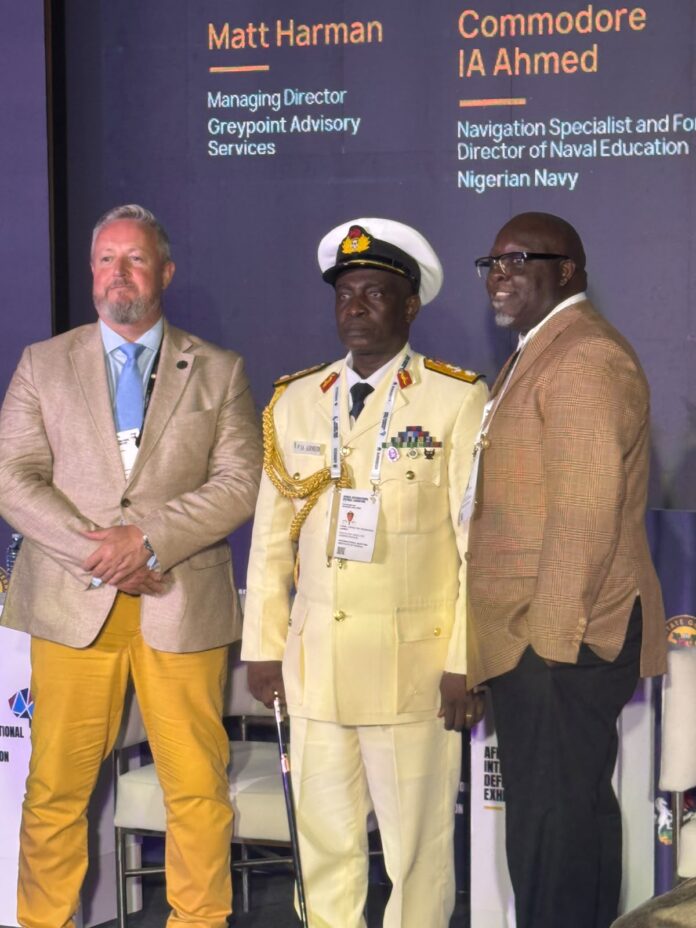
AFRIDEX 2026: Ahmed advocates interoperability to strengthen Gulf of Guinea security
By Eberechi Obinagwam
Commodore Isa Ahmed, the Director of Administration at the International Maritime Institute of Nigeria (IMION) has advocated interoperability as key to effective maritime security in the Gulf of Guinea
Speaking as a Nigerian Navy panelist at the ongoing Africa International Defence Exhibition (AFRIDEX 2026) , Ahmed said emphasis should be less on individual platforms and more on the ability of navies, agencies and regional partners to work together
Speaking on “Interoperability at Sea: Strengthening Maritime Security through Systems, Standards and Integration,” the panelist argued that interoperability must convert separate national and institutional capabilities into a coordinated operational advantage.
Cdre Ahmed’s presentation highlighted the Yaoundé Architecture as the key regional framework for information-sharing and coordinated responses to piracy, armed robbery, illegal fishing and other cross-border threats.
AAccording to him, while the architecture provides the institutional structure –national coordination mechanisms, Multinational Maritime Coordination Centres, regional centres and the Interregional Coordination Centre, it’s success hinges on practical connectivity.
His presentation identified three mutually reinforcing pillars including systems, standards and integration.
On systems, he harped on the necessity of linking radar, AIS, satellite surveillance, vessel-tracking and operations centres so operators gain a fuller maritime picture without necessarily replacing existing equipment.
For standards, Ahmed said common technical formats, reporting procedures, terminology and security protocols and shared information is understood and trusted.
Speaking on integration,he advised on the application of clear responsibilities, liaison arrangements, joint exercises and decision-making processes that turn information into timely, lawful action.
Speaking on Nigeria’s efforts, Cdre Ahmed called for stronger information-sharing among the Navy,Nigerian Maritime Administration and Safety Agency (NIMASA) , the Nigerian Ports Authority and other agencies, regular inter-agency exercises, and technology investments that match defined operational needs.
According to him, reliable communications, consistent procedures, trained personnel and sustainable funding are essential to the Yaoundé architecture effectiveness.
Cybersecurity, institutional trust and human capacity received particular attention. Increased connectivity creates both opportunity and risk; access controls, data protection and ongoing training are required to maintain confidence. Defence procurement was urged to embed interoperability requirements from the outset –defining interfaces, data exchange, security and testing–ather than treating compatibility as an afterthought.
Five recommendations were offered: strengthen national–regional information links; agree practical interoperability requirements before new systems are acquired; build those requirements into procurement specifications; invest continuously in people and joint exercises; and ensure the long-term sustainability and security of shared capabilities.
He said “The future of maritime security will depend not only on the individual capabilities of our navies and agencies, but on our ability to make those capabilities work together,” the panelist concluded.
Success, he emphasised, should be measured by better maritime awareness, sounder decisions and more timely, coordinated responses across the Gulf of Guinea.