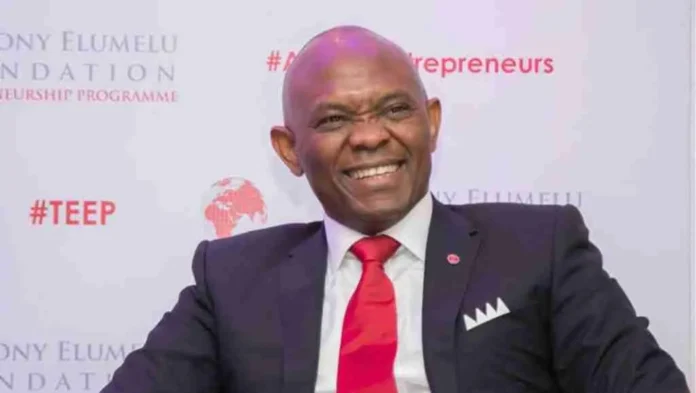
Africa’s prosperity depends on investing in women entrepreneurs – Elumelu
By Eberechi Obinagwam
Chairman of Heirs Holdings, Tony Elumelu, has called for increased investment in women entrepreneurs, describing women’s economic leadership as essential to Africa’s competitiveness and long-term prosperity.
Elumelu made the call on Friday, November 6, while delivering the keynote address on the second day of the Women in Management, Business and Public Service (WIMBIZ) 25th Annual Conference.
Speaking on the need to unlock Africa’s economic potential, he said the continent’s greatest asset was its people, particularly its women and young population, whose talents remained underutilised due to limited access to capital and economic opportunities.
Addressing the gathering of business leaders and professionals, Elumelu said he saw the women in the room not merely as an audience but as valuable human capital capable of driving economic transformation.
“I look at this room, and I do not see an audience. I see capital. I see human capital, the most under-deployed asset in this country,” he said.
Drawing from his personal experience, he recalled how his mother demonstrated business skills through her ability to manage limited resources, attend to customers and sustain a livelihood.
He said her example shaped his understanding of entrepreneurship and reinforced his belief that women already possessed the capacity to build successful businesses but had not received sufficient capital, recognition and support.
“When you ask me whether women can do African business, I might not be the right person to ask because, in my own experience, they already do. We have simply not given them the capital, the title or the credit they deserve,” he said.
The businessman, who is also the founder of the Tony Elumelu Foundation, said his commitment to entrepreneurship was driven by the belief that opportunities should not be determined by a person’s gender, geographical location or circumstances of birth.
He described his philosophy of Africapitalism as the private sector’s responsibility to create economic prosperity and social wealth simultaneously, while ensuring that opportunities reach people irrespective of their background.
On Africa’s economic prospects, Elumelu identified three major challenges that must be addressed to unlock the continent’s potential: inadequate electricity, limited value addition and insufficient investment capital.
He argued that reliable electricity was fundamental to industrialisation, business growth and technological advancement, including the emerging artificial intelligence economy.
According to him, Africa must also move beyond exporting raw materials and begin processing, refining and branding its resources locally to create greater economic value.
“For 100 years, the question asked of Africa has been how can value be extracted. I want to change the question to how value can be created here in Africa,” he said.
He maintained that the continent’s future should be driven by investment and trade rather than dependence on foreign aid.
“The future is investment and trade, not aid,” he stated.
Elumelu further called for stronger intra-African trade, urging governments and businesses to remove barriers that restrict the movement of goods, services and capital across the continent.
He identified infrastructure, including roads, railways, ports and efficient payment systems, as critical to building a functional continental market.
On financing, he urged African financial institutions, insurance companies and pension fund administrators to channel more resources into productive investments rather than concentrating largely on government securities.
He also highlighted the work of the Tony Elumelu Foundation in supporting young African entrepreneurs, noting that 48 per cent of the entrepreneurs supported through its programmes were women.
He disclosed that 265,529 young African men and women with business ideas applied to the foundation’s programme in 2026, but only about 3,200 could be funded, highlighting the enormous gap between entrepreneurial potential and available capital.
For Elumelu, expanding women’s access to finance is not merely a matter of inclusion but an economic necessity.
He argued that no economy seeking sustainable development could afford to undervalue the contributions and talents of women.
“Women’s economic leadership is not a question of constitutional dependence. It is a requirement for competitiveness,” he said.
He urged African leaders, investors and private sector players to recognise women as key participants in wealth creation and provide the resources and opportunities needed to help their businesses grow.
The conference also recognised women whose businesses have made significant contributions across different sectors through the Female Achievers Awards.
The award recipients included Tara Fela-Durotoye of House of Tara, in the beauty industry; Kehinde Kamson of Sweet Sensation, in the quick-service restaurant sector; and Joke Bakare of MedPlus, in retail pharmacy.
Their recognition highlighted the role of women in building sustainable businesses and expanding commercial opportunities across different industries.
The day’s programme also featured a series of microtalks examining practical ways women could position themselves for emerging business and career opportunities.
Speaking on positioning for continental opportunities, Adeola Olusodo, Managing Director, CEO Lekki Worldwide Investments Limited, used the Lekki economic zone as an example of how coordinated infrastructure and predictable business conditions could attract investment and create opportunities beyond large-scale manufacturing.
He encouraged women to explore opportunities in logistics, packaging, technical services, warehousing, training and partnerships with established manufacturers as ways of participating in regional value chains.
In another session, Tope Shonubi, Co-Founder and Executive Director, Sahara Group examined the strategic choices of building, acquiring or partnering to grow a business. He said the decision should depend on a company’s resources, capabilities, market conditions, capital requirements and appetite for risk.
Tokunboh Talabi, Secretary to Ogun State Governor, SSG in his session, “From Where I Sit: How Career Professionals in Corporate and Public service can see and seize opportunity, challenged participants to recognise opportunities within their existing careers and professional experiences, noting that entrepreneurship was not the only route to economic advancement.
He encouraged professionals and public servants considering career transitions to identify problems they understood, assess the commercial viability of their ideas and build on their existing skills and networks.