Africa’s food insecurity linked to poor funding on agriculture, banks’ reluctance for financing, negligible aid
By Eberechi Obinagwam
David Luke, Professor of Practice, and Strategic Director, Firoz Laliji Institute for Africa at The London School of Economics and Political Science (LSE), says the lack of finance is the critical driver of Africa’s food insecurity.
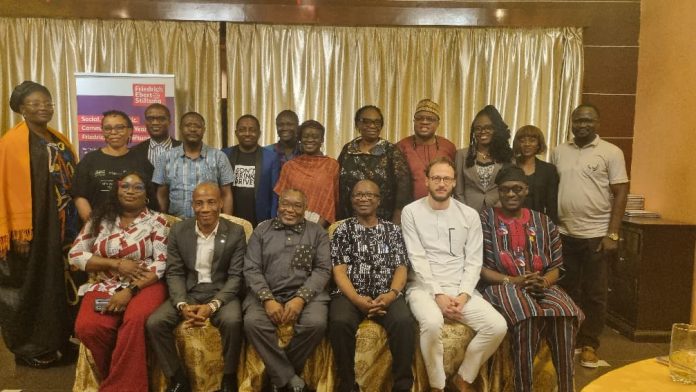
At a dinner organised by Friedrich-Ebert-Stiftung (FES) for his book presentation, ‘How Africa Eats’, he lamented the lack of significant investment in food production.
He pointed to a Comprehensive Agriculture Development Plan (CADAP) of the African Union where it was agreed that the continent governments should spend not less than 10% of their annual budget to support the agricultural sector, but only a few countries have reached that target.
He also said banks in Africa are not really lending to agriculture due to high rates and issues with communal farmland as collateral.
“Microcredit to some extent is helpful, but it does not support production at scale. But it’s very natural, it’s micro. We also found that foreign direct investment is not going into agriculture. And also foreign aid, which as you know this year has collapsed. But even before it collapsed, a very small portion of foreign aid ever went into agriculture,” he said.
He said rich countries subsidize agriculture products like rice, maize, wheat, and proteins such as livestock, meat, poultry, fish – making it hard for Africa to compete.
In response to climate change affecting Africa’s food crisis, he said that though a lot is being done on the adaptation side, the funding is woefully short.
He emphasised that finance remains the key action that African leaders should take to address food insecurity in Africa.
He said his book, “How Africa Eats” focuses on three things; trade, Agricultural policies and climate. “It focuses on trade, because we wanted to explain that we have a particular model of trade on this continent that is not transforming our economies, secondly, we looked at the way we finance agriculture to highlight the deficiencies there, and the third part of the book is looking at how climate is impacting production, and how we are also not doing enough on adaptation, although the knowledge that adaptation requires is increasing all the time, thanks to much of the scientific research that is going on,” he said.
Professor Olawale Ogunkola from the University of Ibadan added that the issue being discussed still revolves around governments setting the right priorities and focusing efforts on achieving them.
He noted that farmers aren’t asking for money; they’re asking for solutions like addressing rural infrastructure problems, improving transportation, stabilising prices, support services, and reducing post-harvest losses which is about 45%.
“If we address the issue of post-harvest losses. it’s like you are doubling agricultural production,” he explained.
He also stressed that infrastructure is key not just for food security but for overall economic activities.
Also, Comrade Solomon Adebosin, Executive Secretary of the Food, Beverages and Tobacco Senior Staff Association of Nigeria, noted that Professor David Luke’s book “How Africa Eats” raised key questions on food insecurity, highlighting that about 70% of African countries face food insecurity, importing food despite having good weather – because they export commodities and import expensive final products.
He stressed that governments aren’t supporting farmers adequately, making food expensive and affecting nutrition; thus, government support is critical to eliminate food poverty.
From the food sector, Adebosin said they will advocate for the government to provide security, finances, and an enabling environment for farmers in Nigeria with the aim to boost food production and regain Nigeria’s status as a “food basket of the nation.”
Lennart Oestergaard, Resident representative of Friedrick Ebert Steffung, (FES) Nigeria, commended professor David’s book, adding that FES has been in a long partnership with trade unions in Nigeria, operating for 49 years.
He explained that FES Nigeria collaborated with LSE on research leading to the book, focusing on food security, climate change impacts and growth opportunities in Africa.
Comrade Jimoh Oyibo, National President, Food, Beverage and Tobacco Senior Staff Association of Nigeria, Segun Ajayi-Kadir, Director General of Manufacturers Association of Nigeria, and other dignitaries were also present at the event.