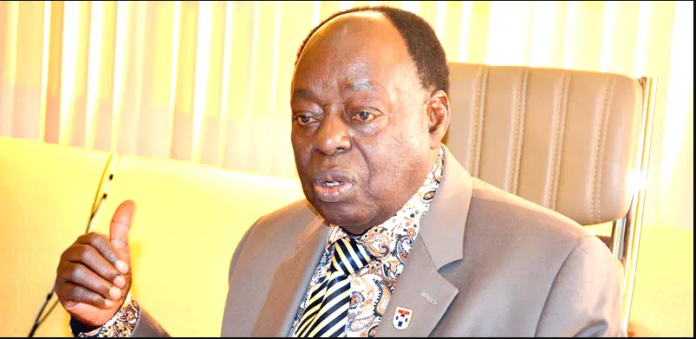
Afe Babalola warns, government not performing its main function spelt out in Constitution
By Jeph Ajobaju, Chief Copy Editor
***********************************
“Record shows that Nigeria as at today is a big debtor country, Nigeria’s total public debt is put at N152.4 trillion or $99.7 billion.
“Consequently, most business companies from other countries do not want to invest in this debtor country.
“As I am talking to you now, I know as a fact that our banks are complaining that the Central Bank is not honouring Promissory Notes issued by government on the allegation that the Federal Government is in debt and cannot pay the Central Bank.
“The main function of a government is contained in Section 14 of the Constitution. For the avoidance of doubt, it reads as follows: ‘The Federal Republic of Nigeria shall be a State based on the principles of democracy and social justice.
‘“It is hereby, accordingly, declared that: Sovereignty belongs to the people of Nigeria from whom government through this Constitution derives all its powers and authority;
‘“The security and welfare of the people shall be the primary purpose of government. The participation by the people in their government shall be ensured in accordance with the provisions of this constitution”’ – Afe Babalola.
***********************************
Nigeria’s growing debt – which some calculations put at $210 billion and counting – rubbishes the country’s economic reputation and discourages foreign investment, warns Afe Babalola, a SAN and university proprietor.
He spoke at the weekend in Ado-Ekiti during the 2025 International Leadership Conference on Leadership, Governance, Sustainable Change and Wealth Creation (2.0), which has the theme, “Shaping Transformational Leaders for a Changing World: Tackling Insecurity, Governance and Development”.
The event was jointly hosted by Afe Babalola University, Ado-Ekiti (ABUAD), Nigeria Trinity Western University (TWU), Vancouver, Canada, and African Centre for Leadership, Strategy and Development (CrntreLSD).
Babalola described the theme as “most appropriate at this time of our development,” noting that Nigeria’s financial situation is alarming with a debt profile undermining investor confidence.
He said the local financial sector is equally feeling the strain, as commercial banks complain that the Central Bank of Nigeria (CBN) fails to honour government Promissory Notes.
His words: “Record shows that Nigeria as at today is a big debtor country, Nigeria’s total public debt is put at N152.4 trillion or $99.7 billion.
“Consequently, most business companies from other countries do not want to invest in this debtor country.
“As I am talking to you now, I know as a fact that our banks are complaining that the Central Bank is not honouring Promissory Notes issued by government on the allegation that the Federal Government is in debt and cannot pay the Central Bank.
“The main function of a government is contained in Section 14 of the Constitution. For the avoidance of doubt, it reads as follows: ‘The Federal Republic of Nigeria shall be a State based on the principles of democracy and social justice.
‘“It is hereby, accordingly, declared that: Sovereignty belongs to the people of Nigeria from whom government through this Constitution derives all its powers and authority;
‘“The security and welfare of the people shall be the primary purpose of government. The participation by the people in their government shall be ensured in accordance with the provisions of this constitution”’.
Development expert Otive Igbuzor, in his lecture – titled “Transformational Leadership in an Insecure and Disruptive Era: Building Ethical, Resilient and Impactful Leaders for Africa” – identified transformational leadership as a major tool necessary to tackle bad governance, corruption, unemployment, gender inequality and environmental degradation in Nigeria and Africa at large.
Igbuzor, founding Executive Director of African Centre for Leadership, Strategy and Development (CentreLSD), stressed that Nigeria and Africa require a new generation of leaders who can challenge conventional approaches and promote innovations.
Transformational leadership will enable the government to reward merit, integrity and innovation rather than mediocrity and patronage, he added.
In his view, Nigeria must be guided by the imperatives of Ethical Leadership, Innovative Education, Institutional Integrity, Inclusive Governance and Continental Collaboration, and urged the federal government to institutionalise leadership training across schools and universities to ensure that leadership formation becomes as essential as literacy.
ABUAD Vice Chancellor Smaranda Olarinde, a Pressor, also described the conference as timely, as it emphasises the vital importance of international, regional and public-private partnership to tackle underlying challenges such as insecurity, hunger, poverty, infrastructural decay, and economic uncertainty.
Read also: