



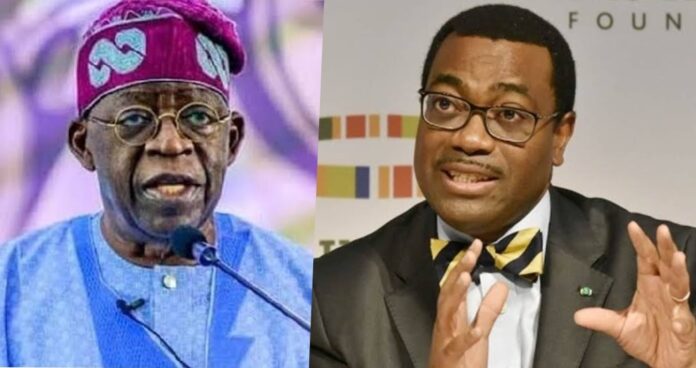
Adesina reminds Tinubu, Nigeria’s GDP per capita now at $824; country must change its current economic model and industrialise to compete globally
By Jeph Ajobaju, Chief Copy Editor
African Development Bank (AfDB) President Akinwumi Adesina has warned that Nigeria is facing a deeper economic regression than many realise, saying with a current Gross Domestic Product (GDP) per capita of $824, Nigerians are significantly worse off than they were at independence in 1960.
With nothing concrete on the ground to show for what Bola Tinubu calls his “economic reforms” so far, Adesina also reminded the President that Nigeria must transform its current economic model and industrialise rapidly in order to compete globally and lift millions out of poverty by 2050.
Adesina – an agricultural economist by training who was once Nigeria’s Agriculture Minister – pressed the points in a statement issued on Thursday following his keynote address at the 20th anniversary dinner of investment firm Chapel Hill Denham in Lagos.
“Our GDP per capita in 1960 was $1,847. Today, it stands at $824. Nigerians are worse off than 64 years ago,” he declared.
In his view, despite being Africa’s largest economy by GDP, Nigeria’s economic structure is deeply flawed and unsustainable, attributing it to decades of policy missteps, institutional weaknesses, over-reliance on crude oil exports, and chronic underinvestment in key sectors.
“Nigeria belongs in the league of developed nations. To get there, we must shift our mindset and pursue rapid economic growth.”
Adesina contrasted Nigeria’s trajectory with that of South Korea, which had a lower GDP per capita than Nigeria in 1960 but has since grown into a global industrial leader, now boasting a per capita income of over $36,000.
Nigeria’s continued lag in development is not due to a lack of potential, but a failure to harness it, he explained.
“Underdevelopment should not be accepted as our destiny. We must break free from this pattern.”
Need for urgent, bold structural reforms
Adesina laid out five urgent priorities to reposition Nigeria’s economy: universal access to electricity, development of world-class infrastructure, rapid industrialisation, innovation-driven growth, and competitive agriculture.
He insisted that Nigeria’s economic future depends on adopting bold, structural reforms that go beyond cosmetic policy changes.
“We need to invest in technology, infrastructure, and innovation. We must become Africa’s industrial powerhouse.”
He cited Dangote Refinery as an example of the kind of large-scale, private sector-led industrial project that could signal a new economic direction.
Adesina:
- Urged Nigeria to leverage its massive pension fund assets, diaspora expertise, and capital markets to fund such transformative initiatives.
- Stressed that for any reform to succeed, it must be accompanied by strong institutions, policy consistency, and good governance.
- Warned that without a credible reform agenda, Nigeria will continue to miss out on global opportunities and fail its growing population.
“The Nigeria of 2050 must be deliberately shaped, developed, corruption-free, and lead the rest of Africa.”
Backstory
Nigeria has 19 per cent of the extremely poor population in sub-Saharan Africa, the highest share across the region, according to the World Bank’s April 2025 Africa’s Pulse report.
The World Bank said the region accounted for 80 per cent of the world’s 695 million extremely poor people in 2024.
More than 1 in every 7 of the world’s poorest people live in Nigeria, which raises urgent questions about the country’s development path.
Read also:
Court sentences 2 young men to prison for 21 years each over robbery in motor park


