Wike, Uzodinma and the indispensability politics
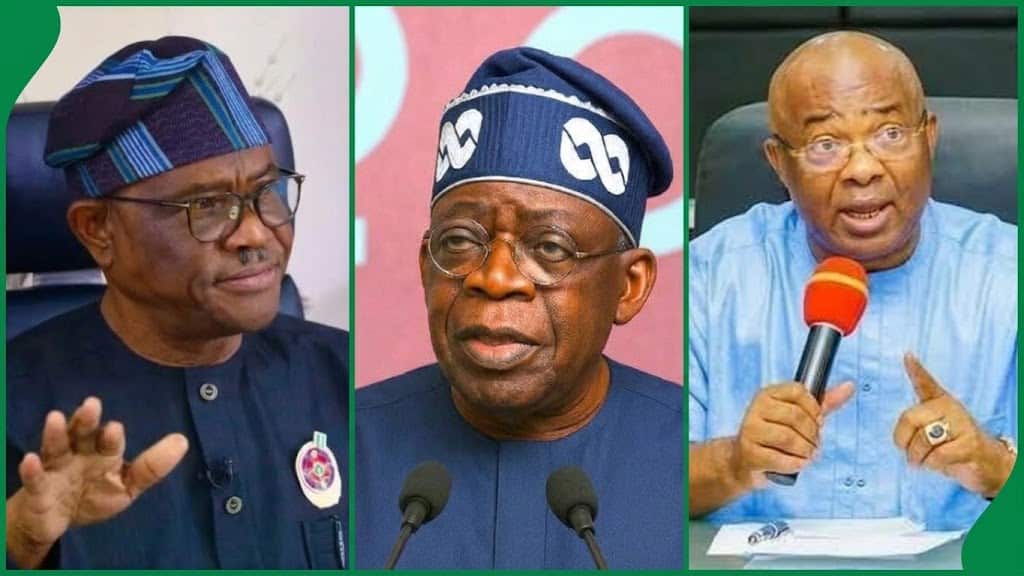
L-R: Wike, Tinubu, Uzodimma
By Ogechi Okoro
I listened to Minister Wike’s response to the position taken by the APC governors on the structure of President Bola Tinubu’s 2027 re-election campaign, announced by Imo State Governor and Progressive Governors Forum Chairman, Governor Hope Uzodinma. The political subtext was hard to miss: this is a contest over who can claim to be most useful to President Tinubu, and therefore most influential around his second-term project.
The APC governors have drawn a line: their campaign machinery, they say, will support APC candidates and will not endorse political arrangements that could weaken the party or create divided loyalty. Wike, meanwhile, insists that his Rainbow Coalition is primarily about mobilising support for Tinubu, while the PDP remains free to contest governorship and legislative elections. That distinction is important because it points to the larger question of who controls the political space around Tinubu’s second-term project.
Wike has never been a politician who hides his ambitions behind diplomatic language. He is direct, combative and intensely transactional. His political strength lies partly in his willingness to enter difficult political terrain and fight for influence. He remains a PDP member while serving as FCT Minister in an APC-led government, and he has openly committed himself to Tinubu’s re-election.
Uzodinma operates differently. His style is quieter, more institutional and less confrontational. As chairman of the Progressive Governors Forum, he now occupies an important position in the APC’s campaign architecture. The governors have publicly committed themselves to defending the party’s candidates while supporting Tinubu’s re-election, so two very different political instruments are operating around the same president.
Wike is the political disruptor. Uzodinma is the institutional operator. That distinction explains why their rivalry matters. Politicians are competing to show who is working hardest for Tinubu, and Wike has accused some of being more interested in appearing useful than in doing the actual work.
But politics is rarely only about loyalty. In Nigeria, political loyalty often carries an implicit expectation of access, relevance and future consideration. The closer a politician gets to the centre of power, the greater the incentive to demonstrate usefulness. That is why Wike matters. He brings political audacity, organisational experience and an unusual ability to operate outside conventional party boundaries. His Rainbow Coalition seeks to mobilise support for Tinubu beyond the formal APC structure, and that creates tension with governors whose authority depends heavily on that structure.
Uzodinma’s response, therefore, should not be dismissed as mere personal rivalry. He is defending an institutional principle: if APC governors are responsible for Tinubu’s campaign in their states, why should another political structure operate alongside them with its own candidates and political interests? Wike sees the matter differently. He argues that supporting Tinubu does not mean surrendering his political independence. He has made it clear that his support for the President does not extend to helping APC politicians defeat candidates in state and legislative contests. That is where the battle begins.
The 2027 election is creating a peculiar political arrangement in which politicians from different parties are attempting to cooperate at the presidential level while competing fiercely below it. That is not political confusion. It is Nigerian politics in its most transactional form, and both Wike and Uzodinma understand the rules.
I would be cautious, however, about reducing either man to simple labels such as “good” or “bad” politician. Their records and political journeys are more complicated than that. Uzodinma’s rise to the Imo governorship remains politically contested, particularly because of the Supreme Court’s 2020 judgment that overturned Emeka Ihedioha’s election and declared Uzodinma the winner. That history continues to shape how people discuss his political legitimacy. It is equally important, though, to acknowledge that he is now the sitting governor of Imo State and chairman of the APC Progressive Governors Forum.
Wike, on the other hand, has built a reputation for political confrontation and delivery-oriented governance, while also attracting considerable controversy because of his methods and political battles. Both men are therefore products of Nigeria’s hard-edged political system. But there is another lesson here: Tinubu does not need to choose between their personalities; he needs to manage their usefulness, which is the real political calculation.
Wike wants to remain indispensable because he understands that political relevance is rarely guaranteed. Uzodinma wants to demonstrate that the APC’s institutional structure, not parallel political arrangements, is the legitimate vehicle for Tinubu’s re-election. Both positions serve their respective interests. President Tinubu, an experienced political strategist himself, understands this better than most.
The danger for both men is assuming that proximity to the President automatically translates into permanent political security. It does not. Nigerian politics has a long memory, but it also has a remarkable capacity for political reinvention. Yesterday’s ally can become tomorrow’s opponent; yesterday’s opponent can become tomorrow’s indispensable partner. That is why I would not spend too much time trying to predict where either Wike or Uzodinma will ultimately land.
The more revealing question is this: after 2027, who will still have enough political capital to negotiate from strength? Uzodinma has the institutional advantage of governing Imo and leading the APC governors’ forum. Wike has the unusual advantage of operating across party boundaries while retaining considerable political visibility and influence. Neither should be underestimated. But neither should assume that today’s relevance guarantees tomorrow’s protection.
The Jagaban understands political power too well to allow any individual, Wike, Uzodinma or anyone else, to become bigger than the political project itself. The contest, therefore, is not merely about who is working harder for Tinubu. It is about who can convince Tinubu that their political machinery is indispensable to the road back to Aso Rock, and who can remain indispensable after the election. That is the real game. In Nigerian politics, the most dangerous mistake a powerbroker can make is confusing being useful with being irreplaceable.
- Dr Ogechi Okoro, a political and social analyst, writes from Hamilton, New Zealand.