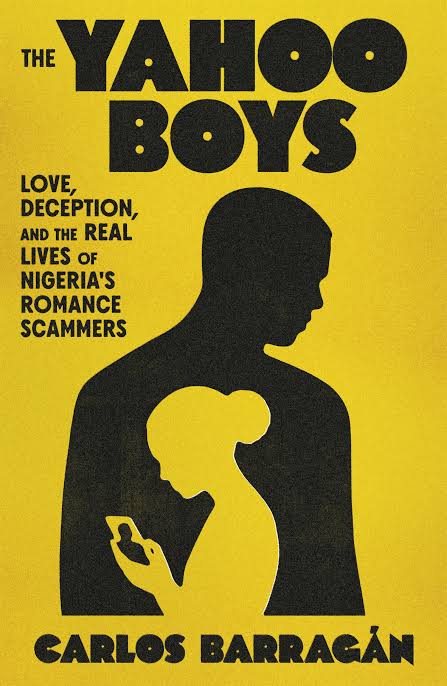
Every man his own Escobar: A review of Carlos Barragan’s “The Yahoo Boys”
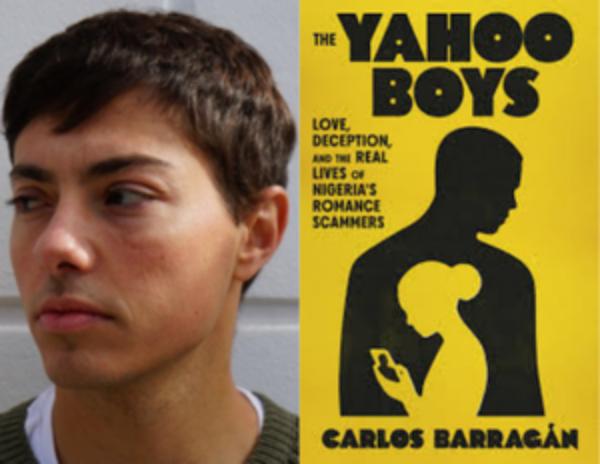
The author Carlos Barragan and his book
By Missang Oyongha
When the Spanish journalist Carlos Barragan announced recently on LinkedIn that The Yahoo Boys, his book about the online scammers of Lagos, had just been released, the comment section beneath his post was animated. There was praise for this first book by a young journalist, but also curiosity from some Nigerian commenters about his motives, as well as defensive queries about why, of all the subjects under the Nigerian sun, Barragan had chosen to write about the already globally notorious Yahoo boys. It was evident that most, if not all of the interlocutors had not yet read the book, but their preemptive reviews implied that Barragan may have produced yet another jaundiced Western portrait of Nigeria. The current reviewer, already in possession of a then-unread copy of The Yahoo Boys, chimed in with the observation that no one could hope to police a journalist’s choice of reportage.
The Yahoo Boys follows several current and former online scammers around the Lagos neighbourhood of Ikotun. Barragan was granted a confessional, forensic degree of access to the social media chat histories of some of his interviewees, and he includes lengthy passages of dialogue between the scammers and their victims, dialogue that is by turns transactional, sentimental, comic, and moving.
Barragan charts the difficult childhoods of his subjects, and their struggles with education; their initiations, as if by sheer osmosis, into the world of online scams: and the debauched lifestyles they lead while financed by a fitful stream of gift cards and cryptocurrency transfers from unwitting “magas” or marks in Europe, America, and Australia. It is a vignette on globalisation, and the intertwining of cybercrime, technology, and ecommerce, and Barragan tells it deftly.
He connects the dots to illustrate how gift cards inveigled from an hapless grandfather in America end up being sold by a Nigerian scammer to a Chinese internet vendor. Yet the very technology that enables scammers to prowl online under colourful aliases also enables their exposure. When the Irishwoman Theresa contacts Amazon to confirm that her gift card has been redeemed by Cody Rhodes in Florida, she is nonplussed to be told that her card was redeemed two minutes after she sent it by an IP address in Lagos, Nigeria.
This scam is the work of Chibuike, one of Barragan’s native informants. He drifts from a dysfunctional but comfortable family home into a series of menial jobs, and eventually ends up in the Yahoo orbit. Masquerading online as the WWE wrestler Cody Rhodes, he milks the lonely and besotted Theresa of thousands of euros and checks into a succession of hotel suites to hold court. Newly tattooed and bejewelled, Chibuike doles out cash to anyone with a request, and acquires an eclectic drug habit, a diet of Canadian Loud, Colorado, crystal meth, and crack.
By the time he sits down to be debriefed by Barragan, Chibuike is yesterday’s man, gaunt, disheveled, and broke.
There is also Biggy, who idolises, as might be guessed, the Notorious BIG, and who rationalises his scams by pointing to the depressed economic situation in Nigeria. To Barragan, he insists that “morality is a luxury he (cannot) afford.” For Biggy, “the only thing in Nigeria young people can do to survive is going into Yahoo.” Ever the dutiful son, Biggy tithes thirty percent of his fraudulent earnings to his parents, enabling them to live in relative comfort amid the prevailing squalor of their neighbourhood. Prodded by Barragan to talk honestly about her son’s pursuits, Biggy’s mother responds with denial and deflection. For all his bravado about being a brainer, Biggy acknowledges that being a scammer is nothing to brag about, and he recoils at the thought of his unborn children finding out about their father’s Yahoo past. In telling the stories of these often amoral individuals, Barragan manages to humanise but not excuse them.
Through Biggy, Barragan is introduced to a young female scammer named Miracle. She is adept at online adoption scams targeting childless Westerners, and her patron saints are Pablo Escobar and the Virgin Mary, improbably. Verbally she veers between self-pity and a hard-nosed braggadocio. Miracle, true to form, pockets a five-dollar Uber fare from Barragan but fails to show up for what would have been their second interview. Barragan has already surmised, based in part on the anecdotal evidence, that when it comes to the Yahoo clan, the female of the species is cannier, perhaps deadlier, than the male.
Attempting to make sense of a society in the grip of a Yahoo-boy culture, Barragan interviews a wide selection of Lagosians, among them a musician who insists that “the real Yahoo Men are the politicians. Scammers steal from foreigners and spend the money here. Politicians steal from us and spend the money abroad.” We might call this the Robin Hood defence, or the Yahoo version of trickle-down-economics. Such warped morality is echoed by Ikotun residents who insist to Barragan that the swelling ranks of Yahoo boys has driven down the crime rate in the area, not seeing that the emotional, financial and existential toll of romance and blackmail scams is being wreaked thousands of miles away. Such blinkered rationalisations of scamming are given the lie by the depredations of Yahoo Plus, sinister variant where scammers enlist the help of herbalists and perform ritual killings to enhance their chances of success.
Barragan’s book is as much the outcome of filial as journalistic duty. The roots of his interest in the Yahoo boys of Lagos lie in an episode from 2016 when his mother Silvia, a Madrid dentist and divorced mother of three sons, fell in on Tinder with an alleged American soldier named Brian. Brian hints promisingly at gold bars he has supposedly filched from a terrorist cache while based in Syria, and the Barragan boys catch the whiff of a con. The sons struggle to pry their mother away from the coils of this snake-oil lothario, but she resists their scepticism, retreating into silence.
Only after Barragan is able to prove, using an app that traces email IP addresses, that Brian is a fiction based in Lagos, Nigeria and not in Syria, does Silvia accept the harsh truth. Researching his book in Lagos many years later, Barragan meets Yahoo boys who have intuited, in their perverse way, the psychological vulnerability that allows lonely middle-aged Westerners become the victims of fake Brad Pitts and Cody Rhodeses. Armed with his own mother’s experience, Barragan is able to understand the willingness of the romance scam victim to suspend disbelief for the sake of an intimacy that seems, to our sceptical reader’s eye, ever more simulated and one-sided.
“Why does tinder tell me you are 6,000 miles from me?” asks one befuddled American doctor of his online inamorata, supposedly one town away in Texas. Biggy, in costume as Emily, deflects this scary moment by glibly assuring the depressed doctor that “the app has a glitch.” Chibuike, as Cody Rhodes, fails to show up in Dublin twenty-five times over a three-year period, offering one inventive excuse after another to the sadly beguiled Theresa.
While Yahoo boys pride themselves on their ability to fleece ‘magas’ abroad, the irony that Barragan uncovers in Lagos is that at least in Ikotun, the scammers themselves invariably fall prey to a motley crew of opportunists and hangers-on. These range from drug dealers to car dealers: from hotel managers to clothing store owners: from nightclub ‘hypemen’ or praisesingers to extorting policemen. Chibuike, drunk on his luck with Theresa, is cleaned out to the last kobo by his live-in girlfriend, who concludes that he may never be the sober, laundered husband she craves. When Barragan himself ambles around Ikotun with his fixer, absorbing the particulars of the locale, he is cheerfully derided as a ‘maga’ for his fixer, so conditioned have the people become to an exploitative dynamic between a white man and a black man. Tellingly, lingo from the world of scams has leached into everyday speech: maga, format, billings, cashout.
His journalistic curiosity and a nagging need to unravel the truth behind a tragic story he hears from one of the Yahoo boys, takes Barragan to Kentucky in the US. With dogged online sleuthing he tracks down Trisha, the browbeaten housewife presumed dead by her Lagosian scammer, Richie. The story about her death is a ruse confected by Trisha and her husband to get Richie off her back, and it works. She is in reduced circumstances because of Richie’s manipulations: she has no job; she has lost her credit rating; her bank and cryptocurrency accounts have been frozen; her house has been repossessed. When Barragan shows up unannounced on her doorstep Trisha and her husband are living in her late father’s rundown house. She has sacrificed everything, unwittingly, to lower the crime rate in Ikotun.
- Missang Oyongha publishes the Substack newsletter, WriteHaus Africa.