



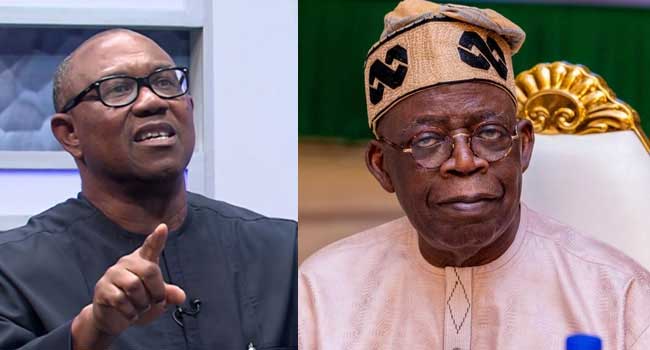
Obi also called for fiscal discipline and accountability from government following Senate’s approval of Tibubu’s $21bn loan
By Kehinde Okeowo
Labour Party (LP) 2023 presidential candidate, Peter Obi, has once again raised concern over Nigeria’s growing debt burden, describing the current borrowing trend as unsustainable and lacking in accountability.
He made his feelings known on Tuesday in a trending post he shared on his X page.
Obi’s remarks followed the Senate’s recent approval on July 22, 2025, of an additional $21 billion, €2.2 billion, and ¥15 billion in external borrowing for the 2025–2026 fiscal cycle.
Reacting to the development, Obi, noted that the Red Chamber also approved a N750.98 billion domestic bond issuance and a €65 million grant.
He added that by the latest loan approval by the Nigerian Senate, Nigeria’s debt now stands at N187 trillion, with palpable fear that it might climb to N200 trillion before the end of the year.
ALSO READ: Utomi calls for revoking of Band A electricity category tariff
Obi further noted, “As our GDP before rebasing was about N269.2 trillion (about $180 billion), the government has borrowed the equivalent of nearly 70% of our previous GDP. Even after the rebasing, which pushed our GDP to about N372.8 trillion (about $243.7 billion), the government would have borrowed about 50.16% of the new GDP (with the approved loans), the highest debt-to-GDP ratio in our history as a nation.
“While the year-on-year increase is about N27.72 trillion and the quarter-on-quarter increase is about N4.72 trillion, we are accumulating very exponential levels of unsustainable debt with little or nothing to show for it in critical areas such as education, healthcare, electricity generation, security of lives and property, and pulling people out of poverty.
“We still rank low in all major human development indicators. While education is underfunded and standards in continuous decline, healthcare remains inaccessible to millions of Nigerians, particularly the poor. Security of lives and property has deteriorated with over 10,217 people killed and 672 villages sacked between May 29, 2023, and May 29, 2025, even when security spending has significantly increased from N2.98 trillion in 2023 to N4.91 trillion in 2025. Infrastructure decay persists across the country, with about 135,000 km of our 195,000 km of roads remaining unpaved, largely unmotorable, and unusable. It is the same depressing situation in almost all sectors of the economy, with the power sector an unquestionable example, with less than 5,000 MW supplied for over 200 million Nigerians.
“Today, over two years after the present government took over and with all the humongous borrowing, we are still confronted with negative reports of worsening poverty, with about 133 million (63%) Nigerians classified as multi-dimensionally poor, increasing unemployment, and disheartening news like 652 children dead as the malnutrition crisis worsens in Northern Nigeria.
“Médecins Sans Frontières (MSF), also known as Doctors Without Borders, has just sounded the alarm over an escalating malnutrition crisis in Northern Nigeria, with Katsina State emerging as one of the worst-hit areas.
“This is a country blessed with enormous resources, yet nobody should go to bed hungry. Still, a persistent deficiency in leadership has thrown the majority of our citizens into increasing multi-dimensional poverty.
“Borrowing is not inherently bad if it is sustainable and tied to productive investments with measurable outcomes. Unfortunately, this current pattern of borrowing without accountability, without transparency, and without transformational impact is simply mortgaging the future of our children. The government should consider the inter-generational consequences of their unsustainable borrowings and show at least a minimum consideration and interest in the future of young and unborn Nigerians.
“We must return to a disciplined and prudent economic management culture, cutting the cost of governance, blocking leakages, investing in human capital, and building a productive economy. Nigeria cannot continue to borrow recklessly while poverty deepens and public trust erodes.”
Obi said It is time to stop the fiscal indiscipline, adding that it’s important to build a New Nigeria, where “leadership is responsible, development is people-centred, and every kobo borrowed or spent delivers a measurable impact to achieve sustainable and inclusive development and growth.”


