



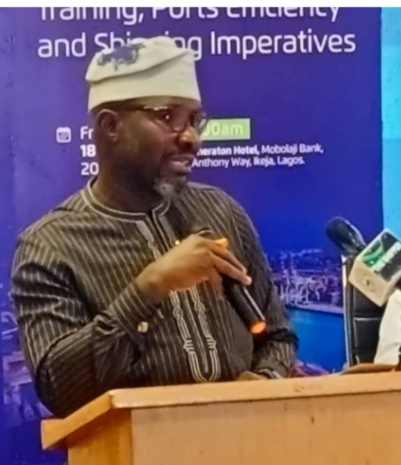
Nigeria must train its officials to compete in the face of tightened global maritime rules, says NLNG MD Ahmed
By Uzor Odigbo
Managing Director of NLNG Shipping and Marine Services Limited (NSML), Mr Abdulkadir Ahmed, has said training of personnel is key for the development of the Maritime industry.
He disclosed this at the 2025 Annual Conference of the Association of Maritime Journalists of Nigeria (AMJON), held in Ikeja, Lagos.
Recall that Mr. Abdulkadir Ahmed of NSML urged for urgent Maritime Training, Digital Reforms to future-proof Nigeria’s Shipping Industry Amid Sweeping Global Regulation.
In a paper titled “The Evolving Global Maritime Regulatory Environment: The Role of Maritime Training and Capacity Development,” Me Abdulkadir Ahmed who was represented by Mutiu Olayiwola, Manager, Finance and Corporate Services NSM, called for accelerated investment in maritime human capital as new international laws and technologies reshape global shipping.
“The maritime industry is undergoing a regulatory revolution from the IMO’s carbon rules to autonomous shipping and seafarer rights.
“If Nigeria does not urgently prioritize structured maritime training and capacity development, we risk losing relevance in global trade,” Ahmed stated.
Ahmed highlighted three major regulatory fronts disrupting traditional shipping practices:
Explaining why Maritime Training is Nigeria’s Lifeline, the NSML boss emphasized that compliance alone is not enough; Nigeria must invest in the competencies needed to interpret and implement these new norms. “Our future lies in the quality of our workforce. The best ships mean nothing without skilled people to operate, maintain, and manage them,” he declared.
Ahmed showcased the NSML Maritime Centre of Excellence (MCOE) in Bonny, Rivers State, as a benchmark for capacity development.
The MCOE is one of Africa’s first UK Maritime & Coastguard Agency-accredited facilities, approved by NIMASA and certified by DNV.
“This eliminates the need for Nigerian seafarers to travel abroad for certification. It saves cost, boosts local talent, and strengthens national pride,” he added.
Beyond Training: NSML’s Strategic Contributions Ahmed also detailed NSML’s broader industry efforts:
Fleet Renewal: Deployment of dual-fuel LNG carriers like AXIOS II and AKTORAS
Shipbuilding Supervision: Oversight of a 23,000m³ LPG vessel build in South Korea
Decarbonization Agenda: Exploring hydrogen and ammonia as alternative fuels
Security & Registry Reforms: Supporting NIMASA’s Deep Blue Project and ship registry modernization.
Ahmed urged policymakers, industry leaders, and maritime institutions to adopt a long-term view by embedding training into every facet of the sector.
“Regulation is no longer static. It’s dynamic, demanding, and global. Training is our weapon. Capacity development is our shield. And partnership is our route to global relevance,” he concluded by applauding AMJON for its role in shaping maritime narratives


