By Jeph Ajobaju, Chief Copy Editor
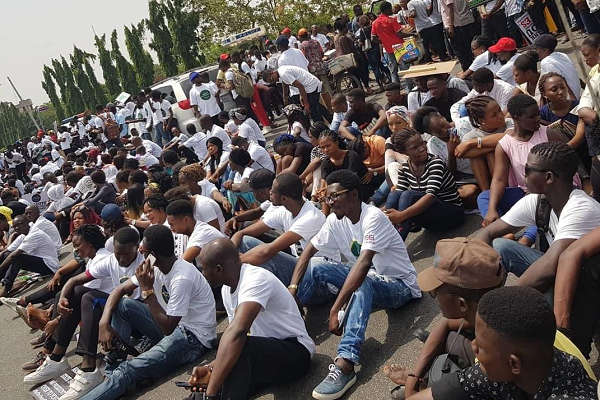
Unemployment rate in Nigeria is estimated at 32.5 per cent in 2021 and is projected to rise next year. About 14 million youths were unemployed in 2020, according to the National Bureau of Statistics (NBS).
Youth unemployment had been high before the pandemic, and even now that the virus is petering out, the underlying factors of joblessness – the economy is based mainly on oil with little expansion in manufacturing – mean that jobs remain scarce.
And elsewhere, for the last 18 months, says the BBC, Covid has led to unprecedented disruption across the world. Older people have been the most at risk from the virus itself but the young have disproportionately suffered from its economic fallout.
“The young jobless have been stuck in a Covid-19 limbo-land,” Sher Verick from the International Labour Organisation (ILO) tells the BBC.
“This crisis has … not only led to the closure of businesses and job losses, but the lockdown measures have also severely constrained young people’s ability to search for a job.”
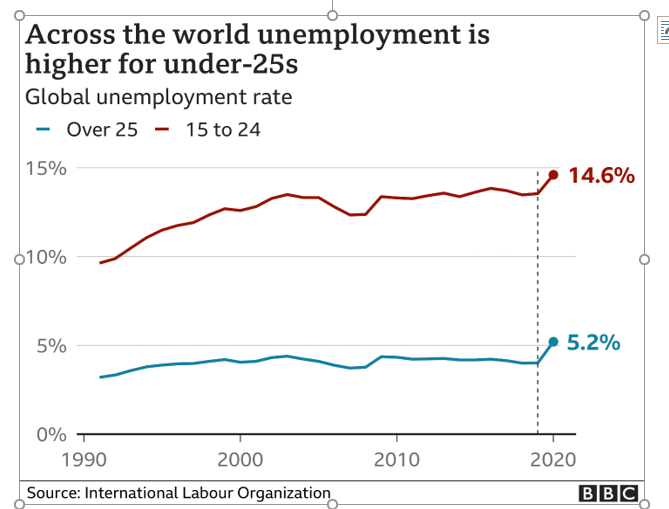
The unemployment rate among young people was 14.6 per cent in 2020, according to the ILO.
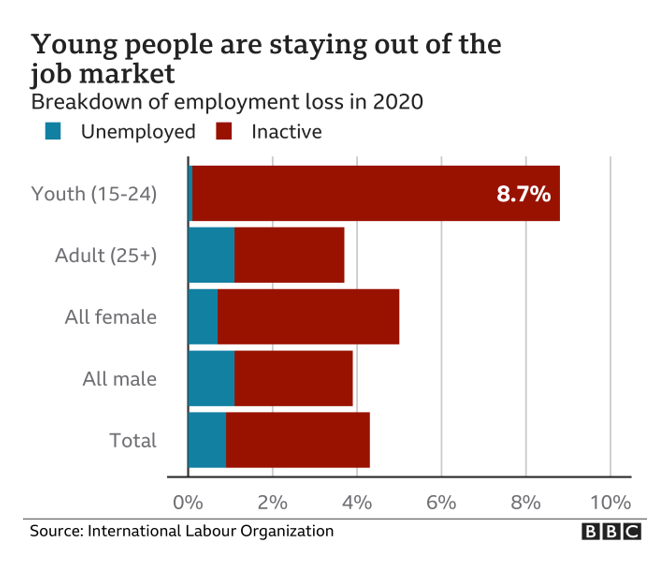
Economists distinguish between people who are unemployed and people who are “economically inactive”.
Those who are out of work but are looking for a job are considered unemployed. People who are not actively looking for a job (this includes those who may have given up searching for employment), or are in the process of starting their own business, are considered “economically inactive”.
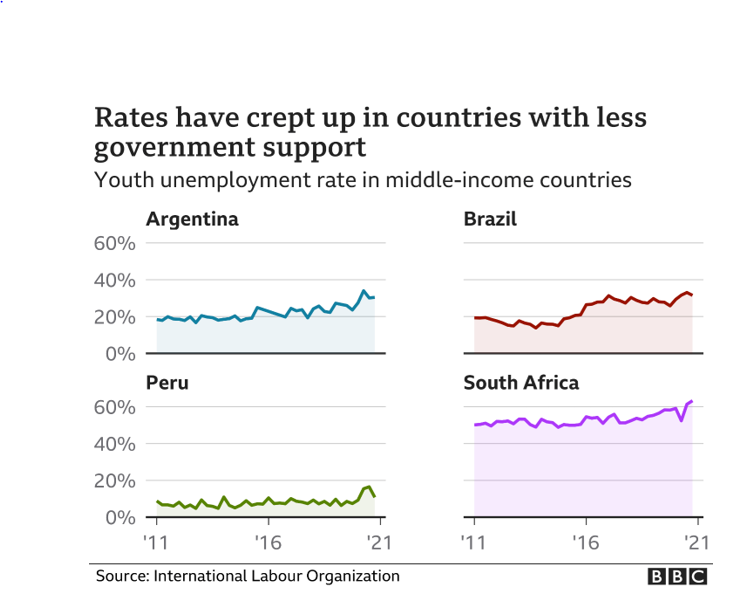
The biggest jumps in youth unemployment have occurred in what economists describe as “middle-income countries” such as Argentina, Brazil, South Africa and Peru.
According to the BBC, Middle-income economies were strong enough to have had thriving hospitality industries before the pandemic, for example.
However, they often lacked the economic resilience to go into extended lockdowns or provide generous support packages to businesses and workers.
In Europe, the pandemic is also posing an economic threat to younger generations.
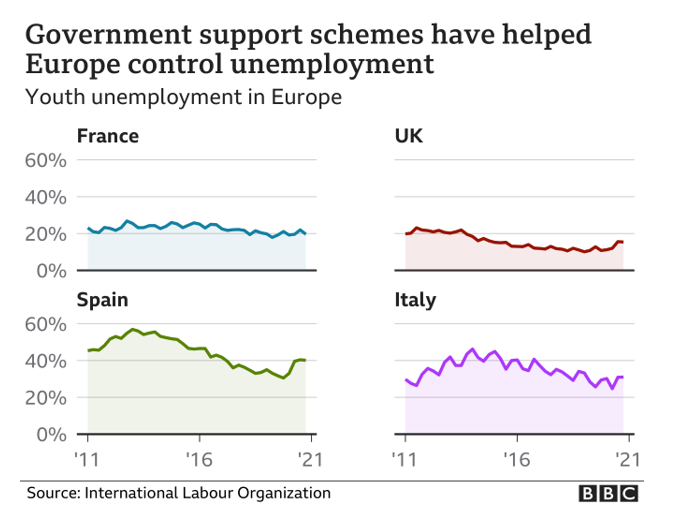
Countries such as Spain and Italy were still recovering from the effect of the eurozone crisis when the pandemic struck. In Spain, the recovery went into reverse.
But stronger economies such as France and the United Kingdom were able to keep youth unemployment relatively stable.
They used expensive government support schemes to make grants, loans and tax breaks available to struggling businesses and help employers pay staff who have been unable to work.
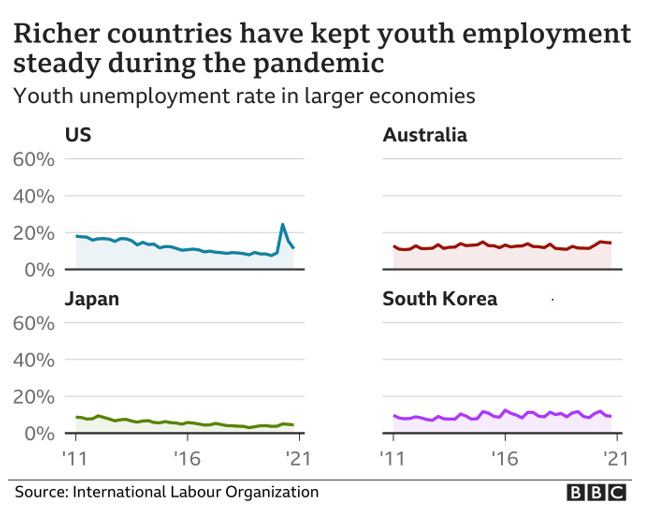
Other big economies saw a spike in youth unemployment in the first part of the pandemic, although government policies have been able to keep this under control.
In Japan and South Korea, rates of youth unemployment have been almost completely unchanged. Meanwhile in the United States, it shot up before the government intervened with heavy stimulus spending by Donald Trump and Joe Biden.
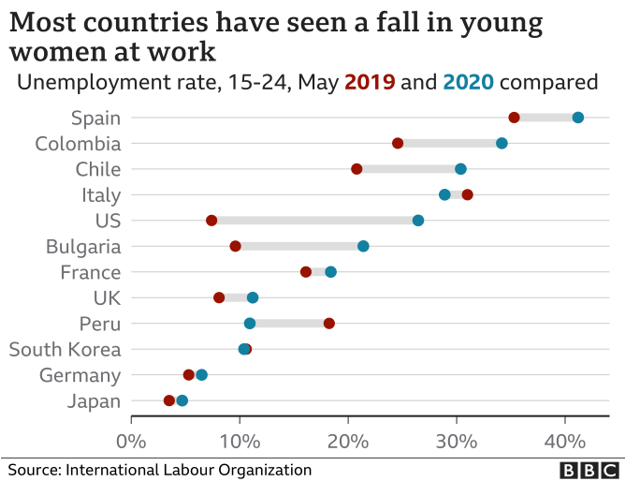
Young women have generally suffered more from the economic consequences of Covid than young men.
That is partly because women are more likely than men to work in some of the hardest-hit industries such as hospitality.
The ILO estimated that around the world, about 55 per cent of workers in hotel, catering and tourism were women.
Women were also more likely to have to stay at home and look after children when schools closed.
In middle-income countries, the unemployment rate for men is 23.7 per cent, while for women it is 29 per cent.
Before the pandemic struck, youth employment rates were still at a lower level than they had been before the global financial crisis in 2007-2008.
That’s because during and after a recession, youth employment tends to recover much more slowly than overall employment. School leavers and university graduates can miss out on valuable work experience.
Once the economy returns to normal, it becomes harder for them to compete with older and more experienced workers as well as the next generation of school leavers and graduates.
“Youth employment recovers slowly following a recession because young people don’t have the same work experience and access to networks that older people have, which means it is harder for them to compete for the fewer jobs that are available after a crisis,” Verick explained to the BBC.
Researchers have shown that graduating or leaving school during a recession can have a long financial hangover, because individuals arrive late on the first steps of the career ladder.
According to economists at the University of Leicester and the University of Nottingham, each month of unemployment between the ages of 18 and 20 leads to a permanent income loss of 1.2 per cent over the course of a career.
Sara Lemos, an economics lecturer at the University of Leicester, says that when young people spend time out of work, “they lose their skills, confidence and ability to reinsert themselves in the labour market, and lag behind.
“Employers see that inability to get a job as a signal that other employers have been refusing that worker, and assume that worker must not be productive enough to be hired.
“Naturally, the longer a worker stays unemployed, the stronger the stigma gets, and the harder it is to find a good job, and good pay.”