When enforcement becomes entrapment: How Lagos Task Force operations enable extortion and car snatching
By Okechukwu Nwanguma
In a city already burdened by traffic chaos and economic strain, citizens should at least find reassurance in the presence of law enforcement. Instead, for many Lagosians, an encounter with the Lagos State Task Force on Environmental and Special Offences has become a source of fear, anxiety, and – too often – financial exploitation.
What is emerging is not merely a pattern of overzealous enforcement, but something far more troubling: a system that bears the hallmarks of entrapment, extortion, and dangerously, a cover for car snatching under the pretext of traffic control.
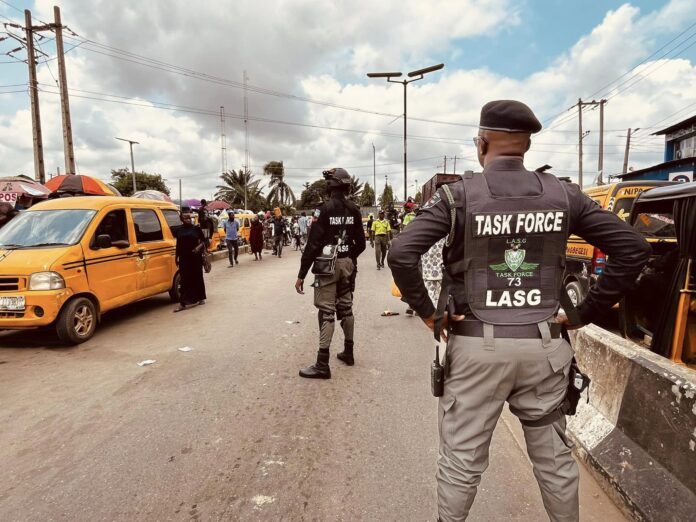
Consider a now familiar scenario. A motorist, trapped in Lagos gridlock, is approached by a tout who offers a seemingly helpful suggestion – “Madam, enter the BRT lane and bypass the traffic.” Trusting this guidance, the driver complies, only to be immediately intercepted by task force operatives lying in wait. Within minutes, the vehicle is seized and driven off – often by individuals whose identities are neither properly disclosed nor verifiable – to the Task Force yard in Oshodi.
At the yard, the ordeal takes a more disturbing turn. Victims are not directed through any transparent legal process. Instead, they are quietly funneled to a civilian intermediary – often a woman seated outside – who offers to “help” secure the release of the vehicle. The condition? Cash payments ranging from ₦100,000 to ₦150,000 or more. No receipts. No official records. No accountability.
This is not law enforcement. It is organized extortion.
Under the Lagos State Transport Sector Reform Law, there are indeed penalties for unauthorized use of BRT lanes. But those penalties are clearly defined and must be enforced through lawful, transparent channels. Payments are to be made through official government systems – not handed over in cash to unidentified individuals operating outside enforcement offices.
What we are witnessing is a deliberate distortion of the law to create opportunities for illicit gain.
Even more alarming is the grave security implication of these practices.
When vehicles are forcefully taken from drivers on public roads – sometimes by plainclothes operatives, sometimes with the involvement of touts – without immediate, verifiable documentation, the line between enforcement and outright car theft becomes dangerously blurred. In a country already grappling with insecurity, this model of operation inadvertently legitimizes car snatching. Criminal elements need only replicate the method: block a vehicle, claim “task force,” and drive it away.
How is an ordinary citizen to distinguish between a legitimate enforcement team and an organized criminal gang?
This is the question the authorities must urgently answer.
The Lagos State Ministry of Transportation and the leadership of the Task Force must confront a hard truth: a system that relies on ambush, civilian collaborators, and cash transactions is inherently corrupt and fundamentally unsafe.
It is also illegal.
The Administration of Criminal Justice Law Lagos State prohibits arbitrary and coercive practices. The principles of due process demand that any enforcement action be documented, transparent, and subject to review. None of these safeguards are present in the scenarios described.
Instead, what thrives is a parallel system – informal, opaque, and predatory.
If the Lagos State Government is serious about restoring public trust and ensuring road safety, urgent reforms are non-negotiable:
First, an immediate ban on cash payments in all enforcement processes. Every fine must be paid through verifiable, digital government channels.
Second, the dismantling of the tout–enforcement nexus. No civilian should play any role in traffic enforcement or in the processing of penalties.
Third, mandatory identification and body cameras for all task force operatives, ensuring that every interaction with the public is recorded and accountable.
Fourth, clear, publicly accessible guidelines on offences, penalties, and procedures, so that citizens are not left at the mercy of arbitrary demands.
Finally, there must be independent oversight and investigation into the operations at the Oshodi Task Force yard. Allegations of extortion and collusion cannot be ignored or internally managed – they require credible, external scrutiny.
Lagosians deserve enforcement that is firm but fair – not one that preys on their vulnerability.
Law enforcement must never become indistinguishable from criminality.
Until these practices are decisively addressed, every such encounter on our roads will continue to raise a chilling question:
Is this enforcement – or is it something far more dangerous?