US Congressional committee Chair condemns repression targeting Nigerians, says “it mirrors China’s well-documented tactics of transnational repression”
By Jeph Ajobaju, Chief Copy Editor
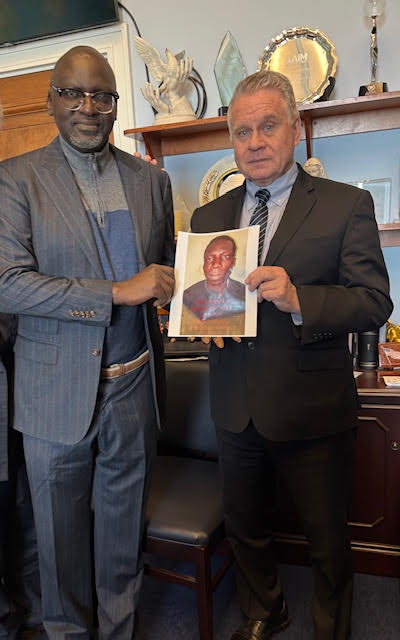
United States House of Representatives Foreign Affairs Subcommittee on Africa Chairman, Chris Smith (R-NJ), has condemned the threats and attacks on human rights lawyer Emmanuel Ogebe and other Nigerians who have courageously spoken out about human rights atrocities in their country.
Arch Bishop Matthew Kukah who testified before a congressional hearing was attacked for doing so and a survivor of Boko Haram’s anti-Christian massacres in Yobe, Habila Adamu, was fired from his state government job after testifying before this committee alongside Ogebe in November 2013 to designate Boko Haram as a Foreign Terrorist Organisation (FTO).
Witness intimidation or retaliation is a criminal offence and Ogebe said the Nigerian embassy in the US violated both its host country’s laws as well as international conventions on conduct incongruent with diplomatic status not to mention violating his rights under the Nigerian Constitution.
Bishop Wilfred Anagbe, who recently testified along with Ogebe before the committee, has also been attacked but Ogebe counselled him to “take heart as we in Benue are known for our courage and these mere mortals raging, God will only laugh at.”
Smith issued a statement on his own outrage over the attacks, a copy of which Ogebe sent to TheNiche.
In the statement, Smith strongly condemned recent acts of transnational repression targeting Nigerians and Nigerian-Americans in the US following a March 12 congressional hearing he chaired on religious persecution in Nigeria.
“These alarming acts of intimidation – occurring both before and after my Congressional hearing – are not isolated,” said Smith, author of H.Res. 220 – to designate Nigeria a Country of Particular Concern (CPC).
“They reflect a troubling pattern of retaliation linked to testimony before Congress on religious freedom abuses in Nigeria.”
Smith has also authored H.R. 3654, The Transnational Repression Policy Act.
His hearing on 12 March 2025 examined Nigeria’s dismal record on religious freedom and considered whether the US should re-designate Nigeria as a CPC under the International Religious Freedom Act.
Testimony spotlighted the systematic persecution of Christians, non-Fulani Muslims, and faith leaders advocating for tolerance – issues that appear to have triggered threats against individuals who testified or supported accountability efforts.
“I am appalled by reports that Bishop Wilfred Anagbe and Father Remigius Ihyula are facing threats – allegedly from Nigerian government sources and affiliated organizations – because of the Bishop’s testimony before Congress detailing violence in Nigeria’s Benue State,” said Smith.
“Credible sources now indicate that Bishop Anagbe may face detention upon returning to Nigeria, and I also fear there are some who would seek to do him physical harm.”
For nearly a decade, Anagbe has sounded the alarm on the government’s failure to protect communities in Benue from violent attacks by Fulani herdsmen, resulting in mass killings, displacement, and the occupation of ancestral lands.
Instead of launching investigation, Nigeria’s Ministry of Foreign Affairs has sought to discredit Anagbe’s testimony, labeling it misinformation despite evidence.
The recent change in the US administration seems to spark fear by the Nigerian government that the CPC designation may become a reality.
“This thuggery not only threatens fundamental human rights, but it also violates U.S. criminal law and undermines a core congressional oversight function,” Smith stressed.
“It mirrors the Chinese Communist Party’s (CCP) well-documented tactics of transnational repression – trampling civil liberties and attempting to silence dissidents far beyond its borders.”
Smith also cited the past case of Ogebe, who has faced retaliatory efforts from Nigerian authorities following his 2015 congressional testimony, including attempts to revoke his passport and smear his reputation.
“Mr. Ogebe was forced to sue to protect his constitutional rights. Others remain in hiding. In the worst cases, they become martyrs. This must end,” Smith insisted.
“The United States cannot allow foreign actors to intimidate or harass individuals within our borders for exercising their basic rights – particularly those who are assisting Congress by providing testimony.
“I will continue to work aggressively with the U.S. Department of State, the Department of Justice, and other relevant agencies to take swift and decisive action to confront these acts and hold those responsible fully accountable.”
Read also:
Customs intercepts at Abuja Airport N8.65b Tramadol sneaked into Nigeria