


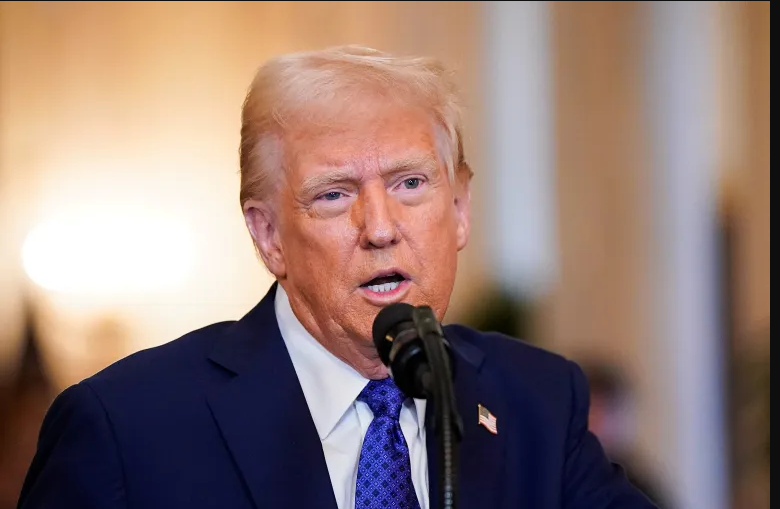
While the frustration of President Trump may partly be understood, his threat of a possible military invasion of Nigeria is largely counterpointed to the established scheme of engagement in international intervention. Capability/Capacity to deal with an issue is often separated with refusal to deal with an issue in international relations. And depending on what the facts present, international actors determine some compact responses, either in form of intervention, assistance, cooperation, collaboration, attack or even alliance formations.
By Olawale Lawal
For some of us, it’s always a delight when we have rumbles in international relations especially when Nigeria becomes a centerpiece of global racketing and whispering. For experts and pseudo experts of international relations and foreign policy the burning issue is Donald Trump’s threat of invasion of Nigeria. By the way, it was so pleasing for me to see Professor Akin Oyebode come out to speak after almost a decade since we heard from this academic elite and a true expert of international law and jurisprudence. And I have been talking too.

My intervention holds apologia to those who are adept at quipping at conclusion of all arguments without knowing their destination – this is a purely academic and diplomatic view. I will attempt here to clarify some issues as I see them. My first tier of concern is the panic in Nigeria over Trump’s designating Nigeria as a Country of Particular Concern – a CPC state. This is often mistaken with Country of Particular Interest (CPI). The latter, CPI is an international instrument used broadly by international actors to cover violations of various levels of human rights and it gives both credence and competence to international legal system. The CPC on the other hand is specific and primarily about violation of religious freedom and it is a United States interventionist policy under the International Religion Freedom Act (IRFA). So, is it a US Act, strictly speaking, and by the way, the US has designated a number of countries using this act. China, North Korea, Iran Russia, Saudi Arabia, Cuba, Pakistan etc. are few examples of some of the states already designated. What is intriguing here is that the CPC targets governments who have policies that have made the practicing of certain religions unbearable or impracticable. The US has often looked the other way, despite designating a country a CPC, if greater economic or political gains are to be achieved, for example, check US/Saudi Arabia relation as a guide.
READ ALSO:
Trump’s CPC classification and Nigeria’s sovereignty
The CPC is a US foreign policy apparatus and therefore is not part of international law, whether as customary or in wider usage. Nations sometimes may ape the foreign policy of a super power; they do so largely because of the universal long-range capability of such super powers, therefore, that the US designates Nigeria a CPC does not put Nigeria at a risk of international excommunication. However, while CPC is still largely a municipal instrument, the issue of genocide is considered very serious in international relations, a la international law. It was the Polish lawyer Raphael Lemkin who coined the word “genocide” in 1944 to refer to intentionality to kill a tribe or race (geno) and cide – killing. Earlier intentional exterminations of a race were termed in different crucibles, e.g., the Killing of the Jews was termed “holocaust” because it predated the arrival of “genocide” to international relations lexicon. Genocide is a crime against humanity and if established, any state or person adjudged to have committed it, faces international opprobrium. To the extent that it is a frontline human rights violation, speaks to its relevance in international jurisprudence. And for whatever it is worth, the establishment of genocide blurs the line between what is a domestic affair and issues of international interests. The claim that a nation’s sovereignty is a protection against interference is a misread of the workings of international relations. States membership of international organizations is a partial submission of sovereign status to a supra national entity. Always, states are required to ensconce in their obligations under international conventions which regulate states affairs. This highlights the point that every international law does not have a close end. In other words, genocide opens a state’s action to international interrogations.
Now, to the claim that genocide is going on in Nigeria, according to President Donald Trump, needs some solemn analysis. By the way, all sectarian bases of establishing genocide are usually hampered by emotional interjections amidst claims and counterclaims. And one needs to exercise serious restrain in denial or acceptance that genocide is taking place in Nigeria, if the meaning of the word still retains intentional killing of a people, and now of Christians. In the last ten years or so, Nigeria has seen killings of innocent Nigerians in churches, mosques, villages, city centers, international relief organizations, security bases and farmlands. These ructions are perpetrated by groups of internecine interests, insurgents and terror organizations with their international affiliates.
While the frustration of President Trump may partly be understood, his threat of a possible military invasion of Nigeria is largely counterpointed to the established scheme of engagement in international intervention. Capability/Capacity to deal with an issue is often separated with refusal to deal with an issue in international relations. And depending on what the facts present, international actors determine some compact responses, either in form of intervention, assistance, cooperation, collaboration, attack or even alliance formations. Agreed, there is a crisis in Nigeria, there is no evidence that the Nigerian government has refused to act or even complicit in the attacks. If this is the case, then we come to the issue of whether Nigeria has capacity and capability to deal with this issue.
It is commonplace that there is very deep security cooperation between the US and Nigeria. The United States has worked closely with Nigeria, both bilaterally and through regional and multilateral frameworks like the Economic Community of West African States (ECOWAS), the Multinational Joint Task Force (MNJTF), the Global Coalition to Defeat Daesh/ISIS, and the African Union. The Department of State also provides Nigeria with one of the highest International Military Education and Training (IMET) allocations in sub-Saharan Africa. All of these in addition to the sales of weapons like attack helicopters and Super Tucano aircraft. All of these must be viewed strictly from the context of capacity building and not capability
So, rather than talking about invasion, the discussion should be around intervention. And I want to believe that there is a difference between cooperation and collaboration, while both means working together, collaboration is broader and more intense, the edge which collaboration has over cooperation is its integrative techniques and infusing of diverse elements to create a unified whole. When Nigeria and the US cooperate, they share ideas, data and equipment, but when they collaborate, they work together.
President Donald Trump is speaking as Donald Trump and whatever he said could only mean intervention and not invasion in the manner that he said it. An Obama or Joe Biden would have said the same thing differently. We should not also forget that Trump used the phrase “disgraced country” to describe Nigeria and that means he was speaking from position of anger or frustration and the direction where that is coming is not easily placed. Could he be reacting to the fact that Nigeria produced a Nobel laureate in Literature who tore his green card as a stake in the unlikelihood of Trump emergence as president of the United States in 2016? But already there is a consular riposte which resulted in the revocation of the permanent visa of the citizen of the cosmopolis. Or does the phrase simply show that Trump was confounded by Nigeria’s security challenges?
Whichever way, Nigeria has a very good opportunity to exert credible collaboration from the United States. The advantage which Nigeria has is still her military which has local understanding of the operations of the insurgents. When the two collaborate, they will succeed.
Olawale Lawal (PhD), is a Professor of History and International Studies, Lagos State University Ojo Lagos

