


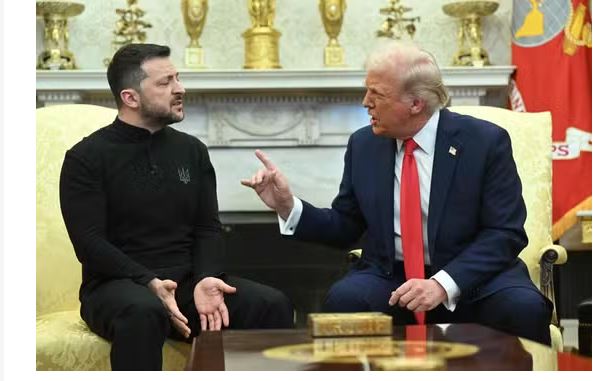
Trump suspends military aid to Ukraine after Zelenskyy clash
US President Donald Trump suspended military aid to Ukraine on Monday, a White House official said, sharply escalating pressure on Kyiv to agree to peace negotiations with Russia.
The move comes just days after a stunning public clash between Ukrainian President Volodymyr Zelenskyy and Trump, who is seeking a rapid end to the war.
Trump earlier on Monday had declined to rule out a pause when quizzed by reporters, but any disruption in the flow of US arms to the front line would rapidly weaken Ukraine’s chance of beating back Russia’s invasion.
“The President has been clear that he is focused on peace. We need our partners to be committed to that goal as well,” a White House official told AFP, speaking on condition of anonymity.
“We are pausing and reviewing our aid to ensure that it is contributing to a solution,” the official added.
Congressional Democrats immediately condemned the pause as dangerous and illegal.
READ ALSO: Trump and Zelensky clash in Oval Office
“My Republican colleagues who have called Putin a war criminal and promised their continued support to Ukraine must join me in demanding President Trump immediately lift this disastrous and unlawful freeze,” said Gregory Meeks, top Democrat on the House Foreign Affairs Committee.
Trump also warned he would “not put up” much longer with Zelenskyy’s defiance, and said Ukraine’s leader should be “more appreciative” of US support.
Speaking at the White House, Trump said Zelenskyy “won’t be around very long” without a ceasefire deal with Moscow.
The pause has gone into effect immediately and impacts hundreds of millions of dollars of weaponry in the process of being sent to Ukraine, The New York Times reported.
Zelenskyy for his part said Monday he was seeking for the war to end “as soon as possible.”
The comment came after Zelenskyy accused Russia — which invaded Ukraine in 2014 and greatly expanded the conflict in 2022 — of not being serious about peace.
He insisted tough security guarantees were the only way to end the war.
But Trump’s stance has upended US support for Ukraine, and Washington’s allies more broadly, and stoked concern about Washington pivoting to Russia.
European support
After weekend crisis talks in London, Britain and France are investigating how to propose a one-month Ukraine-Russia truce “in the air, at sea and on energy infrastructure” — potentially backstopped by troops on the ground.
Zelenskyy said discussions were still focusing on the “first steps,” adding: “An agreement on ending the war is very, very far away” — a comment that angered Trump.
Zelensky added in a video statement that “real, honest peace” would only come with security guarantees for Ukraine, which agreed to denuclearize in 1994 only in exchange for protection provided by the United States and Britain.
“It was the lack of security guarantees for Ukraine 11 years ago that allowed Russia to start with the occupation of Crimea and the war in Donbas, then the lack of security guarantees allowed Russia to launch a full-scale invasion,” Zelenskyy said.
Russia dismissed the comments, accusing him of not wanting peace — echoing US criticism after he was shouted down Friday in the Oval Office.
On the ground, Ukrainian officials reported fatalities from a Russian missile strike on a military training facility some 130 kilometers (80 miles) from the front line.
A respected military blogger said between 30 and 40 soldiers were killed and 90 more wounded in the attack near Dnipro on Saturday.
‘Deliberate’ escalation?
Trump has previously called Zelenskyy, president since 2019, a “dictator” for not holding elections, even though martial law precludes any vote because of the war.
Zelensky dismissed calls for him to resign, repeating his pledge to do so only if Ukraine were given NATO membership, which Russia — and now the United States under Trump — opposes.
In Moscow, Kremlin spokesman Dmitry Peskov blamed Zelensky for Friday’s blow-up with Trump and Vice President JD Vance, saying he “demonstrated a complete lack of diplomatic abilities.”
“He doesn’t want peace,” Peskov told reporters.
On Monday Vance told broadcaster Fox News he was confident Zelensky would “eventually” agree to peace talks with Moscow.
“I think Zelensky wasn’t yet there, and I think, frankly, now still isn’t there,” Vance said. “But I think he’ll get there eventually. He has to.”
But Germany’s likely next chancellor, Friedrich Merz, said the astonishing White House clash was a “deliberate escalation” by Trump.
US and Russian officials have held talks on ending the war, enraging Kyiv and Europe for being sidelined, and prompting fears that any deal could threaten Ukraine’s future.
What pause in US military aid could mean for Ukraine
President Donald Trump’s decision to pause all US aid to Ukraine is a bitter blow – not just for Kyiv but also European allies who have been lobbying the US administration to continue its support.
This is not the first time that the US has withheld military aid. Republicans in Congress blocked then-President Joe Biden’s largest tranche of military assistance for Ukraine in the summer of 2023.
Then, Ukraine just about managed to eke out its existing stocks of ammunition with the help of Europe.
Congress finally approved the £60 billion aid package in the spring of 2024. It was just in time – Ukraine was struggling to fend off a renewed Russian offensive in Kharkiv. The arrival of the delayed US weapons helped turn the tide.
As in 2024, it may be months before the effects of cutting off US aid are felt – at least in terms of ammunition and hardware. European nations have slowly ramped up their production of artillery shells. Overall Europe now provides Ukraine with 60 percent of its aid – more than the US.
However, US military support is still vital to Ukraine. One Western official recently described it as “the cream” in terms of weapons.
Ukraine’s ability to protect its people and cities has heavily relied on sophisticated US air defence systems – such as Patriot batteries and NASAMS – jointly developed with Norway.
The US has given Ukraine the ability to carry out long range strikes – with HIMARS and ATACM missiles. The US has limited their use inside Russia, but they have still been vital to hit high value targets inside occupied territories.
It is not just quality, but quantity too. As the world’s most powerful military, it has been able to send hundreds of surplus Humvees and armoured vehicles – numbers that smaller European armies could never match.
The absence of some of this aid may take time to filter down to the frontline. But there could be a more worrying immediate impact, not least in terms of intelligence sharing.
No nation can match the US in terms of space-based surveillance, intelligence gathering and communications. And it is not just provided by the US military, but commercial companies too.
Take Elon Musk’s Starlink satellite communication network. Every Ukrainian position on the frontline has a Starlink dish.
They are used to relay the latest information on the battlefield. They have been essential to co-ordinate artillery and drone strikes.
In the past, the Pentagon has admitted that it has been funding this lifeline. Given that Elon Musk is a key figure in the US administration, it seems highly unlikely that he will now be willing to foot the bill. He too is a harsh critic of Ukrainian President Volodymyr Zelensky.
Will the US prevent European countries from sending their US-made equipment to Ukraine? When Europe wanted to provide US-manufactured F-16 jets to Ukraine, it first had to receive the approval of Washington.
And then what about the maintenance of US-supplied equipment? The US has also been training Ukrainian forces and then helping them maintain US-supplied equipment.
Biden lifted restrictions on US contractors working in Ukraine towards the end of his term. F-16 jets in particular need engineers and spares to keep on running.
Trump’s decision to pause aid may, to many in Ukraine and beyond, seem petulant. But there is also clearly a political aim to force them to the negotiating table sooner.
The hope among European allies is that it will just be a pause. Without US support, Ukraine will find it an even harsher struggle for survival.

