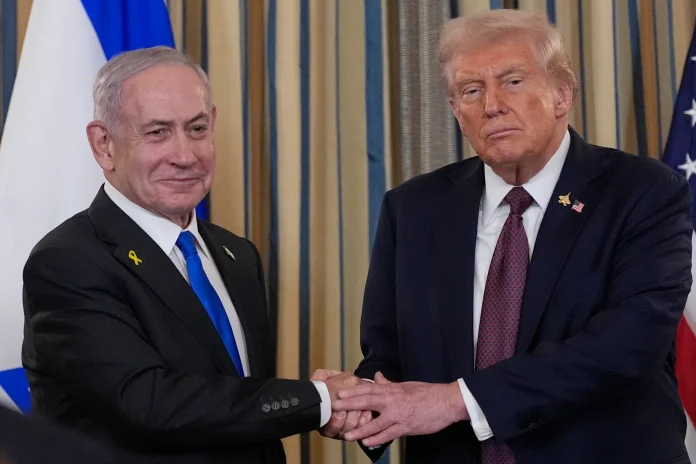
Trump, Netanyahu agree on plan to end Gaza war; Gazans call plan a farce
Trump and Netanyahu say they’ve agreed on a plan to end Gaza war and await Hamas to accept the terms
President Donald Trump and Israeli Prime Minister Benjamin Netanyahu said Monday they’ve agreed on a plan to end the war in Gaza, but it’s unclear whether Hamas will accept the terms.
Trump on Monday laid out a 20-point plan for ending the Israel-Hamas war and establishing a temporary governing board in the war-battered Palestinian territory that would be headed by Trump and include former British Prime Minister Tony Blair.
The plan does not require people to leave Gaza and calls for the war to end immediately if both sides accept it. It also calls for all remaining hostages to be released by Hamas within 72 hours of Israel accepting the plan.
Trump said Israel would have the “full backing” of the United States to take steps to defeat Hamas if the group doesn’t accept the proposed peace deal.
“I think we are beyond very close,” Trump said at the start of a news conference with Netanyahu where he detailed the plan. “We’re not quite finished. We have to get Hamas.”
“If Hamas rejects your plan, Mr. President, or if they supposedly accept it and then do everything to counter it, then Israel will finish the job by itself,” Netanyahu said. “This can be done the easy way or it can be done the hard way, but it will be done.”
The president went on to urge Palestinian people to take responsibility “for their destiny” and embrace his peace proposal.
Qatar’s prime minister and Egypt’s intelligence chief presented Trump’s proposal to Hamas negotiators, who are now reviewing it in “good faith,” according to a person familiar with the matter. The person was not authorized to comment and spoke on the condition of anonymity.
While Hamas has said in the past that it would agree to step back from governing Gaza, the militant group has refused to disarm, something Netanyahu has long demanded as part of any long-term truce to end the war.
The Palestinian government in the occupied West Bank welcomed Trump’s plan and pledged to implement reforms called for in the plan in order to return to Gaza and potentially clear the way for the establishment of a Palestinian state.
“We have affirmed our desire for a modern, democratic, and non-militarized Palestinian state, committed to pluralism and the peaceful transfer of power,” the Palestinian government said in a statement. It promised a series of reforms, including new elections, changes to its schoolbooks and ending a system that pays the families of militants involved in attacks on Israelis.
Netanyahu earlier on Monday extended a formal apology to his Qatari counterpart for a recent military strike targeting Hamas officials in the Gulf emirate that infuriated Arab leaders and triggered rare criticism by the U.S. of Israel.
Netanyahu made the call to Qatar’s prime minister, Sheikh Mohammed bin Abdulrahman Al Thani, as he met with Trump.
Trump described the exchange between the Israeli and Qatari leader as a “heart-to-heart” call.
“As a first step, Prime Minister Netanyahu expressed his deep regret that Israel’s missile strike against Hamas targets in Qatar unintentionally killed a Qatari serviceman,” the White House said in a statement. “He further expressed regret that, in targeting Hamas leadership during hostage negotiations, Israel violated Qatari sovereignty and affirmed that Israel will not conduct such an attack again in the future.”
The White House talks, and apology from Netanyahu, come at a tenuous moment. Israel is increasingly isolated, losing support from many countries that were long its steadfast allies. At home, Netanyahu’s governing coalition appears more fragile than ever. And the White House is showing signs of impatience.
It remains to be seen how Netanyahu will be able to justify to far-right members of his coalition his acceptance of the proposal after promising to press against the militant organization until it was “eliminated.”
The Trump plan indicates that once all hostages are returned, Hamas members who “commit to peaceful co-existence and to decommission their weapons will be given amnesty.” The plan adds that members of Hamas who wish to leave Gaza would be provided safe passage to receiving countries.
Netanyahu’s apology for strike that angered US ally
Netanyahu also used the visit to mend fences with a key U.S. ally in the Middle East.
Israel stuck the headquarters of Hamas’ political leadership in Qatar on Sept. 9 as the group’s top figures gathered to consider a U.S. proposal for a ceasefire in the Gaza Strip.
The strike on the territory of a U.S. ally was a stunning escalation and risked upending talks aimed at winding down the war and freeing hostages. No senior Hamas officials were killed in the strike.
The attack on an energy-rich Gulf nation hosting thousands of American troops, which has served as a key mediator between Israel and Hamas throughout the war and even before, was described by Trump as out of step with Israeli and U.S. interests. And Trump sought to move quickly to assuage his Qatari allies.
Qatar, meanwhile, condemned the strike as a “flagrant violation of all international laws and norms” as smoke rose over its capital, Doha. Other key U.S. allies in the Gulf, Saudi Arabia and the United Arab Emirates, promised their support to Qatar.
The White House said Sheikh Mohammed welcomed Netanyahu’s “assurances” and emphasized “Qatar’s readiness to continue contributing meaningfully to regional security and stability.”
But even as the White House was spotlighting the apology, Israel’s far right national security minister newly defended the decision to carry out Israel’s attack.
Itamar Ben-Gvir, a key coalition partner of Netanyahu’s, in a posting on X called the operation “an important, just and ethical attack.”
“It is very good that it happened,” he added.
Trump has been growing more frustrated with conflict
Trump joined forces with Netanyahu during Israel’s brief war with Iran in June, ordering U.S. stealth bombers to strike three nuclear sites, and he’s supported the Israeli leader during his corruption trial, describing the case as a “witch hunt.”
But the relationship has become more tense lately. Trump was frustrated by Israel’s failed strike this month on Hamas officials in Qatar.
Last week, Trump vowed to prevent Israel from annexing the West Bank — an idea promoted by some of Netanyahu’s hard-line governing partners. The international community opposes annexation, saying it would destroy hopes for a two-state solution.
Gazans say Trump’s peace plan a ‘farce’
Meanwhile, residents of war-torn Gaza expressed scepticism over the latest peace plan unveiled Monday by US President Donald Trump, dismissing it as a farce that fails to end the war.
“It’s clear that this plan is unrealistic”, 39-year-old Ibrahim Joudeh told AFP from his shelter in the so-called humanitarian zone of Al-Mawasi in south Gaza.
“It’s drafted with conditions that the US and Israel know Hamas will never accept. For us, that means the war and the suffering will continue”, said the computer programmer, originally from the southern city of Rafah, devastated by a military offensive that began in May.
The residents spoke shortly after Trump unveiled his 20-point plan aimed at ending the war and to which Israeli Prime Minister Benjamin Netanyahu offered his backing after the two held talks at the White House.
The plan calls for a ceasefire, release of hostages by Hamas, disarmament of Hamas and gradual Israeli withdrawal from Gaza.
Other key points include deployment of a “temporary international stabilisation force” and creation of a transitional authority headed by Trump himself and featuring other foreign leaders.
The plan also stipulates that Hamas and other militant factions would not have any role in the governance of Gaza, directly, indirectly, or in any form.
Abu Mazen Nassar, 52, was equally pessimistic, and feared that the plan aimed to trick Palestinian factions into releasing hostages held in Gaza and no peace in return.
“This is all manipulation. What does it mean to hand over all the prisoners without official guarantees to end the war?” said Nassar, displaced from his home in north Gaza in central Gaza’s Deir el-Balah.
“We as a people will not accept this farce,” he said, adding: “Whatever Hamas decides now about the deal, it’s too late.”
“Hamas has lost us and drowned us in the flood it created.”
Lingering hope and lost faith
Some, like Anas Sorour, a 31-year-old street vendor from the south Gaza city of Khan Yunis, also displaced to Al-Mawasi, dared to hope.
“Despite everything we’ve lived through and lost in this war… I still have hope,” Sorour told AFP.
“No war lasts forever. This time I am very optimistic, and God willing it will be a moment of joy that makes us forget our pain and our anguish,” he added.
But others like 29-year-old homemaker Najwa Muslim, could no longer imagine anything changing.
“I haven’t only lost faith in the deal; I’ve lost faith in life,” Muslim told AFP from central Gaza, where she sought refuge after being displaced from Gaza City, currently under a massive Israeli military offensive.
“If there was a real intention to stop the war, they wouldn’t have waited this long. That’s why I don’t believe any of their words.”
On Monday, at least 30 people were killed across Gaza in Israeli strikes, according to Gaza’s civil defence agency, which operates under Hamas authority.
After almost two years of war and countless attempts at ceasefire deals for Gaza, every new announcement is met with suspicion, even when Trump publicly presented a deal Monday alongside a cautious Netanyahu in an unprecedented move.
Mohammed al-Beltaji, a 47-year-old from Gaza City, summarised his view of negotiations to AFP.
“As always, Israel agrees then Hamas refuses — or the other way around. It’s all a game, and we, the people, are the ones paying the price.”
Earlier Monday, a large plume of black smoke billowed over the hundreds of tents that made up a camp for the displaced in Khan Yunis.