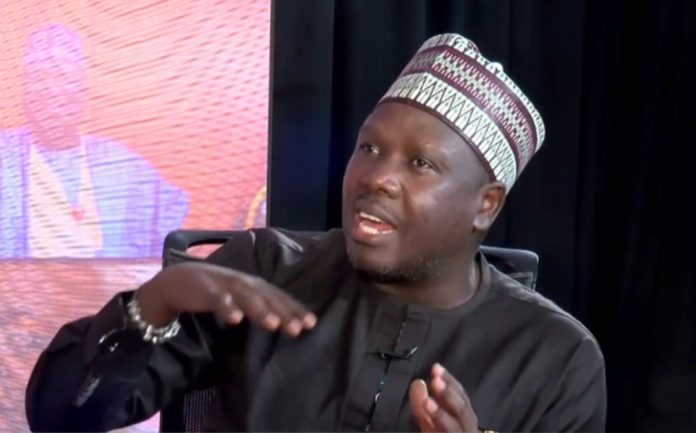
Bwala argued that there is no statutory requirement for appointing ambassadors, noting that the role is largely political.
By Kehinde Okeowo
President Bola Tinubu’s Special Adviser on Policy and Communication, Daniel Bwala, has responded to criticism that trailed the recently released ambassadorial list, saying his boss was not searching for “perfect people” to serve in government.
Bwala made this known on Thursday while appearing as a guest on Arise Television’s Morning Show.
Earlier in the week, President Tinubu appointed 32 ambassadors-designate and sent their list to the Senate for confirmation.
Those who made the list included controversial figures such as former presidential aide and social media influencer, Reno Omokri, and former Aviation Minister, Femi Fani-Kayode.
While addressing the criticism that greeted some of the names on the list, Bwala explained that there is no statutory requirement for appointing ambassadors, noting that the role is largely political.
He went on to argue that ambassadors may be drawn from career diplomats or politicians, just as past Ministers of Defence, before the Buhari administration, were appointed without any military experience.
Bwala further noted that concerns over nominees’ past conduct are subjective, adding that even in advanced democracies, appointments are often influenced by political considerations.
READ ALSO: Shehu Sani explains Tinubu’s ‘snub,’ says ‘I’m too young to be an ambassador’
He cited the United States, noting that some Supreme Court justices appointed by President Donald Trump were selected based on ideological alignment.
Speaking during the interview, Bwala said: “You see, there is no statute or book that talks about the requirement for being appointed as ambassador. That is why you have career ambassadors who are in the embassies. They can advise, they can run diplomatic issues. An ambassador is a political appointment which a President exercises. He can choose to bring a former diplomat. He can choose to bring a pure politician. It is just like appointing somebody as Minister of Defence. Until Buhari, all the Ministers of Defence never had any military experience. They were pure civilians. So political appointment is different.
“Now in terms of whether the people have participated in a toxic environment. I mean, if you look at where we always look up to as the model of democracy: there is Marco Rubio, and if you see the things he said about Donald Trump, even in the primaries. Then you come to JD Vance, you see them surrounded. In terms of appointment, in America there are justices of the Supreme Court who Donald Trump appointed only because they gave judgments favorable to the Republican ideology. That was his consideration.
“I think that the basic thing is you must be judged fit and proper. Now that is generic. The definition as to whether somebody is fit and proper is subjective. Somebody can say, I like the temperament of this one. Another person can say, I do not like it. There are people in government right now whose temperament you could also question.
“Your choice of rice might be different from mine. Maybe you want fried rice and I want pure white rice. But I am trying to suggest to you that the bottom line is the man recruiting them decides whether these people would fit, because Section 5 is clear. The executive powers of the Federation lie in the President. So he runs the government by himself or through delegation. He makes a choice of who he delegates. If he makes a bad choice, he will see it.
“But the beauty of democracy is that we do not go about looking for perfect people. We look for people who are ready to work. Even in the course of work, if you do anything wrong, you will be sacked. That is how democracy is built. Even pastors. You appoint somebody, you anoint somebody as a pastor, and you think that is heaven on earth. He starts and then he misbehaves. Then you subject him to disciplinary measures. Democracy does not close itself to the possibility of error. The government itself is not perfect. In the course of running governance, you take feedback from Nigerians.”
l