


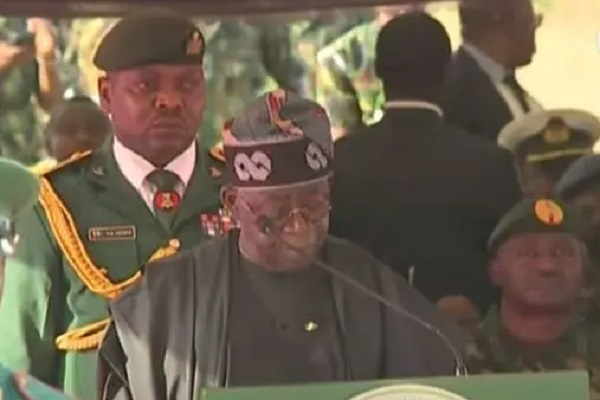
Tinubu urges editors: Let verification be your anchor
President Bola Ahmed Tinubu today tasked Nigerian editors to make verification their “anchor,” balance their “principle,” and professional judgement their guide in shaping the national discourse, especially in the age of rapid misinformation.
The President delivered the charge on Wednesday, November 12, 2025, during his opening address at the Annual Conference of the Nigerian Guild of Editors (NGE), held in Abuja.
Speaking on the conference theme, “Democratic Governance and National Cohesion: The Role of Editors,” President Tinubu acknowledged the enduring importance of the media in strengthening democratic life. He stressed that journalism has historically been an instrument of national awakening, with many journalists making significant sacrifices to defend “reason, dignity and progress.”
However, he cautioned that a democracy requires constant vigilance, stating that the “integrity of public conversation” is essential for its sustenance.
He said: “We live in a time when information travels rapidly and widely. Social media has made every citizen a potential publisher. This has benefits, but it also increases the speed and scale of misinformation. Falsehood can take root before truth has time to speak. In such an environment, the editorial function is more important than ever. Verification must be your anchor; balance must be your principle, and professional judgement must be your guide.”
On his part, Governor Hope Uzodimma of Imo challenged the editors to accept full public accountability for the prevailing trust deficit ahead of the 2027 general elections.
Delivering keynote address at the Editors Conference, Uzodimma argued that the media’s role as “catalyst” for democratic governance and national cohesion inherently makes them accountable for the integrity of the electoral process itself.
He stated that without electoral integrity, democracy cannot exist, and democracy begets the good governance necessary to exorcise the trust deficit.
He cautioned the editors that, while the “pen is mightier than the sword,” the power they wield must be exercised with solemn responsibility.
He said: “Objectivity, properly understood, carries a solemn responsibility. It must be calibrated by overriding considerations of national cohesion and editorial integrity. When your editorial framing treats every electoral challenge as evidence of systemic fraud rather than contextualising it within an imperfect but improving process, you are not being objective; you are making a choice. And that choice has consequences. So, as I speak today about editorial responsibility, I am not asking you to abandon objectivity. I am asking you to practice it at its highest level: accuracy over speed, verification over virality, and context over clickbait. Does that amount to restriction? No. On the contrary, it is a call to rigour.”
President of the Guild, Eze Anaba, spoke on the economic sustainability of the media, saying the media has to survive as a business for it to carry out its constitutional and social responsibilities role.
He proposed several policy recommendations. Key among them is temporary corporate tax relief (for 5–10 years), VAT exemption on essential media inputs (equipment and tools), and the establishment of a low-interest loan scheme through institutions like the Bank of Industry.
The Guild also requested tax deductions for companies that advertise in verified Nigerian media outlets to redirect revenue to local journalism and reduce reliance on foreign grants. Furthermore, the NGE advocated for the creation of an independently managed Media Development Fund to support the digital transformation of newsrooms and encourage innovation like data journalism and multimedia storytelling.

