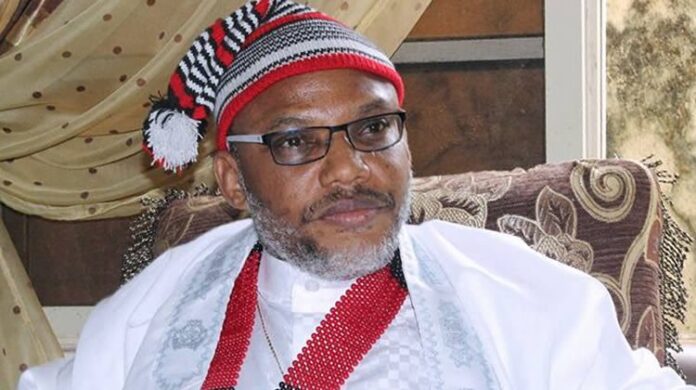
RULAAC seeks Kanu’s release as key to restoring peace in Southeast
By Habiba Kaita
Calls for the release of Nnamdi Kanu, leader of the Indigenous People of Biafra (IPOB), has intensified, the latest being from the Rule of Law and Accountability Advocacy Centre (RULAAC).
In February, RULAAC convened a stakeholders summit on Peace and Security in Enugu, attended by the Nigerian Bar Association (NBA), and several civil society organizations. The meeting observed that peace could not return to the Southeast region unless justice and dialogue are prioritized by the federal government.
In the light of renewed agitation for Kanu’s release, RULAAC noted that at the summit, speakers said the problems of the Southeast did not start with Kanu or IPOB. They explained that after the Civil War ended in 1970, the government promised to help rebuild the region, but defaulted, leading to years of political and economic neglect.
RULAAC explained that the promise of “Reconciliation, Reconstruction, and Rehabilitation” after the war was never fully fulfilled, leaving many people feeling excluded from national development.
“IPOB’s agitation is a political response to decades of exclusion,” said Okechukwu Nwanguma, Executive Director of RULAAC. “Because it’s political, it needs a political solution, not force.”
The stakeholders also pointed out that Kanu’s case has been treated differently from other regional conflicts.
They compared it with how the government handled the Niger Delta militancy, where leaders were granted amnesty and offered jobs, contracts, and education opportunities.
“Even bandits and Boko Haram members have been forgiven and reintegrated,” Nwanguma said. “So why should Nnamdi Kanu’s case be different?”
They said this kind of selective justice deepens the feeling that the Southeast is being unfairly treated.
The stakeholders believe that the actions of the government have made things worse. They said that by responding to peaceful protests with arrests, torture, and killings, the authorities have pushed more young people toward anger and violence.
They say freeing Kanu is about doing what is right, as courts have told the government to release him, but they have not.
“Keeping him in detention, despite court orders, is unjust,” Nwanguma said. “If the government can negotiate with violent groups, it can certainly release someone whose case has been decided by the courts.”
The summit ended with a joint call for the Federal Government to exercise fairness.
“Releasing Nnamdi Kanu is not giving in… it’s doing the right thing,” Nwanguma added. “It will help rebuild trust and show that all Nigerians are equal before the law.”
Kanu is a British-Nigerian activist and founder of IPOB, a movement that advocates for the independence of Biafra, the region that tried to break away from Nigeria between 1967 and 1970.
He became popular through Radio Biafra, where he spoke against what he called the political and economic neglect of the Igbo people.
Kanu was first arrested in 2015 and charged with a treasonable felony. He was granted bail in 2017 but fled the country after the military raided his home in Abia State.
In 2021, he was re-arrested in Kenya and brought back to Nigeria in a process that courts have since ruled was illegal. The Federal Government has kept him in detention, despite several court orders demanding his release, saying that he poses a national security threat.