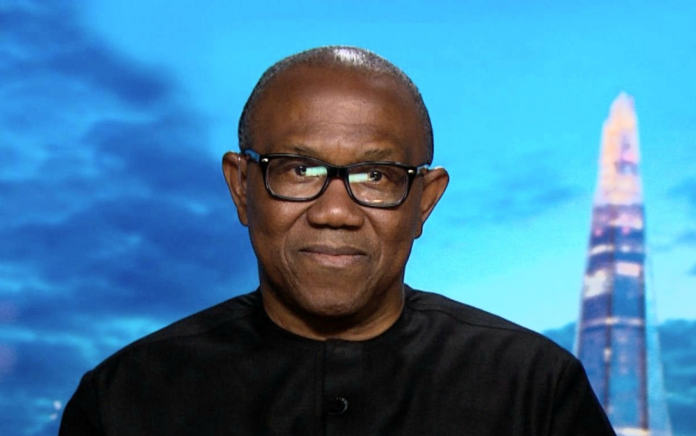
Peter Obi shouldn’t have been allowed to contest 2023 presidential election — Justice Salami
By Jeffrey Agbo
A former President of the Court of Appeal, Isa Salami, has argued that former Anambra State governor, Peter Obi, should not have been eligible to contest the 2023 presidential election under the Labour Party.
The retired jurist made the remarks on Tuesday in Ilorin during a visit by the Wole Soyinka Centre for Investigative Journalism, which honoured him with an award at his residence.
The recognition was presented by the organisation’s founder, Dapo Olorunyomi, alongside its Executive Director, Motunrayo Alaka.
Speaking at the event, Salami also criticised the quality of some members of the bench, linking judicial shortcomings to questionable verdicts.
He said, “There are a few bad eggs amongst some judges. Strictly speaking, I will not say bad eggs. Some of them have a problem with learning. They don’t have a good background to be judges. Imagine appointing a higher registrar as a judge. He has no experience. In the past, this would not have happened. Maybe due to the population explosion, we have everybody reading law. Every university or college is trying to establish a law faculty. All these may be responsible, not because they are dishonest.
“Personally, they are inadequate. This might be responsible for their wrong judgments. At times, if you see the judgments of some of them, even the Supreme Court judgments, you will be astounded and wonder at what is happening.
“For instance, Peter Obi ought not be allowed to contest the 2023 presidential election. In the sense that by the time he lost the PDP primary, LP had submitted its list of members to the Independent National Electoral Commission. And the Constitution says there cannot be an independent candidacy.
“How did he become a candidate of LP if he does not belong to LP? The same thing happened to the Governor of Kano State, Abba Yusuf, who had now defected to the All Progressives Congress (APC). His name is not in the NNPP’s register, but they issued him a membership card, and the register is supposed to be the mother of the card.
“But the Supreme Court Countenanced it, even though the tribunal and Appeal Court frowned at it. That is the problem of competence. People get to the Supreme Court not because they are good but because there is a vacancy in their zone. They supersede people who are their seniors, whom they met at the Court of Appeal and who are more experienced than they are.
“I am a practical example. Some of them who came ten years after I had got to the Court of Appeal, got recommended to the Supreme Court by me because my zone did not have a vacancy. That is the tragedy we have found ourselves in. We hope that with time, everything will be corrected.”
Salami expressed appreciation to the centre for the recognition, noting that such honours are valued within the legal profession.
“I am very happy to receive the award. I hope and pray that your organisation will flourish. I am very sure that many people will, from time to time, be eager to be honoured by you. There is hardly any judge who will not appreciate this type of award coming to him. Even if he is a bad judge, not to talk of others who are very good and dedicated,” he said.
He added that the ideals of Nobel laureate Wole Soyinka shaped his views on national issues, while recalling the influence of the late Obafemi Awolowo on his decision to study law.
“In fact, Chief Awolowo was the one who influenced my decision to read law during his treasonable felony trial. And the government prevented his defence counsel from coming to the country from Britain.
“Chief Awolowo decided to take up his own personal defence. So I thought if I go into politics and I find myself in the same hot spot, I should be able to defend myself,” the ex-jurist added.