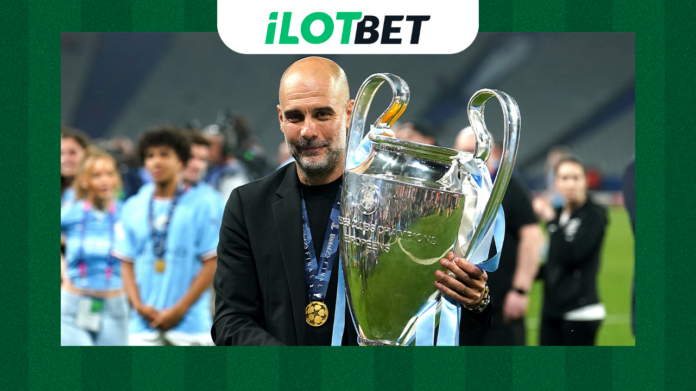
There is a strange contradiction at the heart of Pep Guardiola’s time at Manchester City. The more he wins, the less it seems to satisfy.
By any reasonable historical measure, Guardiola’s first decade in charge has been one of the most dominant managerial reigns English football has ever seen. Six Premier League titles. A historic treble. Four consecutive league crowns. Nineteen major trophies in under ten years. Numbers that, in another era, would have been carved into marble and left unchallenged for generations.
And yet, somehow, it is not enough.
The charge most commonly levelled is simple: for all that domestic dominance, there is only one UEFA Champions League title. For a club of City’s financial power, and a manager of Guardiola’s reputation, the return feels, to some, underwhelming.
But this is where the Guardiola paradox begins to unravel.
Read Also: DR Congo beat Jamaica 1-0 to end 52-year World Cup wait
Because the expectation that City should have turned Europe into a private playground misunderstands the very nature of the competition. The Champions League is not a league campaign built on rhythm, control and accumulation. It is chaos in tailored suits. A tournament decided by moments, a deflection, a refereeing call, a missed chance that lingers just a second too long in the night air.
Even the greatest sides have found it unforgiving. Sir Alex Ferguson, whose reign at Manchester United defined an era, lifted the trophy twice in 26 years. Arsène Wenger, the great modernizer of English football, never won it at all. José Mourinho, the self-anointed “Special One”, claimed two across multiple clubs.
Against that backdrop, Guardiola’s solitary Champions League title at City begins to look less like failure and more like football’s stubborn refusal to be mastered.
And yet the criticism persists, fueled in no small part by the scale of City’s resources. The assumption is that wealth should guarantee not just success, but total domination. That anything short of European hegemony represents a shortfall.
It is an argument that sounds persuasive until you look around.
Other clubs have spent lavishly in the same period, some more chaotically, some less effectively, and found that money alone is no guarantee of coherence. What Guardiola has constructed at City is not merely a collection of expensive players, but a system: a team that controls space, tempo and emotion with almost mechanical precision.
It is easy, perhaps too easy, to forget how difficult that is.
Under Guardiola, City have not just won, they have redefined what winning looks like. Hundred-point seasons. Relentless title races. A brand of football that turns possession into pressure and pressure into inevitability. The kind of dominance that forces rivals not just to improve, but to reinvent themselves entirely.
And this, ultimately, may be the root of the problem.
Guardiola has made the extraordinary feel routine.
There was a time when a single league title could define a managerial legacy. Now, at City, even a domestic double can feel like a footnote. Success has been stretched, elongated, reshaped into something so constant that it no longer registers with the same force.
In that sense, Guardiola has become a victim of his own standards.
The expectation is no longer to win, but to win everything, all the time, everywhere. To conquer England and Europe in tandem, season after season, without deviation or delay. It is an impossible brief, and yet one that follows him relentlessly.
There is also, perhaps, a subtle shift in how greatness is measured. In previous eras, dominance over time was the ultimate currency. Now, the modern game, accelerated, amplified, endlessly debated, places a premium on singular moments. Champions League nights. Defining goals. The kind of instant, global narratives that compress a season into a single frame.
Guardiola’s City, for all their brilliance, have often been too consistent, too controlled, to produce that kind of chaos on demand.
And yet, when the history of this period is written, it is difficult to imagine that nuance will be lost entirely. Nineteen trophies in a decade is not just success; it is sustained excellence at a level few clubs, and even fewer managers, have ever reached.
Perhaps the fairest way to understand Guardiola’s reign is not through what is missing, but through what has been normalized. The idea that a team can dominate England for years on end, playing a style that is both exacting and expressive, while maintaining a level of internal clarity that others struggle even to approach.
In the end, the criticism says as much about modern expectations as it does about Guardiola himself.
Because when greatness becomes routine, it no longer feels like greatness at all.
And that may be his greatest achievement, and his most enduring burden.
Ready to back the best in football? Join iLOTBET today and enjoy top odds, exciting markets and winning opportunities every matchday.