


Ogebe says insecurity worse now than 2000 Sharia riots – marking three years memorial of the lynching of Deborah Emmanuel with impunity
By Jeph Ajobaju, Chief Copy Editor
**************************
Yes, thank you. I actually made three trips to Nigeria in quick succession.
The last one, unfortunately, was right after the Holy Week Massacres – which claimed about 250 lives in the space of two weeks.
It was horrific…
One woman I met had lost her husband, two children, both her in-laws, and her brother-in-law – all in the same genocidal attack.
She herself lost a hand.
Her only surviving child was slashed in the stomach. She’s now hoping that at least that child survives… so she can have one remnant of her family left.
Another chilling testimony came from Bassa Local Government Area in Plateau State.
Two days before the massacre, the military came into the community… and disarmed the locals of their firearms.
That kind of disarmament, just before an attack, suggests complicity.
This is deeply disturbing. The very people meant to protect citizens were effectively preparing them to be massacred – Ogebe.
**************************
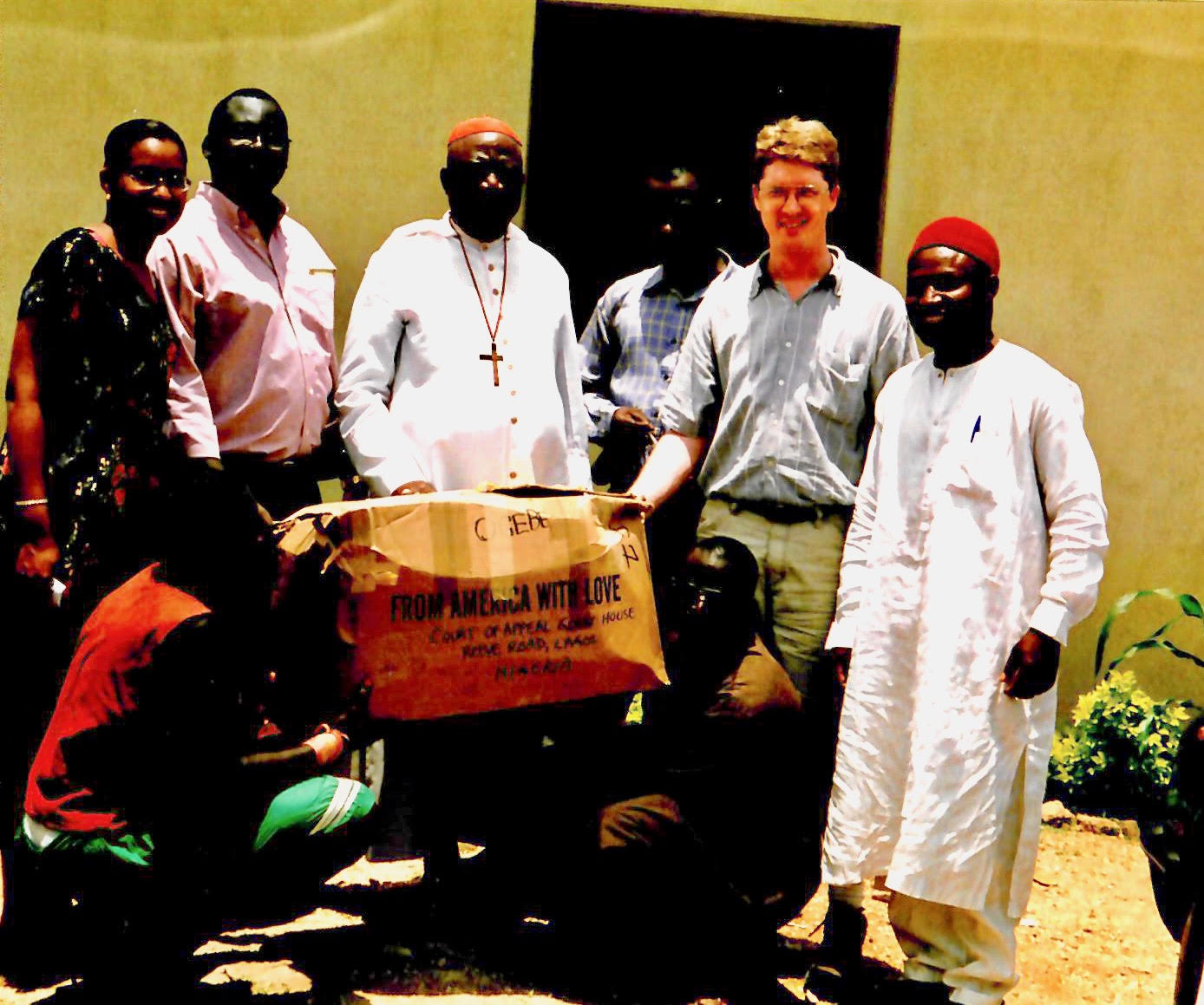
April marked the silver jubilee of humanitarian relief missions to Nigeria which began with the Sharia riots that claimed thousands of lives.
The humanitarian team is co-led by international human rights lawyer Emmanual Ogebe, a Nigerian-American living in Washington, United States, who insists that insecurity in worse in Nigerian now than it was during the Shariah riots in 2000.
Ogebe marked the anniversary in an interview with Truth Nigeria TV, where he argued that “if President [Bola] Tinubu, a Southern Muslim, cannot protect this country, that would be very unfortunate.
“His Vice President [Kashim Shettima] was formerly Governor in the North East – and under him, terrorism grew exponentially. We didn’t expect much from him, but Tinubu is supposed to be a competent operator. Why can’t he secure the country?
Ogebe cited the case of Deborah Emmanuel, a young woman stoned and burned to death [in 2022] by her classmates in Sokoto, in a federal educational institution.
“That’s the level of impunity that makes Nigeria less a human society and more a jungle. We must fight to bring our country into a civil, lawful global order.”
The transcript of the interview Ogebe sent to TheNiche is reproduced below.
But he stressed that “this is the first of several reports we shall be doing to highlight unique situations and interventions undertaken in the past quarter century of our international human rights work.”
Mary Kanum (Anchor)
Welcome to Truth Nigeria TV’s weekly news bulletin. I am Mary Kanum.
Today on The Truth Report:
• Christian hostages escape from a terrorist camp in Kaduna after nearly two months of bitter hunger and forced prayers.
• A human rights lawyer calls out Nigeria’s military, demanding immediate action to stop the killing of Christians in the Middle Belt.
• And in South West Nigeria, Christians warn that plans to introduce Islamic courts threaten the country’s fragile religious balance.
It’s a harrowing story of survival, faith, and courage.
Four Christian villagers, kidnapped by Fulani militants in Kaduna State, North West Nigeria, have escaped after spending 49 days in captivity – days filled with starvation, beatings, and fear of death.
They were abducted on February 23 and managed to flee during a rainstorm on April 29.
Truth Nigeria TV’s Mike Oder James met with the survivors just after their dramatic escape.
[Cut to scene]
The four survivors sat quietly in a car, waiting to be taken to the hospital. Their faces were pale, their bodies frail – but the relief was unmistakable. They had made it out alive.
Napsa Mazami (Survivor)
My name is Napsa Mazami. I was among those kidnapped from Botu Village in Kachia, and taken to a forest near Rijana. Life in the camp was bitter.
We endured constant beatings at the hands of our Fulani captors. They would blindfold us and force us to lie flat on the ground for hours.
Sleep was a rare mercy – we were only allowed to rest around 3.00am, and by 5.00am they would wake us again.
Each day brought fresh cruelty. The beatings never stopped. We lived in fear, with pain as our only companion.
Narrator (Voiceover)
Among the four was Monica Adamu, the only woman held hostage. She said the captors continued to extort her family – demanding more ransom money, even after a full payment had been made.
Monica Adamu (Survivor)
From the moment we arrived at the camp, it was one form of harassment after another.
Every day, they threatened to kill us, claiming our families hadn’t paid the ransom.
They initially demanded N30 million. When the money was brought, they said it wasn’t complete.
Later we found out that the full amount had actually been paid. But the terrorists kept demanding more.
The leader lied to the others, claiming he only received N10 million, and insisted we should be executed.
But the night before the planned execution, heavy rain fell. Only three guards were left with us. They eventually fell asleep… and that’s when we escaped.
Narrator
That rainy night became the turning point. The guards were asleep – and the captives saw their chance.
Samuel Thomas (Survivor)
Three days ago, we escaped from the terrorist camp.
It was raining heavily and the guards had left us unattended. That’s when I realised my handcuffs could be slipped off.
I quickly freed myself, then helped the others.
Three of us removed our chains and we ran.
Minutes later, we saw flashlights sweeping through the forest. Gunshots rang out – they were searching for us.
But we didn’t stop. We just kept running… until we finally reached Maro.
[Cut to family member of escapee]
Sunday Ato (Uncle of Napsa)
Talk with them… they now agreed we should bring N10 million. So we carried the N10 million and gave it to them.
After we gave them the money, they said they would confirm it – then release our people.
So the following day we waited, expecting their call. They didn’t call us that day.
The next day, we kept waiting. Still no word. We started calling their number… but the number didn’t even go through.
On the third day, they finally called us and said: “This money will not release your people. You have to add another N12 million.”
Narrator (Voiceover)
As the survivors were driven to receive medical care, many others remain trapped in terrorist camps – hidden deep in the forests of Northern Nigeria – facing the same threats of torture and death.
But the escape of Christian hostages from a terror camp in Kaduna is just one part of a much larger crisis.
Across Nigeria, Christians continue to face brutal violence – from targeted killings to the destruction of entire communities.
Despite years of bloodshed, justice remains elusive.
Let’s now get more insight into the unending violence in Nigeria’s North.
Joining us is international human rights lawyer, Emmanuel Ogebe, who recently returned from a field mission to Nigeria, where he met with survivors and documented new cases of persecution.
Mary Kanum (Anchor)
Hello Emmanuel, thank you so much for joining us. What was the most powerful – or disturbing – testimony you heard from victims of religious violence during your visit?
Emmanuel Ogebe
Yes, thank you. I actually made three trips to Nigeria in quick succession.
The last one, unfortunately, was right after the Holy Week Massacres – which claimed about 250 lives in the space of two weeks.
It was horrific…
One woman I met had lost her husband, two children, both her in-laws, and her brother-in-law – all in the same genocidal attack.
She herself lost a hand.
Her only surviving child was slashed in the stomach. She’s now hoping that at least that child survives… so she can have one remnant of her family left.
Another chilling testimony came from Bassa Local Government Area in Plateau State.
Two days before the massacre, the military came into the community… and disarmed the locals of their firearms.
That kind of disarmament, just before an attack, suggests complicity.
This is deeply disturbing. The very people meant to protect citizens were effectively preparing them to be massacred.
Mary Kanum
Now, based on what you saw and heard, how would you assess the current situation for persecuted Christians in Nigeria – compared to previous years?
Emmanuel Ogebe
The difference now is that we’re no longer seeing isolated incidents.
What we have now is systematic, ongoing genocide. Not one-time events – but a continuous vortex of violence.
That’s why Nigeria has been ranked the deadliest country in the world for Christians. For 13 out of the last 14 years, more Christians have been killed in Nigeria than in any other country.
We now have multiple non-state actors – Boko Haram, Fulani ethnic jihadist militias – slaughtering innocent people in their homes.
The violence is worse than I have ever seen it – and I’ve been documenting this since April 2000.
Mary Kanum
In your view, is the Nigerian government complicit, negligent, or simply overwhelmed when it comes to protecting Christians from targeted attacks?
Emmanuel Ogebe
The answer is – yes. All of the above.
Complicit. Negligent. And overwhelmed.
Take Bassa for example. That has long been a case of state complicity. There’s really no other way to frame it.
You have the Rukuba military cantonment right there beside Miango and surrounding areas.
Yet in 2021, Fulani militias attacked an orphanage I helped build in 2014 – it was destroyed and has remained uninhabited till today.
We received daily reports of attacks in that area, but the military didn’t show up until the destruction was complete.
One of the victims I interviewed told me that the person who entered their home and killed their family members was dressed in full military uniform.
The Nigerian military must clean house. These are not isolated accusations. These are consistent patterns we’ve documented over the years.
Mary Kanum
What legal options – either within Nigeria or through international mechanisms – are available to Christian victims seeking justice?
Emmanuel Ogebe
Well, domestically, every citizen has a constitutional right to self-defense. That’s a globally recognised principle – it’s about the right to preserve life.
But the case of Sunday Jackson shows that even when Nigerians lawfully defend themselves, the system betrays them.
So while we continue to remind people of their right to protect themselves, we must also acknowledge that the state won’t protect them.
Internationally, we’re working with the U.S. Congress and the U.S. administration to re-designate Nigeria as a Country of Particular Concern – because of its ongoing religious persecution.
Now, to be fair, I’ve heard of some isolated security improvements under the current administration.
But atrocities continue – in Benue, Plateau, and even Gombe State. In fact, there was a massacre there not by Fulani jihadists, but another group entirely.
Some say things have improved in Kaduna, possibly because that’s where the Chief of [Defence] Staff is from.
But that’s not good enough. Improvements should be nationwide, not just where a security chief hails from.
South West, South East, South South, North West – all of Nigeria deserves security.
If President Tinubu, a Southern Muslim, cannot protect this country, that would be very unfortunate.
His Vice President was formerly Governor in the North East – and under him, terrorism grew exponentially.
We didn’t expect much from him, but Tinubu is supposed to be a competent operator. Why can’t he secure the country?
And before I close, I want to highlight the T-shirt I’m wearing. It honors Deborah Emmanuel – young woman stoned and burned to death by her classmates in Sokoto, in a federal educational institution.
Not by terrorists – but by her peers. And they filmed it, confessed to it, and nothing happened to them.
That’s the level of impunity that makes Nigeria less a human society and more a jungle.
We must fight to bring our country into a civil, lawful global order.
Mary Kanum
Emmanuel Ogebe, international human rights lawyer – thank you for speaking with us.
Read also:

