Obasanjo, Obi, Tambuwal, others bemoan state of Nigeria’s democracy at Ihedioha’s 60th birthday colloquium: “What sort of democracy brings you and you grab everything and then illegally, corruptly and you say go to court when you know that even in the court you cannot get justice. So, it is not that democracy is failing, democracy is dying and if we are going to make democracy not to die,” bemoaned Obasanjo

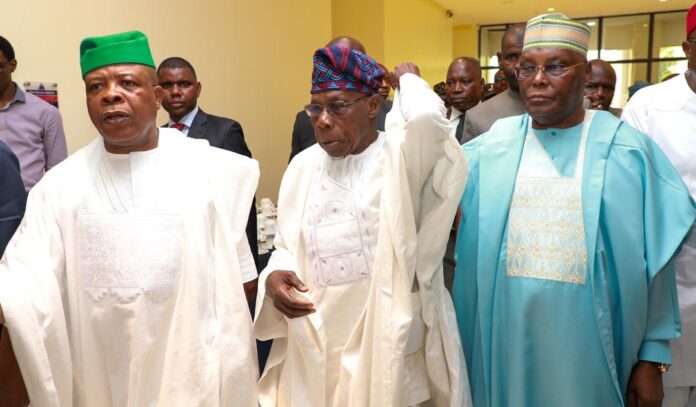
- Obi, Tambuwal and Atiku
By Emma Ogbuehi
As Nigeria continues to grapple with developmental challenges and the daunting crisis of nationhood, former President Olusegun Obasanjo, on Monday, located the problem within the praxis of a democracy that is in death throes.
Obasanjo passed this verdict at a colloquium to mark the 60thbirthday anniversary of the former Governor of Imo State, Rt. Hon. Emeka Ihedioha, at the Ladi Kwali Hall, Abuja Continental Hotel.
The lecture with the theme, “Is democracy failing in Africa,” was delivered by the Catholic Bishop of Sokoto Diocese, Matthew Hassan Kukah.
Kukah, who contextualised the concept of democracy argued that “the democratisation of development leads to the development of democracy,” even as he said that democracy was work in progress.
But in his opening speech, Obasanjo, who was the chairman of the colloquium said that “democracy is dying because the leaders have failed to prioritise the needs of the people.
“Emeka Ihedioha has chosen for discussion: democracy, is it failing in Africa?” he said.
Obasanjo said the idea of democracy is a system of government that delivers to all the people, not a few.
Buttressing his argument with former US President Abraham Lincoln’s definition of democracy as government of the people, by the people and for the people, Obasanjo said it was only within that context that democracy makes sense.
“You should remember that in Africa, before the colonial rule and the colonial power, we had a form of government which attended to the needs of our people. And whatever you call it, to me that was democracy because what is democracy about? American President Abraham Lincoln defined it as government of a people, by the people and for the people,” he said.
READ ALSO: The German hyperinflation
Continuing, Obasanjo said: “Democracy is meant to be a system of government that delivers and delivers to all the people, not just a section of the people, not just a few. But what do we have today? I believe that since we have gone past the Greek democracy which brought everybody to the square, and everybody had a say in the decision making which affected everybody, democracy has now become representative democracy.
“And representative democracy has not taken care of everybody. Today we have a democracy which is government of small number of people, by small number of people over large number of people who are deprived of what they need to have in life. That is not democracy that will endure. So, if you are talking of democracy failing in Africa, democracy in Africa has failed and why has it failed? Because in context and content, it is not African. It does not have any aspect of our culture, our way of life, what we stand for, what we believe, Ubuntu – I am because we are.”
The African concept of Ubuntu emphasizes interconnectedness and shared humanity. ‘I am because we are’ or ‘humanity towards others.’ It is a philosophy that values community, compassion, and mutual respect.
Obasanjo said that is quite different from what obtains today.
“It is, I am because I can grab. What sort of democracy brings you and you grab everything and then illegally, corruptly and you say go to court when you know that even in the court you cannot get justice. So, it is not that democracy is failing, democracy is dying and if we are going to make democracy not to die, we have to look at democracy in the context and in the content of Africa.
“I hope that we will get to that stage so that democracy which will deliver will be the democracy that we will have in Africa.”
On his part, Peter Obi noted that the democracy practiced in the country is not working as it should.
Recalling his experience, where he had to fight for his mandate after being impeached as governor of Anambra State, Obi maintained that he did not resort to bribery.
He said: “Democracy is not working in Nigeria. Everything has been knocked down. I didn’t pay a dime to retrieve my mandate. When I was impeached, Obasanjo called to ask about my welfare. Nigeria should imbibe the Indonesian democracy, proportional representation.’’
Speaking further, Obi said Nigeria’s democracy, which had been progressing since 1999, is now being “knocked down” by the current administration.
“Some people came and knocked everything down. That is the situation we are in now. Everything has been knocked down. Nothing works.
“I became a governor through the court when President Obasanjo and Atiku were in government.
“I did not pay the court one naira. I was sitting in my office, and the court declared me the winner. It can’t happen in Nigeria today.
“When I was being impeached, the president sent people to come and intervene on my behalf. Ken Nnamani came, begging the House (House of Assembly) not to impeach me.
“Today, the president is impeaching a person. They were in PDP; I was in APGA. The president was calling and saying, ‘Peter, are you okay? Even when I was impeached, President Obasanjo called and said, ‘Are you okay? Are you safe?
“When the court eventually declared me (the winner) under Andy Uba (as governor), President Yar’Adua called my phone in London and said, ‘come back. I said, President, I can’t come back.
“When I came back, the military people came and received me at the airport. I couldn’t believe it. And took me straight to him. Now, the president would ask me not to come back. Democracy is collapsing.”
Delivering the keynote address, Bishop Kukah faulted the weaponization of religion in Nigeria, which he described as one of the major hindrances to the country’s democratic development.
Kukah also described the relationship between Obasanjo and Atiku as being like a Catholic marriage, where they quarrel frequently but never broke up.
The cleric, who, however, called for a more honest and inclusive approach to addressing the country’s challenges, said further: “Democracy is working for different people as you can see in their outlook. There is the belief that citizens are free to rebel. There has been debate whether the Nigerian constitution is perfect or not.
“No constitution will be better than the Bible and Koran. Yet, we are still living in sin. The problem is that in Nigeria, the issue of Christian and Muslim prayer is not the best. The weaponisation of religion is a big problem in Nigeria.
“Democracy is work in progress. God doesn’t discriminate between Christian or Muslim prayers. There is no discrimination. We are children of one God. If we are not treating each other rightly, one of them must be a bastard.
“Democracy and its principles are endless contests. There are certain things God has given us which people can’t control.
“We, as Africans, inherited a system that’s not ours, but we can’t say it’s not relevant to us. There are differences between democracy in Asia and that of Africa. Singapore, for example. What do we make of the tenets of democracy in Africa?
“I feel sorry for the judges. At the last election, even small me, I had people calling me, complaining, talk to this, talk to that. Pressure on judges to deliver justice. I agree that there’s an urgent need to clean up the mess.
“Democracy is about everything, it’s about justice. How do we know if democracy is working in Nigeria? Do we measure democracy based on the things we wish ourselves?”
In his remarks, former governor of Sokoto State, Aminu Tambuwal, said democracy in Nigeria is still work in progress but noted that its success depends on the commitment of political leaders to abide by the rules.
Weighing on the emergency rule declared in Rivers State by President Bola Tinubu, Tambuwal recalled that there was cooperation of the National Assembly during a state of emergency under Obasanjo’s administration, saying democracy could work when political actors act responsibly.
“Democracy will work if the actors play by the rules. It’s work in progress. Under Obasanjo, a state of emergency was declared. The NASS worked together to ensure that 2/3 majority passed the emergency. “Each member had to vote. In this same NASS, we have the same constitution. What happened in the last one? We need to chase out the bad operators of democracy”, he stated.
Speaking at the event, former Vice President Atiku Abubakar said Ihedioha has remained loyal, even when they found themselves on different political platforms.
“Emeka and I have kept this relationship and till today I have found him extremely loyal, dedicated and focused, even though sometimes we found ourselves on different political divides but we kept our relationship and I think that testifies the kind of person Emeka is,” he said.
Obasanjo also described the celebrant as a near perfect person.
“You are a determined man. The little that I know about you is that you are almost a perfect man. You take things as they come and you are unperturbed by injustice when they come your way.”
On his part, former Secretary-General of the Commonwealth, Chief Emeka Anyaoku, traced the origin of democracy and what he and his team at the commonwealth did to promote its cause across the globe.
Anyaoku said: “As Commonwealth Secretary-General, I helped members to transit to multi-party democracy. Also the collapse of apartheid administration in South Africa. Review of 1999 constitution
“We need a new constitution to address many challenges. True federalism is the answer to the management of national issues.
“The recent coup in Mali, Niger tend to take us back. The nature of our politics and the conduct of our politicians is another problem of our democracy.
“They have become instruments of capturing political power. It’s only true, stable democratic governance that can rid our country of the crises which impede development.
“I believe Nigeria can change this Eurocentric narrative. We in Africa and Nigeria have a responsibility to get a stable democracy and change the Eurocentric narrative.”
While expressing gratitude to all who attended the event, the celebrant, Emeka Ihedioha, said: “My father told me the most expensive habit is having friends. I have lived my life pursuing the cause for democracy. We should all rise to defend democracy.
“I urge all men to always speak truth to power and protect democracy. I will remain who I am. For me and democracy, it is till God do us apart.”
Attendees at the star-studded event included Deputy Speaker of the House of Representatives, Chief Ben Kalu, former governors Rotimi Amaechi, Ikedi Ohakim, Donald Duke, Gabriel Suswan, Olagunsoye Oyinlola, Celestine Omehia, Kayode Fayemi, Liyel Imoke, Seriake Dickson, Sam Egwu, Achike Udenwa.
Others are former principal officers of the National Assembly – Pius Anyim, David Mark, Dimeji Bankole, Ken Nnamani, Aminu Masari, Mrs. Patricia Ette, and Austin Opara.
Many past and present NASS members including Mrs. Margery Okadigbo, Uche Ekwunife, Nnenna Ukeje, Enyinnaya Abaribe were also present.
There were also Chief S.N. Okeke, Chief John Oyegun, Uche Secondus, Adamu Waziri, Prof Jerry Gana, Osita Chidoka, Babachir Lawal and Boss Mustapha, among many others. HRM Eze Chidume Okoro broke the kolanut.