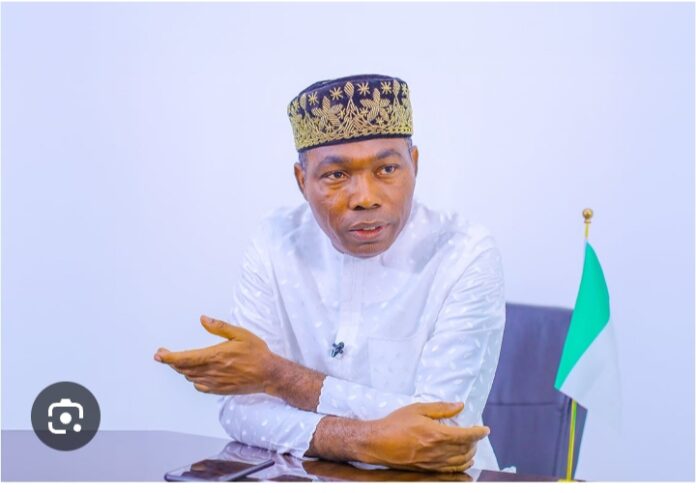
Nigeria needs political reset, not recycled old politicians – Adewole Adebayo
Prince Adewole Adebayo, the Social Democratic Party’s 2023 presidential candidate, says defeating President Bola Ahmed Tinubu alone will not solve Nigeria’s problems. In this interview with a select interview, he speaks on preparations for the 2027 elections, the Electoral Act controversy, and why he believes Nigeria needs a complete political reset rather than coalitions among familiar political figures now positioning themselves as opposition leaders. Henry Nnaemeka was there.
INEC has announced dates for the 2027 general election. Do you think the opposition is ready?
The opposition being ready is a given. What is more important is whether the people are ready. Democracy is about the people.
If you ask me whether I am ready to take over from President Bola Ahmed Tinubu and govern the country better, my answer is yes — even today. You can drive me to the Aso Rock Villa now and ask me to take over, and you will see better results immediately, not tomorrow.
I am better prepared, better intentioned, surrounded by competent people and guided by a clearer vision that aligns with the constitution. But ultimately, it is the people who must be ready to change their government.
The idea that the duty of the opposition is simply to hold the government accountable is misplaced. The primary responsibility lies with the other arms of government. The National Assembly must oversee the executive, while the judiciary ensures that both the legislature and executive comply with the law.
It is then left for the people to hold their elected officials accountable. My job in the opposition is to form the next government. I don’t want opposition to be a career. After the next election, I want to be called President and Commander-in-Chief, not a professional opposition politician.
The Inter-Party Advisory Council (IPAC) recently threatened to boycott the election if urgent amendments are not made to the Electoral Act. Is that the right decision?
The right decision is to have a good Electoral Act. You may recall that I was at the National Assembly when the law was being passed and even got tear-gassed during the protests.
My position has always been that the country needs an electoral law that encourages people to vote, deepens democracy and makes the credibility of elections a matter of law.
That is what the government needs to do. Political parties should continue preparing for elections while urging the government to do the right thing.
Ultimately, the issue is not just between the government and the opposition. It is a national discussion Nigerians must have: whether the Electoral Act as currently passed and signed by President Tinubu reflects what Nigerians truly want.
Do you think it does?
I don’t think so. It appears more about protecting the regime and maintaining control of the electoral process rather than empowering the people.
Do you support IPAC’s threat to boycott the election?
I think IPAC is right to say that if the rules are not fair and clear from the beginning, political parties have the right to question participation under such conditions.
However, I would encourage political parties to continue their grassroots preparations so they are not caught unawares.
Boycotting an election is a very drastic democratic tactic. Isn’t that effectively surrendering to the ruling party?
No. The idea is that if most political parties — particularly those not in government — refuse to participate, the process loses legitimacy. A government cannot simply crown itself without broad participation.
However, such a drastic response would only arise from what many see as a drastic legislative manoeuvre by those in power to shape the electoral system in their favour. The more the conversation is dominated by controversies over electoral laws, the less time we spend discussing real governance issues and policy alternatives.
It can also create voter apathy, as people begin to question whether participating in the process is worthwhile.
My own approach is to continue advocating for the right reforms while communicating clearly with the law-making bodies — the Senate and the House of Representatives — that the laws they passed, which appear to favour themselves and President Tinubu, do not reflect their constitutional duty. Their responsibility is to listen to their constituents and amend problematic clauses.
Are you saying the law, as it stands today, does not provide a level playing field?
Of course there is no level playing field. There are many loopholes and what I would call “booby traps” in the law. But we still have a duty to defeat the government democratically.
Nigerians also have a responsibility. They should make sure that members of the National Assembly who passed these laws do not return to office. Many of them effectively surrendered the sovereignty of the Nigerian people to the whims of one person.
If Nigerians vote them out, they can then replace them with patriots who will enact better laws. The immediate reaction of IPAC is to say that if the rules are unfair, the ruling party should conduct the election alone. But ultimately, the lasting solution to a bad law is to replace the lawmakers who made it.
Will the SDP and you personally join the boycott if IPAC proceeds with that threat ahead of the 2027 election?
That decision will ultimately be taken by the SDP when its National Executive Committee meets next week.
However, I have reminded our members that Nigeria conducted elections even under colonial rule and during military regimes. The June 12 election, for instance, was held under a military administration that did not really want to relinquish power.
So even if the law is imperfect, elections must still hold. Our duty is to defeat the government of the day through the democratic process.
You seem confident in your ability to defeat President Tinubu and the APC. What gives you that confidence?
My confidence is in the Nigerian people. Nigerians are patient, but they are also observant. What often happens is that the communication coming from politicians becomes confused, making it difficult for people to focus on where the real problem lies.
When the opposition criticises the government, Nigerians will judge not only the government but also the opposition. If they conclude that the government is bad but the opposition is not any better, many will simply abstain from voting.
That is why our responsibility is not just to point out that President Tinubu’s government is a disaster — which is evident by many measures — but also to organise the opposition and present clear, credible alternatives.
Defeating President Bola Ahmed Tinubu is not impossible. Even in the last election he won under the law, the arithmetic showed that more Nigerians voted for other candidates combined. What we need now is to mobilise more voters and help them understand that removing the APC from power is their immediate political solution.
Democracy is like a marketplace where many traders are shouting to sell different goods. Sometimes the noise makes it difficult for people to hear a particular message.
What we are doing is amplifying one message clearly: that President Tinubu represents what I consider a colossal historic failure in governance. But Nigerians have alternatives. Instead of constantly lamenting about the situation, they now have an opportunity to support a different direction.
On election day, citizens simply need to come out and vote for the alternative they believe in.
At the same time, Nigerians should also be careful about politicians who were part of the system for decades but are now presenting themselves as new opposition figures. If someone spent 20 years in the Senate without sponsoring meaningful electoral reforms, it is difficult to suddenly present themselves as champions of democracy.
Nigeria needs a genuine break from the past. If we are truly ready to solve our problems as a nation, we must hold both the current government and those who previously failed in power accountable.
Some figures who now appear to be the new face of the opposition, many of whom are in the African Democratic Congress (ADC), argue that the opposition must unite to defeat President Bola Tinubu and the APC. You do not seem to agree with that approach.
I don’t agree with that analysis. If the objective is simply to defeat President Tinubu as a person, without caring about who replaces him, then that approach might make sense. But Nigerians are tired of bad government. Replacing one failing leadership with another does not solve the problem.
Are you willing to work with members of the opposition such as Abubakar Malami, Nasir El-Rufai and David Mark, who are now associated with the ADC?
How can you say you are against the infestation of insects but only kill mosquitoes while leaving cockroaches? That would be hypocritical.
My opposition to President Tinubu is not personal. It is based on his actions, policies and governing philosophy. Many of the individuals you mentioned share similar records in government. Some served in positions of power and acted in ways consistent with the same system we are criticising today.
So if I oppose Tinubu on certain principles, consistency requires that I oppose those same practices regardless of who is involved. It is not about personalities.
The political establishment has different wings. Some are currently in government, while others are outside government after failed attempts to gain power. Their opposition is often not about rejecting the system but about being excluded from it.
Our focus is on the Nigerian people who have been marginalised for decades. We cannot claim to represent them while aligning with the same political actors whose records contributed to the current problems.
President Tinubu represents, in my view, the culmination of many of the failures that have characterised governance since the return to civilian rule. But those failures did not start with him. Corruption and electoral malpractice existed long before he became president.
If Nigerians truly want change, they must be willing to reject the entire system that produced these outcomes, not just one individual.
So you are not willing to work with the ADC, for example?
As the party is presently constituted, if I align with them it would make me a hypocrite. It would mean my opposition to Tinubu is personal rather than based on principles such as accountability, transparency and good governance.
If you are genuinely fighting corruption and poor governance, you cannot selectively ignore the records of those who were previously in power. Nigerians should also question politicians who spent decades in office without introducing meaningful reforms but now present themselves as champions of change. There are over 200 million Nigerians with integrity, competence and patriotic commitment. Why must politics revolve around a small group of familiar faces?
Critics say political parties are not made up of saints. Some argue that people who once held power may have changed or learned from past mistakes. Are you looking for a party of saints?
No. I am not looking for saints. I am looking for decent and honest people.
Do you believe such a political party exists in Nigeria today?
Yes. The Social Democratic Party (SDP). If you come to the SDP, you will see that we emphasise integrity and responsibility.
Are you suggesting the SDP is a party of saints?
Not at all. It is a party of citizens who understand that truth and accountability matter. People can make mistakes in the past, but they must acknowledge them and commit to doing better.
What we insist on is honesty and decency in public life.
You are effectively saying you are ready for the 2027 presidential race.
Yes. I have told my party that and I am working with them toward that goal. I am travelling across the country to engage Nigerians and prepare them for the future.
Ultimately, my presidency is in the hands of God and the Nigerian people. When Nigerians are ready, it will happen.
You secured the SDP presidential ticket in 2023. What assurance do you have that you will get it again?
That is why I am not sitting back waiting for luck. I am working. Others in the party are also working hard.
I joined this political movement in 1991 when I was 19 years old. Since then, there has been no assignment or responsibility given to me within the party that I have refused to carry out.
Realistically, some analysts say the SDP may not have the national political machinery to compete with the APC in 2027.
Let political scientists debate that. Our task is to build the party into a genuine people’s movement.
Remember that this was the party that, under difficult military conditions, won the June 12, 1993 election, widely believed to have been won by Chief Moshood Kashimawo Olawale Abiola. That election played a major role in Nigeria’s democratic struggle.
Our focus is not merely competing with the APC. Our focus is reconnecting the party with the people. Once Nigerians embrace the party again, many of these doubts will disappear.
Do you have the structure to compete in the current political reality?
Our duty is to change that reality. If Nigeria continues on the current path, the country risks serious decline.
What we are doing is building a structure from the grassroots — not just assembling powerful individuals. We are engaging ordinary Nigerians, encouraging political participation and rebuilding trust in democracy.
When people begin to feel ownership of the political process again, a strong and organic national structure will emerge. It will not depend on one individual; it will be built to last. Good politics is the foundation of good governance.
You once said the 2027 election will be an election of ordinary people. What do you mean by that?
Yes, because that is where real change can happen. If the contest is simply between powerful elites — one group of political heavyweights against another — ordinary Nigerians will feel excluded.
When two powerful groups are fighting over the same prize, the ordinary citizen gains nothing. But if it becomes a genuine movement of the people, then the political elite will realise that their dominance is coming to an end.
You often say the SDP wants to defeat the system that President Tinubu represents, not just Tinubu himself. What exactly do you mean?
I am not claiming to be perfect, but I believe honesty can be translated into governance. Politics can be made decent again.
The principles we advocate in the SDP are not tied to one individual. They are rooted in the ideals of the Nigerian Constitution, particularly the provisions in Chapter Two on good governance, social justice and accountability. Any sincere leader who follows those principles can deliver meaningful change.
You say you love Nigeria and want to serve the country, yet you are unwilling to work with President Tinubu. Why?
Because Bola Ahmed Tinubu is not Nigeria. In my view, many of his policies are weakening the country and deepening divisions. Whether intentionally or not, the direction of his governance is making Nigeria weaker rather than stronger.
Is it fair to describe Tinubu as the worst president Nigeria has had?
I believe there are reasons why he stands out negatively.
First, he is currently in charge at a time when the consequences of poor governance are being felt most severely by Nigerians.
Second, his style of governance goes beyond incompetence. It appears designed to personalise power and concentrate authority around himself.
Are you concerned that many governors are aligning with the APC?
That does not worry me. Many of those governors have little connection with the ordinary people they govern. What we are seeing is simply many political actors clustering around power.
My concern is more about governance and respect for the rule of law. In my view, President Tinubu often disregards legal and institutional constraints. Accountability is weakened when other arms of government fail to act independently.
Nigeria’s situation reminds me of distressed companies that are acquired only for their assets to be stripped rather than revived. Sometimes a struggling institution needs careful management to recover, but the wrong approach can make things worse.
So you do not credit the Tinubu administration with any achievements?
The only credit I can give him personally is his resilience in surviving political challenges. Beyond that, I do not see meaningful improvement in the lives of Nigerians.
Large sums of public funds have been spent, yet the impact on citizens’ welfare is limited. Even in places closely associated with the president politically, many people still face worsening economic conditions.
Do you believe the 2027 election will be free and fair?
It must be free and fair because Nigeria has no alternative. The people themselves must insist on it.
Elections become credible when citizens participate in large numbers. If voter turnout is extremely low, the process becomes easier to manipulate. That is why we are encouraging Nigerians not to lose faith in the democratic process.
In 2025, former Kaduna State governor Nasir El-Rufai was expelled from the SDP. What exactly happened?
From what I recall, there was confusion from the beginning about his membership. Local party structures reportedly said they had not formally received him as a member despite public statements suggesting he had joined.
The party leadership looked into the matter and concluded that the proper procedures had not been followed. There were also concerns about attempts to influence party structures and make public pronouncements on behalf of the party without authorisation. Eventually, the party took disciplinary action.
Do you believe he attempted to hijack the party?
I would not necessarily describe it that way. I think he may simply have underestimated the internal discipline and procedures of the SDP.
Some politicians are more accustomed to operating within government structures than within political parties that emphasise grassroots organisation and internal rules.
Some former APC officials, including former Attorney-General Abubakar Malami and others, have complained of selective prosecution. As a lawyer, what is your view?
As a lawyer, my position is simple. When a matter is before a court, it is best not to comment on it out of respect for the judicial process.
In a democracy, anyone accused of wrongdoing has the right to defend themselves in court and is presumed innocent until proven guilty. However, detaining individuals without trial would be wrong. The proper place to determine such matters is the court of law.